







All Our Tips
Articling Tips for Students-at-Law

As summer arrives, so does a new articling season throughout the nation.
The future of articling has been subject of much debate over the last year. With the dust now settled on those deliberations, Canada`s law offices will, over the next few months, begin to welcome their new crops of eager and talented students-at-law.
For many students, it will be the best of worlds and the worst of worlds. And since articling rarely comes with a user manual, here are a few SlawTips for Students-at-Law on succeeding and navigating through the many challenges ahead in your new articling gigs:
- There are no shortcuts. Articling is hard work. So is lawyering.
- Find a mentor in your firm or elsewhere, and establish a trusting relationship. Make it your business to identify the doors that are most open to offering you guidance and support, and enter them as often as is reasonable and comfortable.
- Ethics, ethics, ethics. You are in the final phases of becoming a legal professional. You must now be acutely aware of the professional duties and responsibilities of our profession. So bookmark the applicable Code of Professional Conduct in your province or territory, and read it. Often.
- In particular, always strictly abide by your duty of confidentiality – at home, at work and at play. No exceptions. Period.
- You will meet many people you admire in this industry. You will probably also encounter a handful (or ten) that you don`t care for as much. Be civil at all times, nonetheless – with colleagues, clients, court staff, opposing counsel and the judiciary. It is your duty. It will also make you a better and more respected professional.
- Be concise in your written and verbal communications. Avoid legalese. Edit all redundancy from your work, and make it your point to just get to the point. Proof read everything twice. Check your spelling, grammar and sentence construction. Make the consistent submission of well-written, error-free work the hallmark of your articling career.
- Seek clarification on your assigned tasks and instructions as often as is required. If you aren’t sure about the parameters or requirements of a project you are working on, ask someone who knows for direction.
- Demonstrate respect and appreciation for the law clerks, legal assistants and support staff at your firm. You will soon come to appreciate their knowledge, experience and vital contributions to the successes of the practice you have joined.
- Remember to say “thank you.”
- Work with only one file on your desk at a time. Your desk is not a filing cabinet or storage counter. It is a work space. Eliminating clutter will improve your concentration and reduce the risk of error.
- Be over-inclusive rather than under-inclusive in your research and written work, especially at the beginning of your articles. Doing more than is necessary is always preferable to doing too little and possibly missing the point. Over time, honing in on the central requirements of your assigned work will likely become second nature. It is one of many skills you will acquire. In the meanwhile and thereafter, cutting corners will never be O.K.
- Your legal education may seem at first to have prepared you for surprisingly little that you will encounter as a student-at-law. Over time, however, you will likely see that your legal education has trained you well in the methods you can employ to acquire the knowledge and competencies needed for success as a student and a lawyer.
- Procrastination and “file avoidance” are serious occupational hazards for lawyers. If you feel these issues creeping into your professional life, the solution is a simple one. Just do something – anything – on that file or task you have been leaving behind. Make a call, draft a memo, send an email or speak to a mentor. But do something. Create new momentum. Don`t let a matter sit. If it sits, it will just get worse.
- If you have made an error – big or small- advise your supervisor or principal immediately. The solution will often be simple to implement and you will have managed risk effectively.
- Experiment with technology, and to the extent your firm permits it, use software, the web and mobile apps to augment your effectiveness and skills. Even if your firm isn`t paperless, try to limit the amount of paper you consume and waste. Use your iPad, iPhone (or reasonable imitations thereof) as often as you can. The world is going mobile. The legal profession will catch up, eventually. You don`t have to wait.
- Become a regular reader of Canada`s many excellent law blogs, journals and legal magazines. They will make you smarter. I promise.
- CanLII and Google are a student`s best friends.
- Get involved. Find the time to participate in and enjoy the extra-curricular activities and culture of the legal profession.
- If your articling experience does not meet your needs and expectations, don`t be trapped. Actively look for a better fit elsewhere, and if it presents, make a move. Having said that, it will always be in your interests to maintain positivity and professionalism in every environment, so long as you are there. There are worse things to do than working through a challenging situation.
- Lawyers are real people and so are you. Learn the skill of maintaining work-life balance, whatever the demands upon your time may be. Articling marks the beginning of a critical professional and personal journey. You will need to be comfortable in your own skin to succeed and enjoy your career. So be yourself -always – and let your innate ability and personal strengths shine.
In short, make the most of your articles.
Enjoy observing your own growth. It will be quite rapid – and quite gratifying. You will almost certainly look back on your articling year fondly and frequently as one of the key building blocks in your career. And however it plays out, it will be over before you know it.
Good luck then, to all 2013-14 students!
– Garry J. Wise, Toronto

Check Out AccessCLE

Welcome news from David Whelan of the Great Library – Law Society of Upper Canada:
You can now print and download articles older than 18 months free of charge from the Law Society’s CLE collection, powered by the Great Library.
The service – AccessCLE – has been 100% pay-per-view since its inception in 2007 and contains over 6,000 PDF articles going back to 2004. The articles represent the individual presentations from CLE/CPD seminars put on by the Law Society. Our partnership with the Law Society’s CPD team is ongoing and we continue to receive and add metadata to articles from recent presentations.
The 18 month window is a rolling period. Content within that window is still available but is pay-per-view. You can search for both free and paid articles with either AccessCLE itself or through our discovery engine, Infolocate.ca.
If you need more information please contact Olcay Atacan at [email protected]. We hope this change will improve your ability to access and use this information.
CLE materials are a fantastic place to start a legal research question. They often offer practical advice from expert practitioners. Congratulations to the staff at the Great Library who power this project!
Use Google Docs to Alter PDF Documents

PDF documents are great when you want to make it easy for anyone to view or print a document. But what happens when you need to alter a PDF?  You can, of course, do it with Adobe Acrobat or other expensive PDF Editors, but you can also do it for free with Google Docs! It’s easy.
First, take the PDF you want to alter and upload it to Google Docs. Next, check the Convert text from PDF and image files to Google Documents checkbox. This converts a PDF document into a rich text document you can edit. When you are done your edits, you can download the document as text or flip it back into a PDF file.
Bet most of you didn’t know you can alter PDFs with Google Docs.
Realizing Realization
There are at least two types of realization that comes to play in the financial management of a law firm. In this context we are speaking of Billing Realization and Collection Realization. Both of these represent potential ‘leaks’ in the financial boat of the firm if the firm is not properly attentive to these numbers.
Billing realization is the percentage of recorded lawyer or paralegal time that actually ends up on the bill sent to the client. For example, if $1,000 worth of time is recorded on the time sheet, but is whittled down and billed out for $900, the billing realization rate is 90%, meaning that the firm has billed out only ninety cents of each dollar of time recorded as having been worked. That 10% loss represents one financial leak.
To prevent that leak (and others) from sinking the financial boat, it is important for the firm to monitor not just the aggregate dollars written off as billing adjustments, but to additionally monitor the billing realization percentage.
If possible and if available in your jurisdiction, compare the firm’s billing realization to benchmark numbers in surveys. Try to reach or exceed the realization in the surveys. This is one area which can yield tremendous additional profit for the firm without individual members having to work harder, simply by tightening up billing practices. The gold standard is typically 95%. Anything less than 90% should be looked at carefully.
Have someone designated in the firm as the ‘billing czar’ whose job it is to monitor billings. Most lawyers are at first put off by the thought of someone else, like a billing committee member or “billing czar,” reviewing and changing the final content of a client’s bill. But it is always advisable to have another lawyer – the “billing czar” as it were – make the billing lawyer accountable for discounts given beyond a modest limit everyone agrees to in advance.
Once that bill is in the hands of the client, then your collection realization comes in focus.
Your collection realization rate is the percentage of your billed fees which is actually collected. Collection realization rates are often overstated because lawyers tend to leave uncollectible receivables on the books for extended periods of time, sometimes years, rather than admit that those receivables will never be collected. The Oracle of Delphi said to be true to yourself..and keeping receivables on the books that you don’t have a ghost of collecting is not helping you or the firm.
To determine how the firm is doing, the firm has to acknowledge that there are only a few possible outcomes once a bill is sent: 1) collection; 2) partial collection with the balance written off; or 3) total write off.
According to statistics from the Commercial Law League, receivables in excess of 1 year have only a 28.4% chance of being collected. Receivables in excess of 2 years have only a 12.5% chance of being collected.
Evaluate your receivables using these statistics to calculate the likelihood of bad debt, and then compare what you have collected and what remains as collectible in your receivables against what you billed. Also compare these numbers to benchmark data. This is another area which can yield tremendous additional profit for the firm, without putting in longer hours, simply by tightening up or implementing good receivable management practices.
Realizing the potential information that your realization rates could produce for you should be motivation enough to start monitoring and tracking these numbers today!
–David J. Bilinsky
“The views expressed herein are those of the writer and should not be inferred as those of the Law Society of British Columbia.”
New Articling Students – Legal Reseach Methods Cafe
Most law firms have an orientation program for articling students. I am certain that ‘legal research’ is part of the program – if not, my tip is to add it!
An look back at the conference site for last weekend’s Law and Society Association conference showed a Methods Cafe as part of the program.
Scholars experienced in using different research methods each sit in a large ballroom at different tables, which are prominently labeled with the method about which that expert is prepared to talk. The experts then act as a consultant to anyone who shows up to talk with them about the method’s use in a specific project or in general during the standard 105 minutes scheduled for the session. One person, a few in succession, or a few at once might come to the table during the time. Since this is an experimental venture, the topics make no attempt to cover all possible research methods, but reflect the interest of the expert participants.
A methods cafe may be an interesting way to share practice area specific research paths and sources. Consider having a lawyer (or embedded librarian) from a few practice groups discuss go to resources and when they use them. For an internal program, I would arrange the process to give each (4 or 5 max.) research practitioner the floor for 5-12 minutes to share their best loved source. I would aso recommend that the presentation approach is a ‘war story’ rather than a presentation with powerpoint visuals or an online demo. This research method’s cafe would probably be better described as a resource sharing session.
Today’s Tip: be creative about sharing methods for teaching legal research to articling students.
Go for a Fresh Start With a Device Reboot
Smartphones, tablets, laptops and computers are more reliable and stable than ever before. Most of us take this for granted and we leave our devices turned on 24/7.
However, that doesn’t mean you should never “reboot” your device (i.e., turn the device right off and restart it). In fact, a regular reboot can be helpful. 
Many programs and apps have “memory leaks” (i.e. they grab and use memory as they operate, but then don’t release it for other programs when they are done). While memory leaks may slow a device down (by limiting the memory the device can use for operating programs or apps), you may not be aware that memory leaks have occurred are there as they usually won’t crash an application and will very rarely crash or lockup a device. The longer you leave your devices powered on, the more likely there is memory that is unavailable for allocation due to memory leaks. Memory leaks may also decrease battery life.
How does a reboot help? On a rebooted device all memory is freshly allocated – there is no memory tied up with a memory leak. Thankfully, most devices reboot fairly quickly today. Try to remember to reboot your devices every few days or at least once a week. Do it on a schedule (e.g., when you go to bed, when you sit down for dinner; etc.). You will likely find they operate a bit faster, and you might have better battery life. And if you leave your device off overnight – you are saving energy and you won’t get interruptions!
eCourts: Prepare for Change
Today’s practice tip is get ready for change, because sometime soon, eCourts may be arriving in Canada.
It may seem like equal parts pipe dream and unscheduled inevitability, but in the context of an acknowledged access to justice crisis in Canada, the call for technological modernization of our nation`s courts seems to be approaching critical mass.
What will this brave new future look like? How can we ready our practices?
The recent Report of the Court Processes Simplification Working Group, delivered by the National Action Committee on Access to Justice in Civil and Family Matters, articulates a clear vision on the features and functions of the e-friendly Canadian courts of the not-too distant future:
E-court initiatives can include basic infrastructure initiatives such as court room screens and microphones, document management systems (for discovery, disclosure documents, court forms, etc.), on-line filing and scheduling tools, the capacity to conduct hearings by remote access, and – ultimately – full dispute resolution tools. E-filings and ultimately ecourts can enhance access to justice for individuals (particularly self-represented litigants) in remote areas or for whom attendance is difficult due to work and/or family commitments. Moreover, e-filings may decrease delays and increase efficiencies within the court system, allowing court staff to focus on triage and referral work rather than clerical work. Ultimately, this use of technology could include e-filings, e-searches, e-docket and scheduling requests (see e.g. Québec), as well as the capacity to conduct motions and entire proceedings online.
Imagine judicial reform that in one fell swoop would:
- permit (or require) e-filing of court documents and eliminate the cost and inefficiencies inherent in the current system of in-person court filings, waiting lines and occasionally finicky court personnel
- eliminate the need for photocopying and compiling massive reams of paper in multiple copies of records, briefs and documentary productions
- on routine motions and appearances, eliminate hours of wasted wait-time in crowded, overbooked courtrooms in favour of scheduled, time-slotted hearings by video conference, conducted from the comfort of your own office. Imagine the possibilities – appearing in two different courts in two different cities on the same morning (with virtually no carbon footprint left behind…)
- Allow access by authorized persons to secure online portals containing court filings, schedule information and file-status information, all updated in real time.
What implications do these proposed initiatives have for our firms? For our staff requirements? Our document management systems? Our time management? Will paperlessness ultimately be mandated by policy?
Nobody knows when these changes will ultimately arrive. We just strongly suspect that they will. One day. Possibly sooner than we think. And if we are able suspend all disbelief, at least for the moment, I`d suggest it’s not too early to begin the process of readying ourselves and our practices for the changes ahead.
Here are a few thoughts, then, on things we can do to prepare in anticipation of this new world that could soon be thrust upon us:
- If you’re not a natural when it comes to computer skills and literacy, there is no time like the present to learn. Playing catch-up in the future may not be a happy experience – your clients could be left behind, along with you, if you aren’t ready technically for what lies ahead.
- Get used to videoconferencing. Get a webcam. Practice your on-camera skills. Offer tech-friendly clients and counsel the opportunity to conduct routine meetings with you by Skype or FaceTime. Give some thought to appropriate, discrete backdrops that contribute to a professional and polished appearance. Experiment with lighting. Seek and accept feedback.
- Develop protocols to scan and electronically store all documentation in your clients`files. Get used to accessing your files remotely via LogMein, GoToMyPc, DropBox or Google Drive. Give real thought to optimizing your client folder and subfolder organization to facilitate predictable, easy and intuitive access to the documents you need. Keep rethinking and updating your file organization system as you learn what works best from your own experience.
- Explore currently available online dispute resolution services like the National Arbitration Forum in Minnesota and shortly, British Columbia’s pending Civil Resolution Tribunal. They may be the precursors of the models our courts ultimately adopt.
If you are anxious to see these changes arrive, do something about it. Advocate. Let your legislators, regulators and court officials know you believe these changes are overdue and necessary to the functioning of our courts and the administration of justice.
Study the studies. Attend conferences. Participate in think-tanks and committees. As noted by Rule 4.06(1) of Ontario’s Rules of Professional Conduct, lawyers are to encourage public respect for and try to improve the administration of justice.
In short, prepare for the changes ahead by influencing the direction those changes will take. It may well be our duty to do so.
– Garry J. Wise
Remember Open Data
Today’s Tip is really about finding new sources of information as they appear. The announcement yesterday in Alberta about the Alberta Open Data Portal is a good reminder that information may become available that is relevant to your legal research.
A number of jurisdictions in Canada provide open data. A handy list is available the datalibre.ca blog.
Use Speak Selection to Have Your iPad or iPhone Read to You
Sometimes you just want to sit back and listen. It is very easy to have your iPad or iPhone read text to you (iOS 5 and iOS6). Go to Settings > General > Accessibility and turn “Speak Selection” to on. 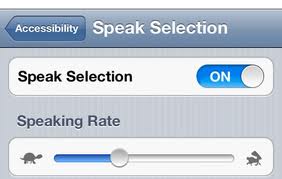 After doing this, simply highlight or select the text you want read to you, and then hit the Speak button.
See how it works for you, and remember to try tweaking the configuration to suit your preferences (you can make it read faster).
There are various screen-reader apps, some of which have more features, but Speak Selection can do the job for you.
Making That Important Decision…
Sooner or later all of us will be facing a big decision.
Most of us put off making that big decision for a number of reasons…we fear making the wrong decision, we feel we don’t (yet) have enough information, we fear that we may be making the decision for the wrong reasons or we fear offending the feelings of those that are near to us by our choice (that may conflict with their views of what you should do).
Having done considerable research into this area just recently – in reading many papers, blogs and advice sites (and compared their information with what feels right) here is a summary of the tips that I have gathered in this area:
1. Collect as much information as possible. You can never get perfect information but you can be reasonably satisfied that you have done your due diligence in assembling the facts.
2. Don’t rush. Give your subconscious time to play with the situation, the facts and your feelings. This is a vital part of making the decision, otherwise known as ‘sleeping on it’.
3. Talk it out with others whose judgment and insight you trust. This is also vital – it provides you with a trusted ‘sounding board’ within which you can explore your thoughts, feelings, fears and desires.
4. Recognize that a big decision almost always means leaving your place of comfort and moving forward into the world. Don’t allow a fear of the unknown to create paralysis.
5. Clear your mind. Before you make that big decision go somewhere where you will be quiet and undisturbed. Begin by taking in many deep long breaths…and close your eyes….allow time and breathing to clear your thoughts and allow a calm to settle.
6. Ask yourself – what will bring you closer to your life’s goals and desires? If a decision is not in alignment with what you desire from life – the goals that you wish to reach..the “thing” that you need to do in your life to make it full and complete…then the chances are that this is not the right decision for you.
7. Now – Trust your Gut. In everything that I have read on this topic this is the most common and the most persuasive of all the techniques. Your mind and body have an internal sensor, compass or ability to discern what is right for you. Only you have the ability to tune into that internal voice. No one else can have this built-in ability to feel what is the right decision for you.
8. Now ..having made the decision…move on it! Allow yourself – wholeheartedly – joyfully – and completely – to act on your new decision. Allow it to now be part of you and your future.. Embrace it!
9. Give yourself time..but go back and evaluate your decision-making process. This is an important step – for you wish to be a learning individual. Making a big decision is a life-experience and you wish to take away as much as possible in order to make better and better decisions as you move forward in life.
All of us need to make a big decision sooner or later. Hopefully these tips will assist you in your next decision.


