







All Our Tips
Limit the Time You Spend on a Task

When a meeting takes longer than anticipated, minds may start to wander. An inefficient meeting can cause participants to “switch off” and cease contributing meaningfully. Similarly, starting a difficult task without a time limit can seem too large a mountain to
climb, and make it easy to procrastinate. One solution is to consciously set a time limit for a meeting or a task, and do it both verbally and visually.
A meeting would begin with an announcement to the participants, “We have 30 minutes to get through our theory of the case. Let’s make each minute count.” A visual cue can be used, such as pointing at a clock and saying “when that minute hand hits the 6”, using a stopwatch, or a gadget such as the time timer, which shows the remaining time on a clock/watch/app in a bold red colour.
A task would be done the same way. Let’s say you have a large memo to write. Set aside “1.0” on the docket to write a section. Then start the countdown. As the time ticks away a sense of urgency will rise, limiting the distractions and helping you focus. When the time is up, you can take a break or start another countdown for the next task.
Another use is to set a time limit for breaks. If you find yourself surfing the net an hour later while at work and wonder where the time went, a visual cue can help again.
This technique – to limit the time for tasks – is a broader application of the Pomodoro technique, or “tomato timer”, where tasks are broken down into 25 minute increments. However much time you want to set for a task, typically it should be less than an hour. Research has shown that uninterrupted concentration tends to top out at about 45 minutes.
The key to effectively setting a time limit is to find a cue you respond to – whether it’s a tomato timer, a clock ticking away, or watching a big red pie get smaller and smaller with each second. Limiting the time for each task can mean you complete more and bigger tasks more effectively.

Confusing Pairs, Part 1

Words you mix up at your peril.
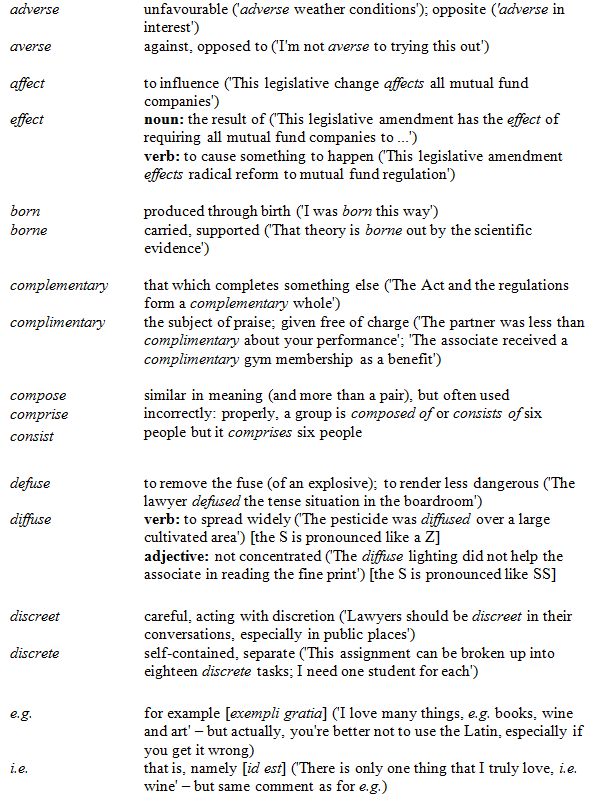
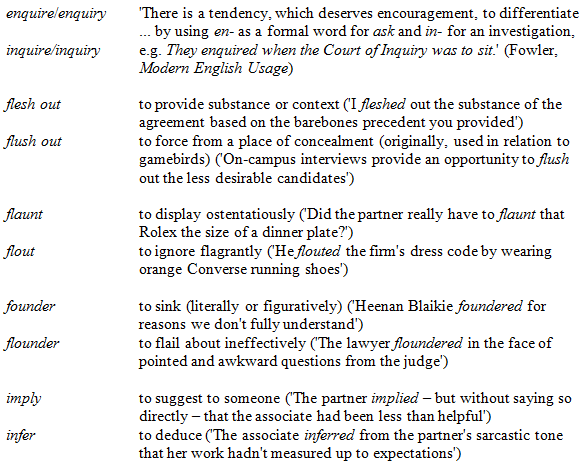
Next week: confusing pairs, part 2
Search Strategy – Cast Your Net Wide
Good keyword searching practice varies from database to database, depending on how the data is structured and how the search engine works. But there are some principles that apply to most situations.
For legal research, whenever you have at least a basic understanding of the legal concepts involved, it is usually best to start out casting your net wide, and refine or expand as you go. The goal, for this strategy, is to create a search that will include ALL relevant documents and as few irrelevant ones as possible.
The following process involves an imagined scenario in which I am searching for case law on drug trafficking and entrapment. But hopefully the process is generic enough that it can apply to a variety of situations.
Step 1: Brainstorm for keywords
Think of (1) all the key facts associated with your legal problem, and (2) any legal concept that may apply. So if I am dealing with a drug trafficking case, the list of keywords might include: undercover, police, bar, drugs, suspicious, ask, request, solicit, cocaine, powder, trafficking, guilty, entrapment, dealing, selling, narcotics, controlled substances.
Step 2: Identify key concepts, group keywords
Group your list of terms into two or more key concepts. There will usually be one or more legal concepts, and one or more concepts that describe a particular factual scenario. Try to think of every possible variant (synonym) for each concept.
For example, if I want to use the entrapment defence on a drug trafficking charge, I might employ one factual concept and two legal ones:
Concept 1: drugs, controlled substances, narcotics, cocaine
Concept 2: trafficking, dealing, selling, pushing
Concept 3: entrapment
Step 3: Create search query
This is the stage where you can look at your keywords more critically, and perhaps eliminate some of them. For example, if the search engine is likely to use terminology drawn from the relevant federal statutes, then you can eliminate synonyms for “trafficking” – as this is the official name of the charge, and is certain to be used in any case on point. By eliminating synonyms, you decrease the likelihood of netting bad hits (e.g. that use a word like “dealing” in an unrelated context).
Separate synonyms using the OR operator and separate concepts (groups of synonymous terms) with the AND operator. Remember to review the search syntax (sometimes under the heading “searching tips”) for whatever database you are using. For example, is the AND operator the word “AND” or an ampersand (&) or the default (no operator). Bearing that in mind, our first search may look something like this:
(drugs OR “controlled substances” OR narcotics) AND trafficking AND entrap!
Step 4: Execute search and analyze results
Regardless of how many or how few hits you get on the first try, it is critical to analyze the results. How many hits are there? If too few, may need to drop a concept, or add some synonyms to existing concepts. If there are too many hits, you may need to add a concept, or drop some synonyms.
How are the results arranged? Relevancy? By date? Or by court level or number of cites? Can you change the order? If you cannot rank by relevancy, then take extra care to keep the number of results manageable, because the best ones might be at the bottom of the list. If you sort rank by date, consider applying a date filter to the initial search (if that is an option).
Look at a few hits – are they relevant? In the best, most relevant, results, check for key terms in the document that you may not have included in the search query. If you see a lot of poor results, check to see how and where your search terms appear in the document. Any terms that are producing poor results should be removed or modified. In some cases, consider adding a “proximity” operator, to search for two terms in the same sentence, or separated by less than a certain number of characters.
Step 5: Reformulate search
No search will net perfect results, no matter how well you refine it. On the other hand, you will rarely get optimal results on the first try. Generally, you can expect somewhere between 3 and 10 iterations to achieve a manageable set of relevant documents. But your research on this database, whatever database it may be, is still not done.
Step 6: Work Laterally
As I said, it is rare that any single keyword search will net 100% of relevant results. So now you need to read your results (the cases), and make note of references to other cases that did not come up in your search results. Then read those, and make note of further authorities. Also, for highly relevant cases, make sure to note them up, track down any citing references, and then look for citing references backward and forward in those (if they are on point), and so on.
I think of mediated searching, using a search engine or classification system, as “vertical” (think drilling down), and searching using cross-references from other relevant documents as horizontal or “lateral.” Some research tasks call for predominantly one strategy or the other, so a good researcher will know when and how to employ either strategies, or the two in combination.
Step 7: Stop
Know when to stop. You are finished your research when you either (1) stop seeing citations to unknown cases commenting on your topic (in other words you’ve seen them all, or very close to it), or (2) see repeated references to a small number of higher court authorities on which you can rely.
[This tip by Ken Fox originally appeared on the Law Society of Saskatchewan Library’s Legal Sourcery Blog]
Do Your Most Important Work in the Morning (“avoiding Decision Fatigue”)
Mark Zuckerberg wears the same outfit every day. It may seem like a small thing, but even little decisions can eventually exhaust our ability to make good decisions. Decision fatigue, which is the theory that our ability to make good decisions deteriorates with each decision we make, applies no matter how small or large a decision. As the day goes on, we use up our decision-making fuel and make poorer decisions. If you’ve experienced at the end of a long day a breakdown in your willpower – getting easily frustrated and angry, or needing to go shopping, or eating a bag of potato chips – you may well have been a victim of decision fatigue. Self-control takes mental energy, and, it turns out, we have a limited amount of it.
You may not need to go as far as wearing the same outfit every day, but a healthy work practice may include doing your most important work in the morning when your decision-making fuel is topped up. If your to-do list has 30 items on it, whittle it down to three (or similarly small handful) and get started with the first item on the list. This may also mean putting aside reviewing emails and phone calls when you get into the office, no matter how strong the urge. Take away the distractions and focus on those top three tasks. You may find that by lunch time you’ve accomplished what you really need to do that day.
Another tip that comes out of this is to avoid sending difficult emails at the end of the day. If you receive an angry client email at the end of the day, your ability to self-censor may be at a weak point. A general rule of thumb is to “sleep on it” and re-visit the email the next morning.
Managing your tasks well is a seemingly mundane skill which can yield big dividends. Good task management means you are more likely to fully immerse yourself in your tasks and not miss important details. Maximize your time by taking on the most important tasks first.
Using a Canned Search to Find Definitions
A frequently asked question is “what does this word mean in a legal context?” In my last SLAW tip, I talked about using legislation to find definitions, in particular interpretation acts. However, legislation cannot define every term used, so if you can’t find your term in the legislation, you may want to check if it has been judicially defined. There are a number of books of words and phrases listing judicial definitions (and truly it is a wonder what has been defined), but, as with legislation, these books cannot be exhaustive.
If you can’t find your term in either legislation or books of words and phrases, you will have to search the case law. I use the following canned search to find definitions:
TERM /3 (define OR mean OR interpret)
For example, if you want to find out if the word “martini” has ever been defined by the courts, use this search on CanLII with the word “martini” substituted for TERM.
Since CANLII automatically expands search terms, you don’t have to use wildcards to find all the variants of your search terms (e.g. mean, means, meaning). However, if you are using this search in one of the paid databases, you will have to add the database’s truncation symbol (e.g. defin! OR mean! OR interpret!).
Thank you to Bronwyn Guiton for suggesting this as a SLAW tip.
Sweep the Sheds
I am adopting a very expansive view of “practice tips” this week given some things that have been on my mind as I recently took on two new staff.
As far as starting businesses go, starting a law practice or professional services firm is remarkably easy and safe relative to many other kinds of businesses. Doing it well is a much different matter. The skills required – project management, human resource management, leadership, and financial judgment, among others – are not taught in law school. Typically, legal education programs only touch upon them briefly and many lawyers hang up their own shingle without these skills. Unfortunately, the lack of skill is often coupled with a lack of insight and the hubris that sometimes accompanies a license to practice law.
It’s no secret that many lawyers and law firm staff complain of bullying, harassment, and disrespect by both colleagues and managers and of poor work-life balance generally. The attrition rate in individual firms and the practice generally is huge, as is substance abuse and poor job satisfaction. These things are massive hidden costs that ultimately affect quality of life and bottom lines. It also leads to injustice. Although the standard of advocacy and adjudication in Canada is generally excellent, one cannot escape the concern that such things divert from the merits of clients’ cases.
Small firms are not exempt. I know one articling student who was warned during his interviews by the firm’s current articling student that “[founding/managing partner] is a yeller and it’s best just to avoid him”. That interviewee rejected his eventual job offer and is now excelling at a litigation boutique. Their loss and another’s gain. I also know one paralegal who is regularly taken for lunch and consolation by the partners who own her firm because the remaining partner (whom she works for) was so belittling, aggressive, and disrespectful that they felt obliged to compensate for that. For big firm horror stories, check out abovethelaw.com. A satirical Twitter account, doubtlessly inspired by true events, @BadLegalLLP is not always that far from its intended satire.
Despite all the talks on civility in the profession, it does not appear to me that we always walk the talk within our own offices. The costs, both to individual reputations and to our profession, is probably just as great as poor quality work or negligence.
I am no expert in human resource management, but I have paid a lot of attention to it over the years and drawn on many sources for insight and inspiration, especially in two areas: rugby and my own clients.
Why rugby? Simply put, it is a character building sport which rewards heart and work ethic over talent (although perceived talent often comes from heart and work ethic). There are no superstars revered the way there is in soccer, hockey, or other professional sports. Despite drawing similar crowds to other professional sports, there are few players who make over $500,000 per year salary. Players are often immortally loyal to their clubs and spend considerable time developing the younger generation while celebrating the older. Sounds a bit like something we are told to aspire to in CLE seminars?
The single best example is the New Zealand All Blacks. Over the 100 years leading up to 2004, the All Blacks enjoyed a 75%-win rate. To put that in perspective, the Yankees’ 1913-2016 win-rate is about 57%. In hockey, Team Canada’s international win rate is 62% if we count ties and losses together and 69% if we exclude ties from the equation altogether.
How did a tiny island nation of 4.5 million not just compete on the world stage against countries like France, England, Australia, and South Africa (countries with far more people and money), but routinely batter them?
In part, it’s because the All Blacks “sweep the sheds”. That means that, following games and practices, the “sheds” (aka changing rooms) are not cleaned by staff, rookies, or players in the dog-house. The captains and star players get the brooms out and clean up the locker room themselves before giving press interviews or heading out to celebrate. This accomplishes two things: (i) everyone knows that nobody is above the grunt work; and (ii) everyone must be respectful of their work environment and colleagues.
They have also been proactive in addressing issues. In 2004, the All Blacks were in crisis mode after a single terrible season. Especially concerning was that morale was in the gutter. Their culture was rotting from the inside. Future performance was threatened. Nonetheless, they managed to regroup and emerge a stronger force than they were before.
From a 3-day leadership retreat came a renewed resolve and approach to re-building the most successful team in the history of sport. They built their culture around the proposition that “Better People Make Better All Blacks.”
In many ways, this was a fresh commitment to old values that had withstood the test of time, but the impact of this reinvigoration is what is notable. In the 12 years since, the All Blacks win rate has been 86%. An 11-percentage point increase would have been a massive turnaround in a team that previously won less than half its games, let alone three-quarters. It is even more impressive when you consider that their competitors are most often those nipping at their heels in world rankings.
While this became the core narrative, its execution required the humility that comes from actually sweeping the sheds. This extended into a more devolved leadership style: arm the players with intention and capacity and then trust them to deliver. The All Blacks field one captain, but 15 leaders are on the field.
They also focused on brain biology, identifying the effect of stress on cognitive function and performance and develop triggers and anchors to help players cope with stress and, where appropriate, use it to perform. Sound relevant to performance in legal practice?
Beyond that, I also pay attention to what my clients do. Like all lawyers, I have clients who enjoy incredible success and others, tragically, whose businesses or lives fail. The ones who succeed and the ones who fail have a few things in common. Here is what I have learned from the happiest, most successful ones:
First, they build a team based on character, culture, and loyalty – not necessarily talent. Talent is great, but it can be acquired. Great talent can perform poorly and ruin others’ performance if it lacks character and loyalty and doesn’t care about culture.
Second, they treat their employees with genuine respect. This isn’t just being civil and polite in person or occasionally picking up the lunch bill. Anyone can do that. Genuine respect includes eliciting and seriously considering feedback. It means putting employees’ desires, where reasonable, ahead of arbitrary personal preferences. It means accepting that there is often more than one right way of doing things and letting another right way happen, even if it’s not your way. People who feel valued and respected perform better than people who largely “perform” from fear of getting yelled at, fired, or not promoted. If your employees need the “stick” as motivation, then fire them and find new ones.
Most importantly as a show of respect, they trust their employees’ judgment. This includes delegating responsibility and accountability. When that judgment is off and results in a mistake, the burden of that mistake is shared equally across the organization. Blame, at most implicit, is channeled into a learning opportunity. Otherwise, the odds are that someone else will benefit from the cost of a mistake.
Similarly, accomplishments are celebrated and shared equally.
Third, they incentivize and reward their employees – and not just monetarily and or for specific accomplishments. Money is important, but so is having skin in the game and feeling valued in intangible ways. That includes delegating responsibility and having trust. Granting more responsibility and trust is often as important as money to an employee. So is work-life balance. An early Friday afternoon departure, encouragement to take ample holiday time, and contribution to one’s non-work pursuits reap dividends.
How do I know this works? The clients I have in mind started with nothing more than their shirts on their backs and built companies with mid-7 and 8-figure revenue streams – in less than ten years.
How does this factor into law practice HR?
Most law firms hire and retain employees by fit or talent or a combination of both. Fit and character are not necessarily the same thing. They each have a very different impact on firm culture and performance. If you have good organizational culture and performance and hire someone who fits but lacks character, your good work can be ruined and quality employees’ capacities will be squandered. As for talent, there is no shortage of that wasting away somewhere, out of sight and mind, due to lack of character.
Many law firm managers govern through fear of a negative consequence. This might result in short-term productivity, but what is lost in the equation is the cost of attrition and inability to develop people’s capacities. This is true even if you do not value positive work relationships and are focused on the bottom line. Trust and empower your employees and they will perform without a hawkish manager being present. That’s called passive income. It’s also called having more time to enjoy what is important in life.
And, of course, exercise humility. Behind every practice, personality, and brand is a person. People have weaknesses and people make mistakes. They have histories that have turned them into the person they are, for better or for worse.
Perhaps most importantly, humility means leading by example, so be prepared to sweep the sheds.
If you do experience attrition, take huge advantage of it by holding an exit interview and find out what it really was like to work for you. You will be surprised at the positive and negative feedback you will hear. It is absolutely priceless.
The above probably sounds naïve to “theory X” managers. Not all people will respond to the kind of approach set out above. I won’t deny that. If you want to build an enterprise that will perform well, bring you enjoyment, and build the kind of value that can be part of a retirement plan, then get rid of the people who don’t fit your culture or lack character and loyalty. It will be a mutual favour.
-Michael McCubbin
Words That Don’t Mean What You Think They Do
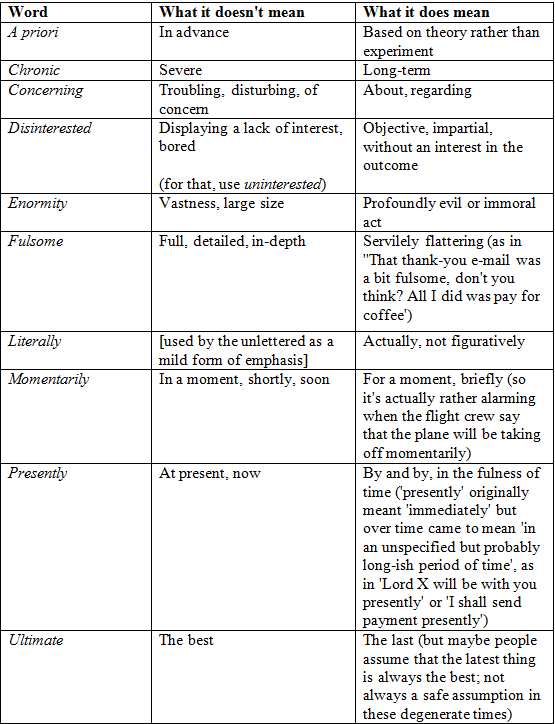
Next: confusing pairs, part 1
The Efficient to-Do List
Time is money. Three words which pretty much sum it up for us all. Especially when your staff consists of your dog – then you quickly realize that passing the buck isn’t an option. Instead, you must learn to sort through the multitude of tasks facing you each day and narrow down your focus to only the key revenue-generating activities, while letting the majority of the “noise” fade away and most of us accomplish this with a to-do list.
However, not all activities are of equal value. There is an economic principle called the 80/20 Rule, or Pareto Principle, that basically means that 80% of the effects of anything in your life will come from 20% of the causes. When applied to your daily to do list, the Pareto Principle means that 80 percent of the value of your list comes from only 20 percent of the items on it.
In other words, if you have 10 items on your list, you could focus on only two of those tasks and get the vast majority of success even though you ignore the other 8 items entirely!
Now I know you may be ready to go after your to-do list cutting out all the low-payoff items – before you get out the hatchet, read my short list of suggestions so that you cut out the right tasks:
- Know what your goals are. You can’t choose your biggest payoff tasks if you don’t know what your goals are. Thoughtful planning is critical so you know what you’re trying to accomplish and can rank your items accordingly. In order to do that you need to …
- Write it all down. Write every task down, from the largest to the seemingly least important that has to get done. Before you can rank your items, you need a complete view of every task in your work world. I call this a brain dump. From it, you can determine what to delegate, what to defer, and what to start working on each day.
- Evaluate. With your goals in mind, ask yourself, “What are the top three activities I can complete today that will move me closer to those goals?” Put an asterisk next to those tasks and start the day there.
- Track your success. At the end of the week, review your daily lists. Have you made significant progress towards your goals? Which tasks turned out to be the most important? Which did you think were important but proved to be less valuable?
- Keep refining. Use your weekly review to make informed decisions going forward. If you notice that you often rank your social media efforts as critical, but they don’t seem to be impacting new business, resist putting those as starred items on your daily lists.
Remember, though, that tools are only as good as the person who wields them. No to-do list, app or program, no mindset, trick or suggestion is going to help you build a better, more productive work day. Only you can do that, and you do it by sitting down at your desk, day after day, starting fresh with your daily to do list and the top 3 things you want to get done.
-Andrea Cannavina
866-848-2195 x101 [email protected]
Save Time: Start With Secondary Sources
Here’s a tip I always mention when I’m introducing students to the legal research process: you will save time if you start by consulting the leading secondary sources on your topic, rather than going straight to the legislation or case law.
Ludmila B. Herbst, Q.C., wrote the following about the importance of starting with secondary sources in her 2006 CLE BC course paper “Effective Legal Research”:
A vast array of material is available in which authors (both learned and not so learned) have assembled and synthesized the case law and statutory materials applicable to particular issues. Make use of these where possible. Both the commentary and the footnotes may direct you to applicable case law, legislation and other secondary sources and may suggest analogous areas of law to research. In addition, secondary sources set out principles on which your answer may ultimately need to be based if primary authority cannot be located.
But where to start when you’re unfamiliar with the the leading texts? CanLII’s LegalResearch.org (formerly Cathie Best’s The Best Guide to Canadian Legal Research) advises researchers to start with a library catalogue:
As you gain experience, you will become familiar with the leading texts in various areas. If you do not know of a good text on the subject you are researching, the traditional approach is to conduct a keyword search in the library catalogue.
Not all library catalogues will cover all topics though, and if you’re just starting out it’s difficult to know which source is considered to be the most authoritative on a given topic. Fortunately, LegalResearch.org has gone through the work of creating lists of suggested leading texts. And if you need to dig a little deeper into your topic, use the checklist below to ensure you haven’t missed a thing!
This checklist, which was inspired by LegalResearch.org’s more exhaustive version, can also be downloaded as a Word doc here. You are welcome to edit it and repurpose it.
- Encyclopedias
- Canadian Encyclopedic Digest (CED) on Westlaw or in print
- Halsbury’s Laws of Canada on LexisNexis Quicklaw or in print
- Leading texts
- Check your library’s catalogue, which will include both print books and ebooks
- Suggested textbooks from CanLII’s LegalResearch.org
- Suggested textbooks from Legaltree.ca. Use the topics down the left side of the page to navigate.
- “Selected Secondary Sources” from the back pages of each Halsbury’s volume
- Research guides from other law libraries. Bora Laskin Law Library currently offers the strongest lists of suggested texts.
- “Selective Topical Bibliography” from The Practical Guide to Canadian Legal Research by Nancy McCormack. This starts on page 503 of the 2015 ed.
- Journals and seminar papers, which may be useful when encyclopedias and leading texts are outdated or don’t provide enough detail about your jurisdiction or topic.
- Local CLE resources, such as BC’s CLE Online course materials
- Journals on HeinOnline
- Journals on Westlaw
- Journals on LexisNexis Quicklaw
- Articles found via Google Scholar
- Local specialized indexes, such as Courthouse Libraries BC’s BC Legal Literature Index
- Memorandums and factums on the same topic
- Your organization’s internal knowledge management database
- Prior advice from the same legal file
- Documents from colleagues who have worked in the area before
- Wikis, blogs, and newsletters
- Wikipedia
- Blogs and newsletters published by law firms, often on Mondaq.com/Canada, but also via this custom Google search or via Fee Fie Foe Firm Canada.
— Bronwyn Guiton (@BronwynMaye)
Build the Team!
There’s a lot of teamwork that goes on in a law office. Sometimes it runs like a well oiled machine. Sometimes it just fizzes and pops!
So, for today’s tip, ask yourself what’s one thing you can do to take your team to the next level? Here are some ideas to get you started:
- Communicate – Great teams know how to communicate. They make space for each individual to express their ideas, not just the ones that are naturally expressive. They don’t shy away from differences of opinion, but rather use them as an opportunity for open discussion about continuous improvement.
- Prioritize – Great teams seamlessly move forward together on all their day-to-day tasks. They also respond in harmony to urgent matters. They are able to do so because they are aligned on priorities and a method to shift, as needed, in the face of change.
- Core values – Great teams agree on core values. When faced with challenging decisions, how to choose between competing needs or how to respond to anomalous situations, they defer to the values that built the firm.
- Trust – Great teams deal with each other in a transparent and inclusive manner and, as a result, they trust each other. They stay focused on the task at hand without distracting concerns about hidden agendas. They are all driven by the best interest of the client and the firm.
- Mastery – Great teams don’t reinvent the wheel everyday. They master the processes that are key to their success. And they are always looking for ways to take that mastery up a notch, to be more efficient and effective.
So, which of these qualities is most critical to your team’s strength? Ask yourself, and ask your team, what can you do to bolster them?
—
For more on team building, see the following posts on SlawTips:
- Creating the Team: A Leadership Moment
- Collaboration, Law Firm Style, Part One
- Collaboration Law Firm Style, Part Two
Also see the following team articles on Sandra Bekhor’s LinkedIn blog:


