All Our Research Tips
Finding Black’s Law Dictionary Online
One resource that users may not be aware is available in Westlaw Canada’s LawSource module is Black’s Law Dictionary, possibly because it is the only “international” piece of content included in the module.
Black’s Law Dictionary is the most widely used law dictionary in the United States and (according to Thomson Reuters’ marketing department) “the most widely cited law book in the world”.
To access this resource, log in to Westlaw Canada, go to the International tab and then click on the link to Black’s Law Dictionary.
— Susannah Tredwell
Posted on September 29th, 2021 - Editor: Susannah Tredwell

—
End of Life
This comes to all of us, whether we want it or not.
Increasingly nowadays, one can make a conscious end-of-life decision: note the hyphens you’ll need in order to make the phrase an adjective.
But what one should never do is make the phrase the horrible verb that I saw in an announcement from a tech provider that is discontinuing a line of software tools:
[Nameless tech vendor] is to end of life [products X, Y and Z] in a move that will see those core legacy products not supported after December 2023.
First, if they are ‘core products’, why are they being discontinued?
Second, note the sneaky use of the passive voice as a way to remove human or institutional agency (and thus responsibility), instead of more honestly saying We will no longer be supporting …
And that awful use of end of life as a verb! Not even hyphens can redeem that.
(Thanks to Sandra Geddes for bringing this horror to my attention.)
–Neil Guthrie (@guthrieneil)
Posted on September 22nd, 2021 - Editor: Neil Guthrie
—
Do Lawyers Read Anymore?
I fear they do not, as these recent examples of lawyerly prose will suggest:
· bare with me
· you have free rain
· he is a real jem
The clear inference to be drawn from these solecisms is that people hear things but have not seen them in print (or even on a screen).
In a word-based profession, this is distressing (to say the least).
–Neil Guthrie (@guthrieneil)
Posted on September 15th, 2021 - Editor: Neil Guthrie
—
Yikes! Oxford Errors
It pains me when I see the University of Oxford making terrible errors. But errors are errors.
Both occurred in recent LinkedIn posts.
The first:
One in four people in the world do not have access to safe drinking water.
That should, of course, be does because the subject of the sentence is One, not four or people. This is a distressingly common error, but not one Oxford should be making.
The second:
Between 2000-2015, 3248 people were infected with plague worldwide.
Rewrite that as either Between 2000 and 2015 … or From 2000 to 2015 …
Two deplorable errors from people who should know better (and, obviously, two deplorable states of affairs in terms of public health).
–Neil Guthrie (@guthrieneil)
Posted on September 8th, 2021 - Editor: Neil Guthrie
—
Recent Horrors
Some frightful things that have imposed themselves on your humble scribe’s tender eyes.
Actual drafting by a senior partner
What this means is clear enough, but the drafting is simply awful:
Both whether or not the Code applies to the Proposed Structure and how it may apply to it therefore are central to appreciating if the Proposed Structure is a viable paradigm in law.
There are so many ways to improve that by putting it in normal English. How about this:
The Building Code may determine whether the proposed structure is legal.
Jump
Almost as bad, but not quite as frequent as reaching out to people, is the request to jump on a call.
Do these verbs make things sound more important than they really are?
Let’s just talk.
Productize
A LinkedIn post I came across exhorted readers to productize their law firm’s content.
Please, please, please, no.
Ludacris
Yes, this is the stage name of an American rapper and actor – but a friend received an e-mail from a lawyer (a LAWYER!) who used it, in all seriousness, to mean ridiculous or risible.
The lawyer had clearly never seen ludicrous, the word from which the rapper derives his moniker.
Time to insert an emoji expressing shock, horror, dismay, despair. If there is one that captures all that.
–Neil Guthrie (@guthrieneil)
Posted on August 25th, 2021 - Editor: Neil Guthrie
—
Unnatural Compounds
No, not enclosures where odd things happen. Rather, combinations of words that look strange.
The New York Times – generally a newspaper one admires – has taken to writing things like monthslong: see, for example, Mary Hui, ‘After a Dip, Hong Kong Real Estate Again Eyes the Stratosphere’ (22 March 2019).
Compounds often start off as two or more words, become hyphenated and later lose the hyphen (holder of shares, share-holder, shareholder).
This doesn’t always work, however: securityholder looks weird. So does loophole, because it suggests the pronunciation loo-fole. The hyphen keeps a helpful separation between the consonants.
Similarly, monthslong looks unnatural (can you think of any other English word with the sequence NTHSL?) and invites one to say month-slong or the more awkward mon-thslong.
The NYT may do it, but it’s best avoided. Keep the handy hyphen.
–Neil Guthrie (@guthrieneil)
Posted on August 18th, 2021 - Editor: Neil Guthrie
—
Use Search Filters on CanLII
Applying filters to your search results is a great way of narrowing them down and can help save time you might otherwise spend scrolling through hundreds or even thousands of results!
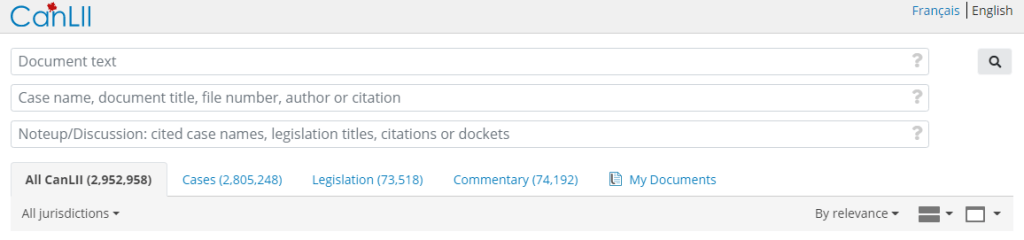
The search filters bar is accessible at the top of every search results page and features four primary filter tabs (All CanLII, Cases, Legislation and Commentary), each with their own set of subfilter categories.
(click to view a larger image)
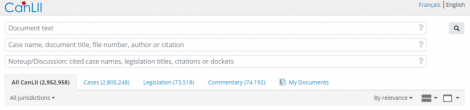
The number beside each filter indicates how many documents on CanLII are in each category. This number changes after you use the search fields and when you apply search filters. You can apply multiple filters at the same time to narrow down your results.
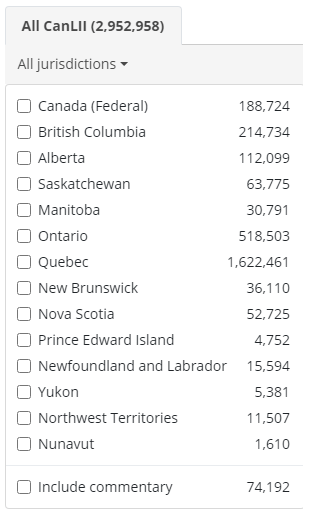
Here is a breakdown of the various filters and subfilters and what they do, followed by an example search at the end of this post:
- “All CanLII” — search results will contain all content types on CanLII; applied by default.
- Filter your results by jurisdiction (i.e. results only from federal courts or from certain provinces and territories)
- Option to include or to not include commentary in results (i.e. case and statutory law only)
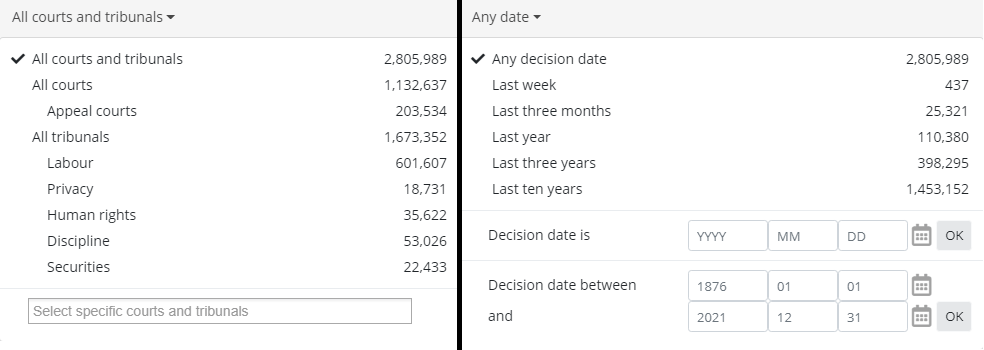
- “Cases” — search results will contain only case law
- Filter cases by jurisdiction
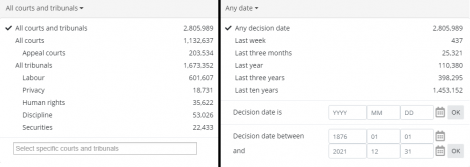
- Filter cases by court/tribunal type or a specific court/tribunal
- Filter cases by decision date
- Six general filters (decisions made in the last week, last three months, last year, etc.)
- Two customizable filters (decisions made on a specific date and decisions made between two dates).
(click to view a larger image)
- “Legislation” — search results will contain only statutory law
- Filter legislation by jurisdiction
- Filter legislation by type (i.e. consolidated, annual, regulations, etc.)
- Filter legislation by version or by date of effect
(click to view a larger image)

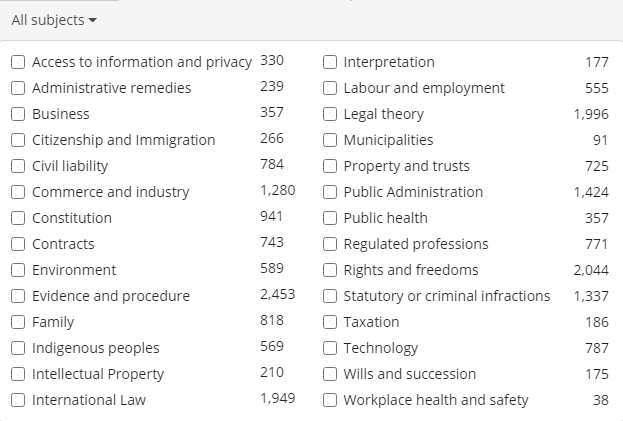
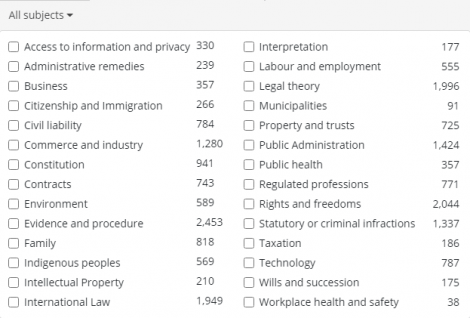
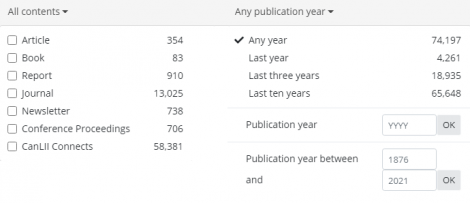
- “Commentary” — search results will contain only legal commentary
- Filter commentary by subject (i.e. contracts, intellectual property, property and trusts, etc.)
(click to view a larger image)
-
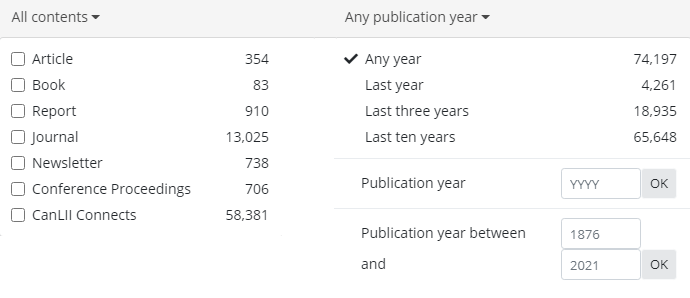
- Filter commentary by content type (i.e. books, reports, journal articles, etc.)
- Filter by publication year (similar format as decision date filter for cases)
(click to view a larger image)
Sample search:
You’re looking for British Columbia appeal court case texts from within the past year involving wrongful dismissal.
- Input “wrongful dismissal” with quotation marks around the search terms into the first search field on the CanLII main page. The quotation marks are search operators that will limit your results to documents that include the phrase “wrongful dismissal” or variants on it. For more information on using operators in your CanLII searches, check out this tip.
- Click on the ‘Cases’ tab.
- Add the ‘British Columbia’ subfilter from the ‘Jurisdictions’ dropdown menu.
- Add the ‘Appeal courts’ subfilter from the ‘Courts and tribunals’ dropdown menu.
- Add the ‘Last year’ subfilter from the ‘Date’ dropdown menu.
Voilà! This will provide you with a results list of all the BC cases on CanLII discussing wrongful dismissal in the past year.
–Alex Tsang (@atsang101)
[This tip first appeared on the CanLII blog and is also available in French]
Posted on August 11th, 2021 - Editor: Alex Tsang
—
A Singular Problem
I received an e-mail informing me of the death of an alumni of the firm where I articled.
I was saddened by that news – he was a very nice guy – but also (albeit in a less significant way) by the writer’s choice of words.
The Latin singular is alumnus, meaning a foster-son – but also any male child who is a ward, charge or pupil.
By extension, alumnus came to be applied in the USA to former pupils or students. When universities went co-ed, the Latin alumna (foster-daughter, ward etc.) was available.
The plural of alumnus is alumni; if you have more than one female former student, they are alumnæ.
Sometimes alumni is used to refer to all former students, regardless of sex (or gender); alumni/æ is also seen. (I’m not a fan of using a slash for that kind of thing, but it’s functional.)
Alum is a nice way to way to be gender-neutral, and I suppose lends itself to the plural alums.
But an alumni? Never.
At Oxford, the old way was simply to call everyone who had left the university (or gone down, in traditional parlance) an old member, regardless of age.
Perhaps because this seemed ageist, alumnus and alumna are now officially used (after the predictable outcry from traditionalists, who saw it as yet another example of encroaching Americanism).
Old member does have the advantage of being easier to pluralise if you don’t know Latin.
–Neil Guthrie (@guthrieneil)
Posted on August 4th, 2021 - Editor: Neil Guthrie
—
Co-
This prefix is overused.
Certainly in co-conspirator, where it is unnecessary, as co- and con- both import the notion of joint action.
That doesn’t stop US legislators from perpetuating the redundancy, however: see, for example, Rule 801 of the Federal Rules of Evidence (where – strike two! – it is spelt without a hyphen).
Co- also appears a lot in modern job titles: She is co-head of the financial services practice group or The firm appointed two new co-managing partners.
This isn’t wrong, but somehow it’s not pretty – especially where the shared position has two elements like vice-president or managing partner.
Joint would be a more elegant substitute?
–Neil Guthrie (@guthrieneil)
Posted on July 28th, 2021 - Editor: Neil Guthrie
—
More Bad Verbs From Nouns
We’ve already covered the awful reference when refer to is meant (but I seem to be losing the battle in getting people to use the latter).
Two new horrors crossed the radar recently. One is reference again, but used to mean checking a candidate’s references for employment purposes. Ugh.
The second is cascade.
This is unobjectionable when used to describe what water in the fountains at Versailles does (when the fountains are actually on).
But please don’t repeat this horror in relation to e-mail: Feel free to cascade this within your organization.
One coinage I do like, and which ultimately derives from a noun (volunteer), is voluntell/voluntold. It expresses so well how things get done in law firms!
–Neil Guthrie (@guthrieneil)
Posted on July 21st, 2021 - Editor: Neil Guthrie
—