This was adapted from a discussion on the CALL listserv; many thanks to Jenny Thornhill, Bronwyn Guiton and Alexandra Everitt.
Unfortunately there is no easy tool that will allow you easily track the changes to a specific section of the Criminal Code over the years, but the following two resources may be helpful:
Crankshaw’s Criminal Code of Canada is available both in print and online through Westlaw Canada. Bronwyn Guiton noted that “Crankshaw’s isn’t always reliable in bridging major changes in provisions however and so some work may be needed to verify your findings. For example, it doesn’t do a good job of telling the reader that prior to sexual assault, the prior equivalent provision referred to the same offence as something else. That’s where the concordance/historical table comes in.”
Permit as a noun meaning ‘licence’ is totally fine (In Canada, we require owners of guns to
have permits), as is the verb form when it means ‘to allow’ (Smoking is not permitted).
In legal usage – and I think mostly in US legal usage –
permit as a verb has come to mean ‘to license’ or ‘to issue a permit to’ (The permitting of architects is governed the relevant statute and professional rules).
I haven’t heard how
permitting in that last sense is pronounced, but I suspect it may more like
PER-mitting than per-MITT-ing. (The latter would be correct in something like
weather permitting, of course.)
Better to avoid
permitting in the regulatory context, I think.
Worse is
permissioning, which you may encounter if you deal with the technical aspects of document security in your legal workplace (Permissioning can be controlled at a file or matter level, or individually by user).
Avoid this altogether, especially when it’s easy (and more elegant) to say something like
Permission can be granted …
Now that we’ve entered the realm of knowledge management and legal tech,
templating is now something people seem to do.
Please don’t. Just create a template (or model or precedent or sample).
The data analytics unit at one of what we used to call the Big Four accounting firms exhorts us to Think different. Do different. Be different.
Be different is fine (grammatically and as a matter of practice), but the other two? Oh, dear.
They really should be Think differently and Do differently, as those verbs need adverbs (typically ending in –ly) rather than adjectives like different.
The copywriters wanted something that would catch the eye, of course – even if that meant resorting to a grammatical solecism.
What these phrases mean is ‘Think[or do] that which is different’ – but that would be too much of a mouthful (or eyeful).
So, there is a logic to the construction, but it’s still a stretch grammatically.
Sometimes an adverb is not required: Think big, Think pink, Think victory. But with different, let’s just say it’s different.
And besides, the whole verb + different formulation is a bit of a cliché: Apple is famous for Think different back in the late 90s; and CBC Radio has recently used Hear different in exactly the same way.
[Admin note: thanks to Karen Sawatzky of Manitoba’s Great Library for this tip; it was originally published on Great LEXpectations.]
Did you know? Plain language summaries of SCC decisions are available under “Cases in Brief”:
Cases in Brief are short summaries of the Court’s written decisions drafted in reader-friendly language, so that anyone interested can learn about the decisions that affect their lives.
They are prepared by communications staff of the Supreme Court of Canada. They do not form part of the Court’s reasons for judgment and are not for use in legal proceedings.
These summaries cover decisions from 2018 on. This looks like a handy resource to refer to clients or self represented litigants who need to understand a decision but are struggling to read the legalese. Or lawyers who want to be up on the law and it’s not in their area of practice.
For that reason it’s generally harder to find Ministerial Orders than Orders in Council, although this depends greatly on the province. Some provinces, such as British Columbia, make all their Ministerial Orders available in one place. For other jurisdictions you may have to look specifically at the Ministry’s website to find the order (e.g. Transport Canada provides its orders here: https://tc.canada.ca/en/ministerial-orders-interim-orders-directives-directions-response-letters.)
One thing to keep in mind is that, depending on the jurisdiction, the same number may be used for multiple Ministerial Orders. Drew Yewchuk gives an example in a blog post: “there is an M.O. 20/2020 from the Minister of Environment and Parks and an M.O. 20/2020 from the Minister of Justice.”
(And just to confuse the matter further, both Ministerial Orders and Orders in Council may also be regulations which involves another numbering system.)
If you find you use a lot of semi-colons, there’s a good chance your sentences are too long. Break things into smaller units, especially for readers using a small screen.
Semi-colons can be useful in lists where the enumerated items are clauses with internal commas, so you know what goes with what. Parentheses could help, but a thicket of round brackets (or any kind of brackets, really) is hard on the eye (as my friend and colleague Angela Swan points out).
In those situations, it might be easier for your reader to put the items in a bulleted or numbered list. In my view, you can dispense with the semi-colon at the end of each line.
Do not place a semi-colon in the salutation of a letter: Dear Ms Ali; is just weird. A colon or comma would do. Or you can dispense with punctuation altogether; the white space after the salutation provides an adequate break.
Note the use of a semi-colon in the previous sentence, where it effectively joins a thought that explains a previous one. A comma after altogether would be wrong, as you’d end up with a non-grammatical comma splice or run-on sentence.
A dash could also be used in that sentence – and would add a bit more emphasis.
But go easy on dashes. Too many and they lose their punch.
The Canadian census is carried out every five years (you may remember filling it out earlier this year) and, in addition to basic demographic information, covers such areas as housing and employment.
If you’re trying to find census information on a more granular level than simply for the country as a whole, the first thing that you need to determine is what geographic area you are interested in. Do you want to pull statistics for the country as a whole or on a more granular basis?
Statistics Canada divides the country up in a number of different ways including:
Provinces or territories (e.g. Alberta). Each province is assigned a two digit code that can be found here.
Census divisions (CD) are “intermediate geographic areas between the province/territory level and the municipality” (e.g. Greater Vancouver).
Census metropolitan areas (CMA) are “one or more adjacent municipalities [with] a total population of at least 100,000” (e.g. Toronto, Montréal and Vancouver).
Census subdivisions (SCD) are municipalities or areas treated as municipal equivalents (e.g. Vancouver, CY). There are 54 different types.
Dissemination areas (DA) are geographic units “with an average population of 400 to 700 persons” and are “the smallest standard geographic area for which all census data are disseminated.” Each dissemination area has a four-digit code which is preceded by the two-digit province/territory code and the two-digit census division code to produce a unique identifier (e.g. 12 09 0103).
Economic regions (ER) are groupings of “complete census divisions […] created as a standard geographic unit for analysis of regional economic activity.” (e.g. Lower Mainland–Southwest).
Federal electoral districts (FED) are areas represented by a member of the House of Commons (e.g. Vancouver Quadra).
You can also use Geosearch to narrow down your geographical area, e.g. to drill down to the map forDissemination Area 59153845, but keep in mind that data is not always available for the smaller geographic divisions.
What does it mean when you table a motion at a meeting?
It depends on where you live.
For those in the non-US parts of the English-speaking world, to table means to submit something formally for discussion or consideration.
The expression comes from act of laying your submission on the table of a legislative assembly or other decision-making body (like a board of directors). This usage goes back at least as far as the 1650s.
In the USA, however, tabling has, since the mid 1800s, meant postponing or even shelving a matter indefinitely.
Winston Churchill noted the difference in World War II: British officials wanted to table (i.e. raise) something as a matter of urgency; their American counterparts thought they meant ‘putting it away in a drawer and forgetting about it’ (The Second World War (1950)).
In Canada, we see both; but the non-US usage makes more sense when you think of the actual table of the deliberative body.
It’s disheartening to see how frequently people mess up with commas.
This kind of thing is all too common: Partner, Alfredo Garcia will be speaking about …
Remove that comma! And don’t be tempted to leave it but add one after Garcia! Both suggest that there is only one partner (which, as you know, is not possible as a matter of law).
Another version of the same error: My colleagues, Suresh and Amy, will … It’s not an error if these are your only colleagues, which is the implication of those offsetting commas. If you have more than just the two colleagues, no commas.
A worse blunder was made by former prime minster Stephen Harper, who tweeted this on International Women’s Day in 2019: Special mention to @LaureenHarper, my mother and daughter.
Mr Harper, you really ought to have put a comma after mother in order to make it clear that there are three main women in your life, not just one with multiple roles.
Unless, of course, there is some weirdness going on in your family that we didn’t previously know about.
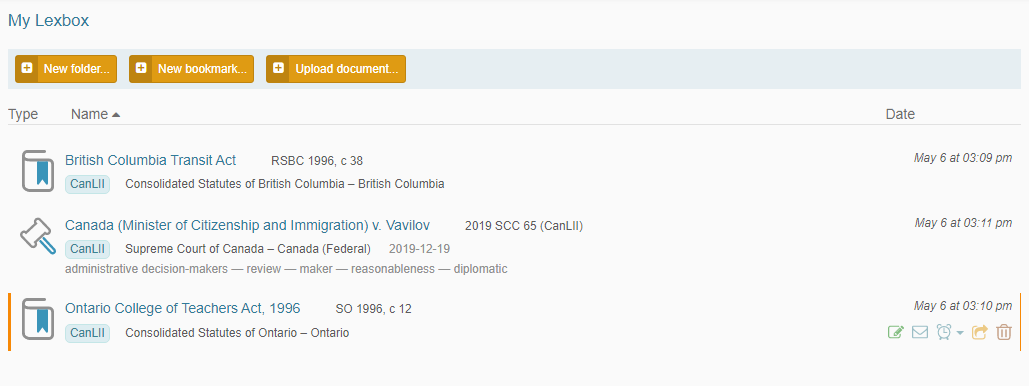
For legal professionals working with a high volume of cases, it can be difficult to stay up to date with legal research for all of them. However, with the alert feature on Lexbox, it’s easy to keep track of changes to legal information on CanLII that is relevant to your field of work or study.
Lexbox offers three types of alerts:
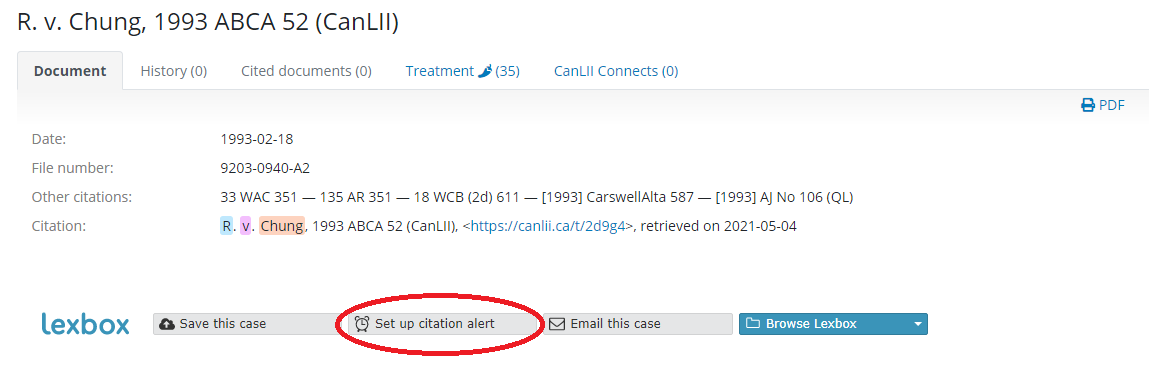
1. Citation alerts — these allow you to track the impact of a case over time.
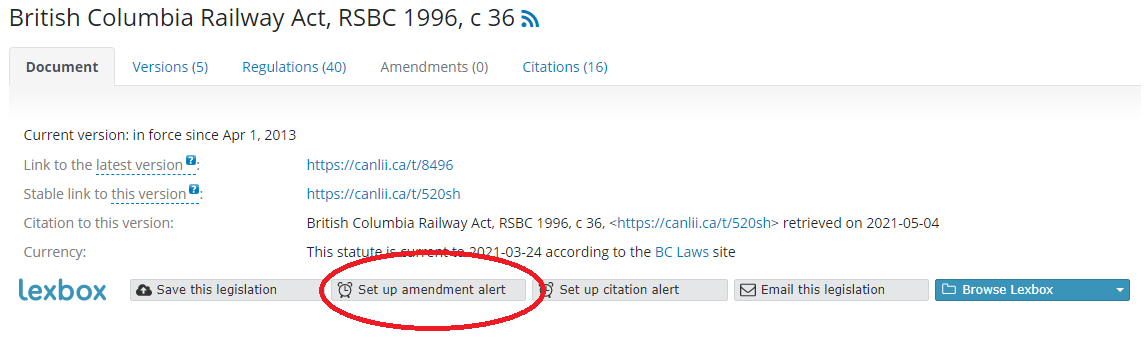
2. Amendment alerts — these allow you to monitor the changes in a statute over time.
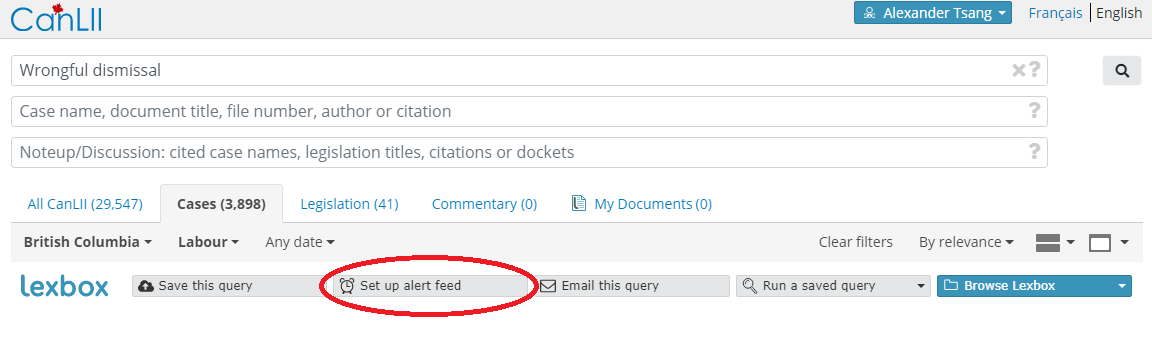
3. Query alerts — these allow you to stay informed of the latest appearances of a term or topic in CanLII documents
There are two ways you can set up citation and amendment alerts on CanLII with Lexbox:
a) the corresponding buttons in the Lexbox bar located on every search page and case/legislation page or;
b) the alarm clock icon that appears on the bottom right corner of each search result.
You can set query alerts by making a customized search and then clicking the ‘Set up alert feed’ button in the Lexbox bar at the top of the search results page. For more information on making customized searches, see our previous posts on using operators and search filters on CanLII.
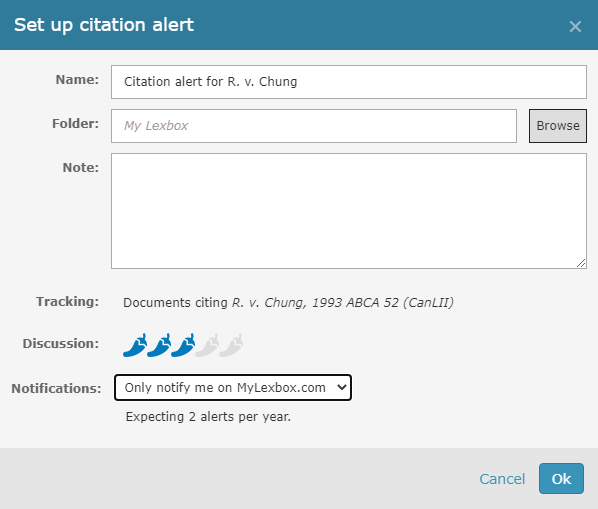
Upon clicking any of these alert buttons, a pop-up box will appear where you can:
Customize the title of your alert
Choose the folder on Lexbox where you want to store the alert
Add a contextual note attached to the alert
For citation alerts only: Choose the level of a case’s discussion intensity required for Lexbox to send an alert to you. The intensity is measured in jalapeño icons.
Choose how you will be notified about the alert (within your Lexbox folder, by a daily email, or by a weekly email)
When you are finished customizing your alert, click ‘Ok.’
You can check your alerts, modify them, or cancel them at any time by visiting your Lexbox account.