All Our Research Tips
Search Multiple Sources
Today’s Tip comes from Melanie Bueckert, Legal Research Counsel, Manitoba Court of Appeal. Melanie shared a story about looking for citing cases:
I wanted to know if the Supreme Court of Canada had ever cited its decision in F.H. v McDougall, 2008 SCC 53. So I headed over to Quicklaw, pulled up the QuickCite record and filtered it by “Supreme Court of Canada”. There was one result from 2011.
Just to be thorough, I thought I would check Westlaw to see if there was anything more recent. This is not an easy task, as you likely know. I found the KeyCite record all right (though it only contained 574 results, rather than the 1400+ on QL), but didn’t find any easy way to just display the SCC results. You can use the locate feature to filter by jurisdiction (though it wasn’t clear to me which jurisdiction I should choose to capture SCC results) or by document type (‘highest courts’ still left 86 results, as it included all appellate courts). In the end, I reviewed all 574 results only to find that no SCC cases were listed (not even the one I found in QL).
So I got frustrated and thought I would try my luck with CanLII. They showed a similar number of cases in the reflex record, but again it was a struggle to get the results to filter by court. You can select individual databases from the reflex record page, but if you’re using Internet Explorer you also need to include some text in one of the search boxes (like the case citation in the full text search box) in order to get the search to work. Finally it did – and returned the one result I had already found in QL.
So I guess the upshot is that it can be tricky to easily filter judicial consideration of cases by jurisdiction or court. I worry about folks relying solely on Westlaw as it would appear that the KeyCite records, even for Supreme Court of Canada consideration of their own cases, are not particularly up-to-date. It was especially disconcerting because McDougall was listed in the Authorities link for the case that mentioned it (2012 SCC 3). I guess the work-around would be to run a full-text search of the case name or citation in an SCC judgments database, but those types of searches make me nervous about missing something.
Like Melanie, I feel strongly that searching for judicial consideration should be done with more than one tool. Thanks for sharing this tip!
Posted on January 23rd, 2013 - Editor: Shaunna Mireau

—
Use Storify to Save and Send
One of the things that we are careful to do in the Field Law Libraries is to make sure that the output of research is the way that it is needed. There is no sense in providing a printed copy of something if the requester wants to send a tweet about it. Likewise, there is little use in sending someone a short URL if they need to attach something to a printed brief.
Today’s Research tip crosses into technology: Try using Storify to capture information where your research sources are from social medias or the web.
To see a sample of what you can create with storify, check out the sample I made for Commentary about R. v. Dunn.
Posted on January 16th, 2013 - Editor: Shaunna Mireau
—
Find Your Groups
I confess to being a skim-a-holic. I find personal satisfaction in having a really good idea what people in the legal industry are talking, thinking, and writing about.
The problem is that there is a ton of new information. If 3 hours of video is uploaded per minute to YouTube just from mobile devices, how do you determine what to pay attention to? If there are 500,000 new blog posts each day, which are the most meaningful to your work?
My method for narrowing the flood of information to the most succinct and ‘important to me’ trickle is to find groups. Groups in this case are a selection of people whose work (blog posts, Twitter stream, LinkedIn updates, Google+ shares, traditional publications, etc.) alerts me to what is most important.
Not sure where to start? After following Slaw, try browsing the LinkedIn Groups Directory or spending a few minutes browsing the Groups You May Like link from the LinkedIn Menu bar. The groups directory is searchable and the results list shows how active the group is.
In addition to following groups to keep up with your interests, you can also skim open LinkedIn Groups as a source of information about an industry that you are researching.
Posted on January 9th, 2013 - Editor: Shaunna Mireau
—
Currency
I usually talk about currency from the “the quality or state of being current” perspective. Today, I used the Bank of Canada Currency Converter to look at the exchange rate which leads me to today’s tip that deals with another definition of currency:
Look to the Bank of Canada site for money issues.
For those of you who keep track of the prime business rate for the purposes of calculating interest under the Northwest Territories Judicature Act, s.56(2), the latest interest rate is 3%.
Happy New Year!
Posted on January 2nd, 2013 - Editor: Shaunna Mireau
—
Supreme Court of Canada Decisions
Today’s Tip: Consider how you need a decision to help determine where to get it.
An announcement from the SCC last week inspired this tip:
Major addition to the Supreme Court of Canada decision’s website
The Supreme Court of Canada and Lexum are proud to announce that the Court’s decision website now contains all decisions back to 1907. Moreover, all the PDF versions of decisions up to 2010 are identical to the official version available in the Supreme Court Reports.
This major content addition has been made possible thanks to the support of the Supreme Court of Canada. The Court has been at the forefront of free access to judicial decisions for the past 20 years. Lexum is proud to provide its technology and infrastructure to ensure continuous and efficient availability of Supreme Court of Canada decisions.
The PDF copies, even for the earliest cases, are clean and beautiful. If I were preparing for a hearing and needed a copy of an SCC decision for the authorities, I would use this source.
If I were researching, comparing and contrasting case law, or noting up I would probably use a different source. Supreme Court of Canada decisions are available in many places:
I may have missed some sources, but as you can see, you have plenty of options.
Happy Holidays!
Posted on December 26th, 2012 - Editor: Shaunna Mireau
—
Legal News for the Super Busy
Are you the most busy lawyer in Canada? Do you still need to know what is going on in the legal industry in our country?
The US Legal Market offers busy lawyers a 5 minute daily visit of the RSS feed for the legal gossip blog Above the Law to keep up to date on what is happening inside the legal industry. Associate bonuses, policies from big law firms, law firm mergers, layoffs and closures.
Here in Canada, we have 140Law – a daily offering of legal headlines offered as a roundup post on the Wise Law Blog by Garry Wise and through the Wise Law twitter stream. Today’s research tip is to follow these headlines for Canadian legal industry specific news.
Thanks for compiling 140Law for us Garry, and Merry Christmas.
Posted on December 19th, 2012 - Editor: Shaunna Mireau
—
Check for Coming Into Force
I was looking at the Interest Act (Canada) recently which reminded me to remind Tips readers to look carefully and closely at coming in to force information when researching legislation.
The Act at section 4 reads:
Marginal note: When per annum rate not stipulated
4. Except as to mortgages on real property or hypothecs on immovables, whenever any interest is, by the terms of any written or printed contract, whether under seal or not, made payable at a rate or percentage per day, week, month, or at any rate or percentage for any period less than a year, no interest exceeding the rate or percentage of five per cent per annum shall be chargeable, payable or recoverable on any part of the principal money unless the contract contains an express statement of the yearly rate or percentage of interest to which the other rate or percentage is equivalent.
R.S., 1985, c. I-15, s. 4; 2001, c. 4, s. 91.
The research trail at the bottom of a section will tell you amendments to that section that are in force for federal legislation. The Department of Justice Laws site gives a handy list of pending amendments when you look at the table of contents for an act:
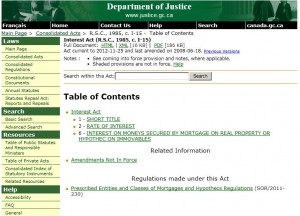
The Amendments not in force particulars for this act have a couple of references to section 4. This means that there are acts that have been assented to and are only awaiting proclamation to be brought into effect. They many never be proclaimed and eventually be repealed under the Statutes Repeal Act. Read very carefully and look at the Table of Public Statutes for the key to coming into force dates.
The Table of Public Statutes for the Interest Act shows:
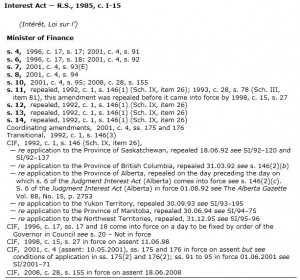
The at the Privy Council Office website provides a search engine for identifying proclamations by act name.
Posted on December 12th, 2012 - Editor: Shaunna Mireau
—
Legal Infographics
A note about an infographic was delivered to me by email yesterday. Canada’s Anti-Spam Legislation website www.fightspam.gc.ca. The infographic touted in the email was titled “Worried its Spam? 5 Things to Look for”.
Sharing the infographic was encouraged in the email. Sharing is what infographics are all about.
Gyi Tsakalakis has a fantastic collection of Law Infographics on his Pinterest channel. Gyi has jsut started contributing to Attorney at Work. Gyi’s byline for his Optimize!column:
Gyi Tsakalakis helps lawyers put their best foot forward online because clients are looking for them there. He is a co-founder of AttorneySync, a digital marketing agency for law firms. You can find more of his writing at Lawyerist & Avvo’s Lawyernomics blog. You can ask him a question (or just say hi) at LinkedIn, Twitter, Google+ and Facebook.
Thanks Gyi for sharing your Law Infographics collection.
Posted on December 5th, 2012 - Editor: Shaunna Mireau
—
Start at the Beginning
My browser is crowded with so many links in my favourites bar that sometimes it is faster to type a known URL than scroll for my link. Typing “parl.gc.ca” in the address bar of my browser inspired today’s tip. My shortcut to the parliamentary website skips directly to English, my sadly unilingual preferred language. As you can see below though, the beginning of the site has “important notices“…something that could be overlooked.

Click the image to enlarge.
Today’s Tip: Start at the beginning.
Posted on November 28th, 2012 - Editor: Shaunna Mireau
—
A Visual Tip
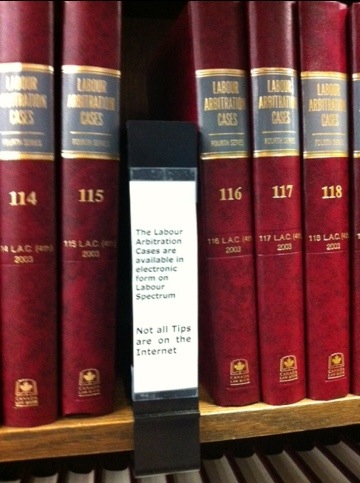
As the shelf sign says, not all tips are online. Remember to read the notes provided by your law library.
Posted on November 21st, 2012 - Editor: Shaunna Mireau
—