All Our Research Tips
Don’t Make Things Up
Hat tip to BLG’s Neil Guthrie for his digest titled “Submitting a fake judgment: not a good litigation strategy”. The case reference is D’Souza v Linton, 2013 ONSC 70. The opening paragraph of this endorsement reads:
This matter came before me on July 31, 2012 as a motion to set aside an ex parte default judgment. The judgment, dated June 19, 2012, purports to bear my signature.
It is interesting to me that the word “purports” and its variations appears in 425 decisions – so far in 2013.
On another note, this case comment came to me via Lexology, one of several services for monitoring law firm newsletters.
Posted on April 3rd, 2013 - Editor: Shaunna Mireau

—
Regulation and Act Section References
One of my colleagues asked a great question that makes for an excellent tip:
The definitions of the Minor Injury Regulation say in (g)(ii):
any insurer made a third party to the claim by the Court under section 635(14) of the Act
But there is no s.635(14) in the current Insurance Act. There was a s.635(14) before the July 1, 2012 amendments, which was Rights of Creditors. That section is now 579, 579(15) to be exact.
The question was “What am I missing”.
The answer is “Nothing” since the correct section number that should be referenced can be identified.
Regulations are not always updated when an act is revised. Last July, a major amendment to the Insurance Act for Alberta was brought into force that revamped section numbering. The context of the regulation making power in the act stayed the same, thus the regulations made under the previous act follow along, even when the section references do not line up.
For Alberta, this theory is dealt with by the Interpretation Act, see sections 36(1)(e):
(e) all regulations made under the repealed enactment remain in force and are deemed to have been made under the new enactment, insofar as they are not inconsistent with the new enactment;
At some point there will likely be a Regulations Act Regulation, or an Insurance Act Regulation that amends all of the section number referenced, but those administrative cleanup duties are likely lower on the priority list than substantive regulatatory changes.
Posted on March 27th, 2013 - Editor: Shaunna Mireau
—
Federal Bill Numbers
Today’s Tip is a caution about searching for federal bill numbers. Be careful that you understand what you are looking for.
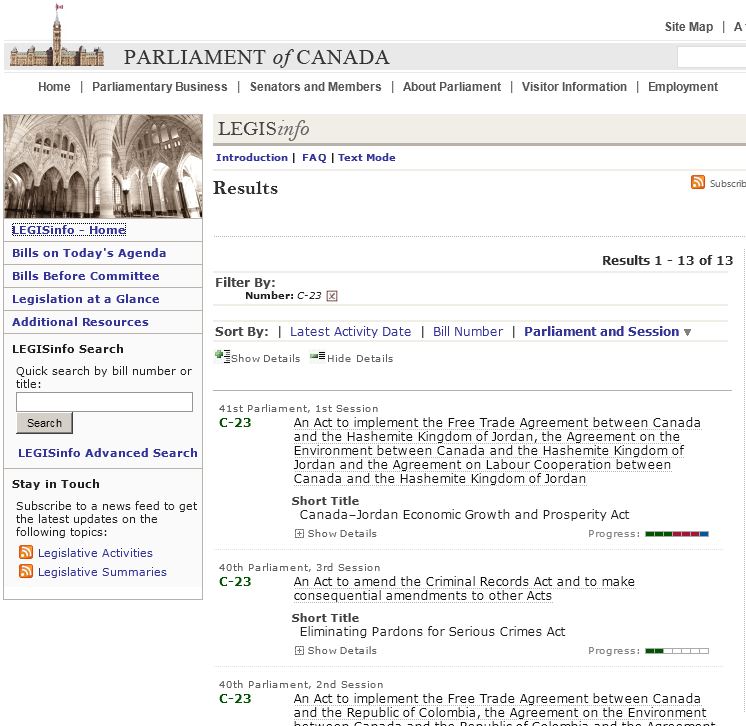
I was asked to look for “Bill C-23”. I quickly used my bookmark for LEGISinfo, the Parialment of Canada’s research tool for finding information on legislation before Parliament, both current and historical (back to April 2006), to search by bill number for C-23.
The FAQ page reviews how bills are numbered, but it does not tell you about bills like C-23A.
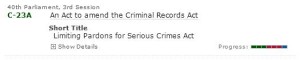
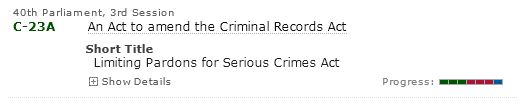
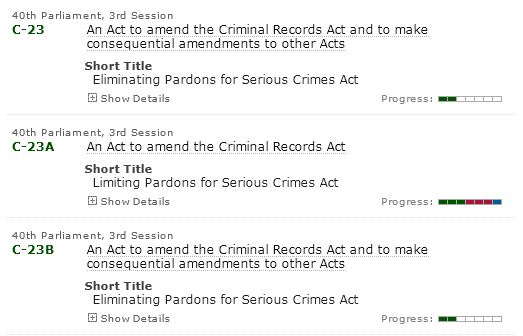
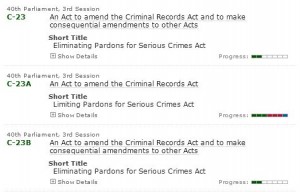
My “blink” told me that there was a 2010 Bill that dealt with Pardons, but my initial search result for Bill C-23 showed only the initial 2010 bill that was replaced by C-23A. A detailed look at the Status for Bill C-23 will tell you that:
Pursuant to Order made by the House of Commons on June 17, 2010, the Bill was divided into Bill C-23A and Bill C-23B.
This tip could be divided into A and B as well.
A. Don’t simply look at a status list without expanding it further. Had I assumed that C-23 from the 40th Parl. 3rd. Sess. only made it to 2nd reading, my requester would have only had part of the information needed.
B. If someone asks you for a bill number, make sure you know some context. There is a Bill C-23 in nearly every session. A search for “pardons” in the bill title does show all the information needed for this particular research.
One further caution: A quick title search for ‘pardons’ doesn’t show bills with ‘pardon’ in its singular form. You may want to bookmark the , which offers a Title and Content option.
Posted on March 20th, 2013 - Editor: Shaunna Mireau
—
Watch for Trends
Today’s Tip is about looking outside your borders for trends. You decide where your borders are – your department, your organization, your city, perhaps your country.
A tweet by Darin Thompson inspired this post:
@darin_thompson: It’s on! #ODR to become a part of the legal landscape in the European Union
http://europa.eu/rapid/press-release_MEMO-13-192_en.htm?locale=en
I believe that Online Dispute Resolution and Alternative Dispute Resolution are trends to watch. What trends are you watching?
Posted on March 13th, 2013 - Editor: Shaunna Mireau
—
Use the Telephone
I have mentioned in the past that calling a friend can be a fast path to a research answer. It can also be a quick path to resolution of a technical problem. With email and web forms being the new normal for business communication, it may simply be that a phone call or well thought out voicemail message is different enough to be ‘noticed’.
As an example, we have been having technical problems with a website database recently. The form to report technical difficulty used several times garnered zero response. A voice mail message to the organization did set a resolution in motion. For a variety of reasons I am not willing to share the site, but the telephone was the path to a solution.
Have you noticed a particular communication method getting a better or faster result?
Posted on March 6th, 2013 - Editor: Shaunna Mireau
—
Dead Space
We all have them – those days where it feels like your imagination shrugs its metaphorical shoulders, gives you an apologetic half-grin, and heads to Fiji. You’re stuck – you can’t engage with your work, or generate new ideas. Douglas Adams described it best: The Long, Dark Tea-time of the Soul. Here are a few tips to help you endure.
- Set the bar low – this isn’t going to last forever, so don’t be your worst enemy. Populate your to-do list with tasks that don’t require a lot of creativity, but still make you feel like you’ve accomplished something. You have them – clearing your inbox, weeding files, shelf reading. Basic housekeeping tasks that on your best days are not worthy of you are perfect for now.
- Work your network – your imagination may be on hiatus, but you know lots of lively, interesting people. Go talk to them. Book a coffee with your mentor or protégé. Have lunch with a favourite client or colleague. DO NOT whine about your problems – instead, ask them about what they’re working on. Absorb their energy. Ask questions. Be inspired.
- Read – now’s the time to wade through the stack of professional publications and the backlog of blogs that has been accumulating. Personally, I avoid overly academic journals – I want something more sprightly and energizing. The Harvard Business Review blogs, TechCrunch, Bored Panda – all of these can be sources of inspiration. Don’t spend the whole day with text, but an hour or so may present you with some ideas worth exploring when your own creative juices are flowing again.
- Move – go to the gym, get outside, do something physical. Perhaps the blood which should be circulating through your brain has pooled lower down. Get your heart pumping.
Editors note: This research tip was shared by Wendy Reynolds. I love Wendy’s suggestion to use dead space to read – keep up with that pile of current awareness material. Thanks for sharing this Wendy.
Posted on February 27th, 2013 - Editor: Shaunna Mireau
—
Never Start From Scratch
The fastest path is one that you have already traveled. The sign posts are familiar and likely the vehicle as well. You will know how to get where you are going and likely how long your trip will be. This is as true for legal research as it is for your daily commute.
Look to your prior work product. While each client has a unique situation, there are enough similarities in the issues that they bring you that you will be able to use your experience for the best research outcomes.
Keep and search your work product (research memos, opinion letters, advice you give in an email, notices, briefs, pleadings, factums, etc.) so that you don’t have to start each research problem from scratch.
An inspiration Hat Tip to the new APLEN Training Centre, a resource launched yesterday for libraries to share their training materials and learn from the collective experience of library staff. The Training Centre developed by the Alberta Public Library Electronic Network is available to the public as well as to libraries.
Posted on February 20th, 2013 - Editor: Shaunna Mireau
—
Who Inspires You
Today’s Tip is a follow-up from a theme that I see running through recent Research tips.
The theme is about WHO. Who can you go to for a quick answer, who do you trust to be your source for information, who is the person that inspires you or inspire your confidence.
I posted yesterday at Slaw about being inspired by Stephen Abram recently. Perhaps Stephen is one of the people that inspire you as well. If you are looking for a great place to be inspired, consider attending the Canadian Association of Law Libraries Annual Conference in Montreal May 5-8, 2013. Stephen will be offering a session on Librarians as Innovators.
Related Posts:
Find Your Groups
Look to Experts for Case Comments
Go to the Source
Look to the Library of Parliament
Talk to Your Librarian
Posted on February 13th, 2013 - Editor: Shaunna Mireau
—
Look to Experts for Case Comments
I have a pretty easy time monitoring Canadian case law that is of interest to people in my organization. RSS feeds for CanLII searches or to monitor court output, good newsletters available from commercial legal publishers both in print and online, and the great sharing services offered by lawyers and firms, for example:
For global case law that you should know about, look to the law blogs. A great example of how law blogs can keep you up to date on foreign decisions that will interest you, check out Barrk Sookmans post today Google wins sponsored links case in Australia. Today’s Tip: follow practice specific blogs for highlights on the most important foreign judgments in your area of practice.
While this method for following foreign case law does not replace research on a specific question that will spring your decision to look at foreign material, it is a good way to keep in the global loop.
Posted on February 6th, 2013 - Editor: Shaunna Mireau
—
New Government Publications Resource
A press release received in my email inbox inspired today’s tip. Because I subscribe to an email list used by Canadian law libraries (CALL-L – an open list, more info here), I received the following press release:
APLIC/ABPAC releases its Government and Legislative Libraries Online Publications Portal (GALLOPP/PPGPE): A key resource for locating Canadian and Provincial Government Publications.
The Association of Parliamentary Libraries in Canada (APLIC) is proud to announce the release of its unique pan-Canadian bilingual government and legislative publications portal known as GALLOPP (Government and Legislative Libraries Online Publications Portal) / PPGPE (Portail des publications gouvernementales et parlementaires électroniques). It promises to become a vital resource for Canadian libraries seeking the electronic publications of Canada’s federal, provincial and territorial governments and legislatures.
The result of collaboration between provincial and territorial legislative libraries from across Canada and the federal government’s Depository Services Program (DSP), the portal provides one-stop access to over 320,000 electronic provincial, territorial and federal government publications and legislative materials dating back to 1995.
Its simple and easy-to-use English and French interface allows users to search for documents by keyword or full-text and then link to the electronic copies of the materials hosted by the collecting library. Results can be cross-jurisdictional or limited by jurisdiction or date.
The portal is a unique resource bringing together for the first time the significant government document repositories that have been built by individual legislative libraries and the DSP.
New documents will be added regularly to GALLOPP. A detailed scope note on the site provides an up-to-date description of the portal’s content.
The portal is available at no charge and is accessible on the APLIC site at http://www.aplic-abpac.ca/aplic_home.html .
The APLIC Portal page offers a scope note describing the wonderful material now amalgamted for searching in this new database resource. There is even an easy to understand option.
My sincere congratulations and thanks to the Association of Parliamentary Libraries in Canada for making this material easier to access. Having this information is a fantastic reason to make use of email lists.
Posted on January 30th, 2013 - Editor: Shaunna Mireau
—