All Our Research Tips
Use a Concordance
When looking at legislation it is sometimes helpful to know if there are similar provisions in other provinces. Rather than reading through each and every statute to check for equivalent provisions, it is much faster to use a concordance.
The trick is finding a concordance for a specific act. While concordances don’t exist for all acts, they do exist for a significant number of them. Publishers often include concordances in consolidated legislation. For example, LexisNexis’s Consolidated Canada Business Corporations Act & Commentary concords the Canada Business Corporations Act with all the provincial and territorial business corporations acts.
Concordances also exist between old and new versions of legislation. For example Quickscribe includes a concordance between British Columbia’s Companies Act and Business Corporations Act (which replaced the Companies Act) in its BC Business Corporations Legislation Manual.
In addition to concordances produced by commercial publishers, governments often produce a concordance between old and new legislation when the subject is important enough. For example British Columbia provides a concordance between the Local Government Act and the Community Charter.
–Susannah Tredwell (@hannasus)
Posted on February 25th, 2016 - Editor: Susannah Tredwell

—
Lose the Latin
Bryan Garner, editor of Black’s Law Dictionary and a legal writing expert, recently blogged on the exciting topic of when italics should be used for Latin words and phrases and when they can be in roman (plain) type. It must have been a slow day in the blogosphere.
His ‘fuzzy rule’ is that you can skip the italics when the word has become fully naturalised into English. So, ‘habeas corpus’ and ‘prima facie’, but ‘sensu stricto‘ and ‘in pari materia‘.
In a waspish mood, I left a comment on Garner’s blog, asking whether it wouldn’t be better to write ‘strictly speaking’ and ‘on the same subject’ for the last two of those, since our clients don’t generally converse in Latin.
Mr Garner doesn’t seem to have liked the comment, because it is still ‘awaiting moderation’ months later – but I stand by it.
If you’re acting for the Vatican or writing for an audience of learned monks, Latin is fine. Otherwise, use it only when it’s absolutely unavoidable or so widely understood that it doesn’t look like a dead, foreign language.
Lawyerly use of Latin has its pitfalls too, if you get things wrong. US lawyers use scienter as a noun (‘degree of knowledge that makes a person legally responsible for the consequences of his or her act or omission; the fact of an act’s having been done knowingly, esp. as a ground for civil damages or criminal punishment’: Black’s Law Dictionary, ed. B. Garner). But scienter is really an adverb (‘knowingly’ or ‘skilfully, expertly’).
Better to stick to the language you and your readers know than to try looking all edjumicated.
Next week: banish business jargon
–Neil Guthrie (@guthrieneil)
Posted on February 17th, 2016 - Editor: Neil Guthrie
—
Quickly Arrange Multiple Windows
Doing legal research increasingly means having multiple windows and applications open. You might be referring to CanLII in one window, the CRA website in another, and that email you’re working on in a third. Some of you might even have two or three screens set up beside each other on your desk!
This new normal became 100% more efficient for me when I learned how to use the below four keyboard shortcuts to quickly marshal all my open windows. These first two shortcuts instantly resize your window to take up half of the screen and then snap it to one edge or the other.
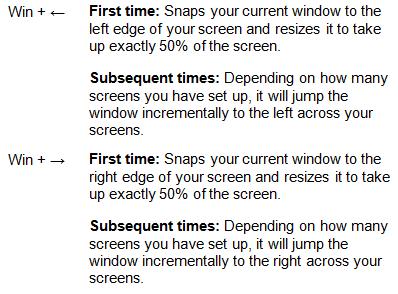
These second two shortcuts will maximise or minimise your window. I use them less often than the two shortcuts above.

These shortcuts are compatible with Windows operating systems only. They were introduced with Windows 7 so you’re out of luck if you’re still on Vista! The “Win” key is often found in the bottom left of your keyboard, between Ctrl and Alt.
— Bronwyn Guiton (@BronwynMaye)
Posted on February 10th, 2016 - Editor: Bronwyn Guiton
—
Advice for Associates and Students
You feel nervous about publishing something, right? You should be, a bit – but don’t let it put you off.
Some things to bear in mind:
- get a partner to vet your idea and your draft, for technical accuracy
- defer to the senior person on points of law (unless you can show you’re right), but not always on stylistic matters (as an articling student, I stood my ground when a partner insisted that theirself was a word)
- check whether your firm acts for any party you’re talking about – you don’t want to say anything a client might not like
- be cautious in taking positions on public issues – your firm may represent parties with interests at stake, even if those parties aren’t mentioned specifically in your blog post or update
- humour is good, but be careful; it can backfire
- consider anti-spam legislation (basically, no commercial electronic messages to parties with whom you don’t have an existing business relationship)
- if available, have your marketing or communications people check the formatting of your piece and run a draft by you before publication
On a more positive note:
- write about something that clients will find interesting
- pitch it at a level that will engage, not alienate, your reader
- write plain, understandable prose – not Latinate legal mumbo jumbo (which will alienate your reader)
- explain why this new case or statutory provision (or whatever) is relevant: what does the client need to do, be aware of, avoid?
Now that I think of it, many of these are useful pointers for partners, too.
Now, get writing.
Next time: lose the Latin.
–Neil Guthrie (@guthrieneil)
Posted on February 3rd, 2016 - Editor: Neil Guthrie
—
What Is a Limited Revision of an Act?
The Local Government Act, R.S.B.C. 2015, c.1, came into force on January 1, 2016. If you know that the last Revised Statutes of British Columbia were produced in 1996, this citation looks a little confusing. The explanation is that the new Local Government Act is what is known as a limited revision of an act.
British Columbia’s Statute Revision Act allows the government to produce a limited revision of a single act instead of revising all the statutes. Traditionally, British Columbia’s statutes have been revised every 15 years or so, with R.S.B.C. 1996 being the last general revision; it remains to be seen if there will ever be another general revision of the Statutes of British Columbia.
These limited revision acts are cited R.S.B.C. followed by the year of revision (e.g. R.S.B.C. 2015, c.1). Just to confuse things further, British Columbia’s limited revision acts were cited S.B.C. until 2013.
British Columbia is not the only province that can produce a limited revision of an act; several other provinces (e.g. Alberta) have the power to produce a limited revision.
–Susannah Tredwell (@hannasus)
Posted on January 27th, 2016 - Editor: Susannah Tredwell
—
That and Which
People have trouble with the correct use of that and which.
Writing in 1926, the grammarian H.W. Fowler said the rules are ‘an odd jumble, and plainly show that the language has not been neatly constructed by a master builder’.
Fowler advocated a fairly simple rule (and people who think about these things have largely followed it) – ‘although it would be idle to pretend that it is the practice either of most or of the best writers’ (Fowler again; if you don’t have his Modern English Usage you must buy it now).
That
- use it where the information in the clause that follows is defining
- in other words, what comes after that is essential to the meaning of the sentence and limits it
- example: She gave me a list of books that had influenced her
- not just any old books, but a limited selection as defined by that
- that is restrictive
Which
- use it where there is no particular limitation in the clause that follows
- what comes after which is not essential to the meaning of the sentence
- example: I always buy her books, which have influenced me greatly
- her books, but the fact they have influenced me is merely descriptive
- which is non-restrictive
Ross Guberman, the US legal writing guru, suggests an easy and workable test: ‘Use “which” if you would pause when reading the sentence out loud. If you wouldn’t pause, use that.’
Next: advice for students and associates
–Neil Guthrie (@guthrieneil)
Posted on January 20th, 2016 - Editor: Neil Guthrie
—
Make a Prospective Consolidation
When we’re working with an Act that has had significant amendments passed, but not yet brought into force, I’ll often make a prospective consolidation to help our lawyers advise their clients on forward-looking strategies. Having a prospective consolidation on hand makes work more efficient and it can also reveal new implications for the amendments. I’m going to walk you through how I do this myself and share some lessons I learned along the way.
The method I use, which is described below, makes use of a blackline tool. A blackline tool is an app that compares two similar documents and then highlights any changes. I think the benefit of using a blackline tool as the last step in making a prospective consolidation is that you get to see precisely which words have been amended. Often, amendments are made by repealing and replacing whole sections or sentences as opposed to just changing the few relevant words or phrases. If you run a blackline, you can see where exactly the changes were made. This can reveal the actual intent of an otherwise puzzling amendment.
Shaunna Mireau pointed out the benefits of prospective consolidations in August 2011 here on SLAW Tips. My own experience with prospective consolidations has been in the context of new Acts being significantly amended prior to being brought into force. In BC we had a new Pension Benefits Standards Act passed in 2012, but not brought into force until September 30th, 2015. In the meantime, the 2012 Act was significantly amended in 2014. As a result, between 2014 and September 2015 there was no public consolidation of the new Pension Benefits Standards Act that lawyers could work with that reflected the 2014 amendments.*
Five steps to creating your own prospective consolidation
- Get a clean, current Word version of the of the Act being amended. Save it. Then save a copy of it. (This means you will have two copies of it.)
- Following the amendment instructions in the amending Act, edit one copy of the existing Act you saved in step 1. Save the prospective consolidation document and the unmodified version of the current Act to the same folder.
- Select both document and compare them in whatever app you use to blackline documents. (At our firm we have the Workshare Compare tool handy through the right-click menu.) Make sure that the unmodified version is set as the original or baseline document and the prospective consolidation is set as the new document to compare.
- Save a copy of the blackline output. Double check it for clarity and tweak it if need be. This is your finished product.
Tips for making this work well
- Start with the original Act in single-column native-Word format. By single-column, I mean don’t use the two-column format that bilingual legislation is offered in. By native-Word format, I mean try to start with a Word document or by copying and pasting text from a web page into a Word document. If you convert a PDF to a Word document you’re in for a world of hurt courtesy of all that invisible formatting. (By the way, Alberta’s QP Source Professional, is my go-to for Alberta statutes in Word format.)
- When the blackline app spits out your finished product, I recommend going back in and tweaking anything that looks off. Sometimes this is as simple as deleting a few rogue periods or paragraph marks. However, in other cases it’s actually quicker to go to your original clean copy of the Act, or the prospective consolidation copy, and tweak the problem areas there before re-running the blackline.
- Depending on who you think might see your prospective consolidation, I think it’s worth converting the final product to a PDF and adding either a cover page or a watermark that clearly identifies it as an unofficial consolidation generated within the firm.
— Bronwyn Guiton (@BronwynMaye)
*I do want to give credit to Quickscribe, who, in Spring 2015, put together their own prospective consolidation of the new BC Pension Benefits Standards Act for users before the BC government brought that Act into force. Quickscribe is an independent business doing awesome things with BC (and some federal) legislation!
Posted on January 13th, 2016 - Editor: Bronwyn Guiton
—
Take a Pass on the Passive
Does the subject of your sentence do something (She said that), or is something done to the subject (That was said by her)? The first is an active construction, the second a passive one.
The active voice is much more effective. It tends to be shorter and simpler, more natural and direct, more engaging.
Lawyers, who are often accused of being verbose and overly complicated, unnatural, indirect and anything but engaging, favour passive constructions.
Which is more forceful? I love you (active) or You are loved by me (passive)? We recommend the chocolate mousse (active) or The chocolate mousse is recommended by us (passive)? No points for getting the right answer: it’s too obvious.
With good reason, Theodore Blumberg Seven Deadly Sins of Legal Writing (2008) calls passive constructions the first deadly sin of legal writing.
There are some occasions when the passive is the better choice, but not many:
- the responsible party is irrelevant or unknown (The summons was served)
- result > responsible party (Mission accomplished)
- you want to deflect blame (Mistakes were made, as opposed to Our client made mistakes)
- for emphasis (He was shot) – although it’s easy to deaden rather than heighten effect with the passive
- to improve flow between two sentences (Bupinder is a model associate. He is consistently praised by partners.)
- to vary sentence structure? trust me (note the active voice there), the passive rarely works
- sounds better? doubtful; see examples above
- to create ambiguity and uninteresting prose? for sure
Next tip: that and which
–Neil Guthrie (@guthrieneil)
Posted on January 6th, 2016 - Editor: Neil Guthrie
—
Read the Regulatory Impact Analysis Statement
Since 1986 almost all federal Canadian regulations have included a Regulatory Impact Analysis Statement (RIAS) following the text of the regulation.
Why should you read the RIAS? Unlike acts, you will not find a discussion of new regulations in Hansard. The RIAS tells you what the rationale was for a given regulation and what it was expected to achieve. A RIAS is usually divided into five sections: issue and objectives; description and rationale; consultation; implementation, enforcement, and service standards; and contact information.
Another benefit of Regulatory Impact Analysis Statements is that they are written for a range of readers. The target readers for the RIAS are “parliamentarians, ministers, TBS officials, members of the legal community, affected parties, and interested members of the public”. As a result, the instructions for writing a RIAS emphasize the use of clear language, stating that it should “be understandable to anyone who may wish to read it.”
–Susannah Tredwell (@hannasus)
Posted on December 30th, 2015 - Editor: Susannah Tredwell
—
Apostrophe Catastrophes
In many ways we’d be better off without the apostrophe, judging by the frequency with which it’s incorrectly used, its functions misunderstood.
Here’s a handy guide.
Possessive
- singular possessor: John’s book
- singular possessor ending in S: James’s is preferable to James’, but both are OK; and the possessive form of many biblical and classical names traditionally leaves out the additional S (Jesus’, Claudius’)
- plural possessors: the Singhs’ house is next to the Joneses’ house [not the Jones’ house – or, heaven forfend, the Jone’s – but the Jones house (non-possessive) would be fine (see ‘Is it plural or possessive?’, below)]
- no apostrophe: possessive pronouns (his, hers, ours, yours, theirs, whose and the sometimes troublesome its, not to mention mine)
Contraction
- it’s (it is); also what’s up, let’s (let us), who’s who, don’t, you’re (that is, you are; never to be confused with the possessive your) etc.
- note, however, that some contractions take a period (‘Mr.’, ‘St.’ for ‘Saint’) – although they could usefully lose that, as they have in the UK
Plural
- don’t go here! but people do; I saw this apostrophe catastrophe in a publication from one of the Seven Sisters: the legislature’s intention to provide substantial protections to franchisee’s [it’s the second apostrophe that’s wrong, I hasten to add]
- this is the dreaded ‘greengrocer’s apostrophe’ (tomato’s, bean’s …)
- traditional to pluralise some things with an apostrophe (dot your i’s and cross your t’s)
- better to use capitals and drop the apostrophe (cross your Ts)
- this may help you avoid the temptation to use an apostrophe when you absolutely must not (see franchisee’s above)
Is it plural or possessive?
- some things could go either way: British Bankers’ Association (possessive) and Canadian Bankers Association (plural, adjectival noun) are both correct; similarly, shareholders’ agreement/shareholders agreement
- some things probably could not: Keep out, police dog’s working
Law firm names
- apostrophes have been creeping in (e.g. Gilbert’s LLP, which to me has the somewhat unfortunate ring of ‘Gilbert’s very own little LLP’)
- confusion with the plural at work here?
- but be careful with that too: Torys is correct (two Torys founded it), Stikemans is not (only one Stikeman)
Up next: take a pass on the passive.
–Neil Guthrie (@guthrieneil)
Posted on December 23rd, 2015 - Editor: Neil Guthrie
—