All Our Practice Tips
Do Something Different!
♫ So put me on a highway
And show me a sign
And take it to the limit one more time…♫
Lyrics and music: Don Henley, Randy Meisner, Glenn Lewis Frey, Donald Hugh Henley, recorded by The Eagles. Thanks Glenn for all the great music.

(image by Wade M – CC BY-SA 2.0 licence)
This is a new year’s resolution of a different sort. All of us resolve to get healthier, to live better lives and to do better this year than last. How many of us resolve to keep our minds sharp and agile? Here are some suggestions:
- Learn something different: Take a course that is completely removed from anything else that you have done. The more you learn the better your mind learns to rework its neural pathways. Taking on the challenge of the unknown is more beneficial than doing the same thing over and over.
- Start an aerobic exercise: There is a mind-body connection and the fitter the body the fitter the mind. Keeping your cardio system strong can lessen the chance of system health concerns which in turn, reduce the effects that the passage of years take on them mind. Keeping a daily aerobic exercise has been shown to beat depression, increase mental sharpness and bolster the immune system!
- Get enough sleep: Chronic sleep depravation is linked with the build up of proteins in the brain that are linked with reduced learning and cognitive decline.
- Drink your coffee: Studies have shown that two to four coffees a day may decrease the incidence of Alzheimer’s by 30 to 60 percent!
- Eat a healthy diet: There is evidence that brain and heart health may contribute to warding off dementia. You have heard it all before: stick to fruits, veggies, whole grains, healthy fats and a moderate amount of alcohol,
- Use your mind: Don’t resort to a calculator or computer. Do it in your head (you can always check it using the tech). Math strengthens reasoning and problem solving skills.
- Don’t stop learning: Evidence shows that the best classes are those that are both mentally challenging as well as socially demanding. Photography is great here!
- Do puzzles: There is a correlation between doing puzzles and increased scores on mental tests. Hey, it can’t hurt!
- Engage: When in a situation, try to turn on all your senses. Notice scents, tastes, feelings, sounds, sights in situations around you. This activates different areas of your brain at the same time.
- Use your left *(or right)* hand: My father was ambidextrous. For those of us who are not, trying to use your “other” hand challenges your mind and senses!
- Be Positive!: Maintaining a positive attitude not only helps you mentally, it also increases your social skills!
- Be Creative: Take up writing, a musical instrument, poetry, quilting or something that challenges to come up with something original.
- Help Others: No truer statement was ever written when someone said “When you help others, you help yourself”.
- Adjust: As we age, we won’t be running marathons as we used to (or whatever it was that defined your peak). Runners World magazine advised seeking new goals as we age that adjust to our life conditions such as running different runs or seeking new running partners. Redefine what is success to you.
- Give thanks: So many people are caught up in the race of comparing themselves against others. Stop. Take a breath. Now think about what you have and how fortunate you are compared to many others. Practising gratitude can be a very affirmative habit that increases your life happiness and satisfaction.
- Carry a notebook: OK your memory isn’t as good as it used to be. So write things down in a notebook that you carry with you. Albert Einstein said: “Paper is to write things down that we need to remember. Our brains are used to think.”
- Repeat things: When you meet someone new, repeat their name several times in your conversation. This will help you remember their name. Use this for other things you need to remember.
- Meditate: A lawyer that I have known for a very long while sent me a CD with meditation music saying that this was one of the best things he has ever learned. I pass his advice on to you.
- Ask for Help: Who said we need to do it all ourselves? Lawyers don’t want to seem incapable; my advice: give it up. All of us can’t possibly learn everything we need to learn in life. Mentors are worth their weight in gold.
All of us age – that is inevitable. The effects of aging however, are (somewhat) optional. By exercising our mind, we are encouraging it to stretch and in effect, challenging it to take it to the limit one more time.
–David J . Bilinsky, Vancouver, BC.
Posted on January 21st, 2016 - Editor: David Bilinsky

—
Use a Screensaver to Protect Client Confidentiality
 Legal professionals properly place high priority on securing our computer infrastructures to protect client confidentiality.
Our desktop screens, however, are often overlooked, as a source of potential security breaches.
Is your computer screen visible to visitors to your office? Are wandering eyes able to catch a glimpse of confidential information on your desktop?
There’s an easy solution to avoid inadvertent lapses in confidentiality that can happen when screens are exposed.
Use a screensaver to protect the data on your screen.
Whether it’s a built-in screensaver that ships with your operating system, or one of the numerous installables that is available online, there is no shortage of options for hiding your screen when your computer is idle.
If you are marketing-minded, you can use your firm’s logo or other promotional material as a screensaver to hide your screen, while also building your brand.
You can even use your website’s home page or any live web page as your screensaver.
However you choose to do it, use a screensaver to ensure that the data on your desktop screen offers no temptation to people who enter your office, whether they be clients, cleaners or other visitors who pop in for a friendly chat.
–Garry J. Wise, Toronto
Posted on January 14th, 2016 - Editor: Garry J. Wise
—
How to Keep Those New Year Resolutions!
♫ We made our resolution for our brand new year:
No more letting days go by…♫
Lyrics, music and recorded by The Limousines.

So many of us resolve to do things better in the New Year even if we don’t make formal New Year’s Resolutions. Problem is that good intentions die hard. How can you increase your chances for a positive change and outcome? Here are a number of suggestions put forward to increase your chances for a real positive change:
- Start Small: Rome wasn’t built in a day and changes take time. By starting with a small change you can reap the benefits of achievement early and reinforce the knowledge that change is attainable.
- Start with One Goal: If your list is as long as your Christmas gift list, chances are you will get discouraged with the daunting nature of what you have taken on. Change is hard: Don’t overwhelm yourself.
- Slippage is Inevitable: Perfection is an abstract concept. By picking yourself up after a wee break, you can get yourself back on track.
- Choose New Goals: Avoid trying to achieve the goals that you previously set that may not have worked. Giving yourself a fresh goal can be invigorating and empowering.
- Keep Working at It: Change is a process and processes take time. Babies learn to walk by taking tiny steps. But they lead to big things.
- Seek Support: Don’t do it alone. Friends and family can be the positive reinforcement that you need and help get you through a dark spot.
- Reward Yourself: Reward behaviour to celebrate your success!
- Keep Trying: Keep at your new behaviour until it starts becoming part of your routine and personality.
Most of all don’t give up! We all know that change is hard but determination can overcome resistance. You made your resolution for the brand new year; now no more letting days go by!
Posted on January 7th, 2016 - Editor: David Bilinsky
—
Keep a “Happy Client Folder”
I’m sorry if this sounds like a cheesy idea, but it’s a good one nonetheless.
There will be inevitable slings and arrows in the life of any professional. Hopefully, the good days will outnumber the bad.
Some days, you may need a positive reminder, though
Thankfully, there will always be clients who are good enough to let you know that they feel you’ve done a good job, that they are happy with the results you’ve achieved, and that they truly appreciate your hard work and good service.
For the last little while, I’ve been copying all those thank you emails to what I call my “Happy Client Folder” on my iPhone.
It’s nice to know that in one, easily available repository, there is a collection of kind words, gratitude, and acknowledgement of a job well done.
So that brings me to today’s tip: Maintain your own Happy Client Folder. It will always be there at your fingertips as reminder that your work is appreciated and your successes have not gone unnoticed
One day, you may be glad it’s there.
Wishing all of our readers much joy and happiness in the festive season.
Garry J. Wise, Toronto
Posted on December 24th, 2015 - Editor: Garry J. Wise
—
Some Good Advice
♫ Get a leg up
What’s the matter
Are you shy, shy, shy? ♫
Lyrics, music and recorded by: John Mellencamp.
In an article entitled: 5 Rules for When to Listen to Advice (And When Not To) in Inc. Magazine, Matthew Swyers, the Founder of The Trademark Company
 stated (here I am just going to summarize) the rules as to determine if advice is worth anything:
- Context: Determine the weight to be given to advice from the context in which it is given.
- Unsolicited Advice: Determine why someone is giving you advice.
- Motivation: What is the person seeking who is giving you advice? Matthew says, “What is their end game?”
- Knowledge: How reliable is the advice that you have been given?
- Experience: What experience does this person have relative to the advice that they are giving?
All this is to put the following advice in context. Peter Legge, O.B.C, CSP, CPAE, HoF, LLD (Hon)
 is an author, a very successful businessman, a community leader and an incredible presenter. I went to one of his presentations years ago and just rediscovered his handout: a publication entitled “97 Tips: Doing Business in Tough Times, Proven Strategies that Work“. Since the U.S. Federal Reserve raised interest rates slightly on Wednesday, which I understand is bad news for the Canadian dollar and economy, I thought it was appropriate to post some of his 97 tips here that deal with leadership and personal conviction. Full disclosure: I went up to Peter after his presentation and asked if I could republish, with attribution, some of his tips and he agreed. I assume that this approval and consent has not expired with the passage of time. After all, Peter’s advice is timeless:
- Be positive. You become what you think about. If you refuse to accept failure and if you think like a winner, you will be one.
- Be decisive. Take action. Nothing kills a good idea or an opportunity faster than procrastination. Survey the options, make the call, move on it, and never 2nd-guess yourself. There’s nothing to be gained from regret.
- Achieve. Do not try hard, do not make excuses. Do what needs to be done. “Sometimes you have to do your best, but sometimes you have to do what is required,” said Winston Churchill. This is the time to execute with conviction.
- Know what’s important. No matter what kind of challenge you find yourself up against, always face it with absolute clarity. Be specific about what you want to accomplish and be sure you are perfectly clear on what’s most important.
- Don’t be afraid. Remember, everyone around you has fears, phobias and doubts. Rise above your worries. Think about the example set by New York Mayor Rudolph Giuliani on September 11. The people around you are losing their cool, show them that you are not afraid. Face your fear and do it anyway.
- Stay true. These may be tough times indeed, but when it comes down to it, nothing has really changed. It still all about doing business the best that you can. So, stay focused on your organization’s mission, stick to your core values and don’t waver from your goals. Stick to your knitting.
- Be unforgettable. When clients are looking for a product or service, make sure they think of you first. Be appreciative, considerate, courageous, positive-thinking and excited.
- Small can be beautiful. Don’t let yourself get too big for your britches. Successful small business is infinitely preferable to a big business that has been marginalized by undisciplined growth. Grow when you’re ready.
- Handwrite thank-you cards. Write 5 thank you notes daily. Don’t think people via email. Handwritten notes have become a rarity. Send personal greetings for important occasions as well as lesser ones.
- Take time to think. Slow down. Don’t be rushed or pushed into making the wrong decision. Look out the window and take 30 minutes a day to think about your challenges. Your decisions will be much better in the long-run.
- Be thoughtful and courteous. Courtesy is a hallmark of a distinctive approach to business. People are drawn to doing business with the people they like and who treat them well.
- Be kind. People will forget what you said. The will forget what you did. But they will never forget how you made them feel. Learn how to listen. Be sensitive to the needs and expectations of people.
- Make yourself heard. Marketing costs are often the 1st expenditure to be cut when money gets tight. But this is the time when you actually need to increase your marketing efforts, not cut them. After all, if your competitors stop advertising while you continue to trumpet your own business, guess who’s message customers will notice?
Thank you Peter in helping all of us keep a clear head, set our compass and take your advice on how to get a leg up and not be shy!
(p.s. If you want to get the rest of Peter’s tips, you should be able to order them from Peter Legge Management Co. Ltd at 604 299 9188.)
-David J. Bilinsky, Vancouver, BC.
Posted on December 17th, 2015 - Editor: David Bilinsky
—
How to Deal With Difficult People
♫ The wheels on the bus go round and round,
round and round,
round and round.
The wheels on the bus go round and round,
all through the town…♫
Lyrics and music by: Lydia Ulsaker, sung by teachers, parents and children everywhere.

(image by: LaurMG, used under the Creative Commons Attribution-Share Alike 3.0 Unported license.)
James C. Collins wrote the best seller: “Good to Great: Why Some Companies Make the Leap…and Other’s Don’t.” It has stood the test of time and sold over 4 million copies according to Wikipedia.
Jim has some very good advice that is contained in his seven characteristics of companies that went from good to great. For this column I am only going to deal with the first:
First Who, Then What: Get the right people on the bus, then figure out where to go. This is all about finding the right people and trying them out in different positions.
Of course to get the right people on the bus, you have to find out who may be the wrong people on the bus that perhaps have to get off.
Well that is all well and good if you are in a management role and have the authority to ask someone to politely get off the bus. What if you are a fellow rider and have to work with someone who should have been asked to get off a long time ago but for one reason or another, is still on the bus. Now what?
Forbes.com published Kevin Kruse’s article “Dealing with Difficult People”. The full article can be found here, but I am just going to summarize his excellent advice:
- Don’t get dragged down. Don’t get sucked into their world of negativity.
- Listen. Use good listening techniques. They think no one is listening to them.
- Use a time for venting. Let the Downer vent for 5 minutes. Then move on.
- Don’t agree. Appeasing them only adds fuel to the fire.
- Don’t stay silent. Silence will be interpreted as agreement.
- Do switch extremes into facts. Switch them to fact-based statements.
- Move to problem solving. Help them move to a problem-solving mode.
- Cut them off. Nothing worked? Then politely shut them down.
You want to enjoy the company of those with whom you work while the wheels on the bus go round and round.
-David J. Bilinsky, Vancouver.
Posted on December 3rd, 2015 - Editor: David Bilinsky
—
The Growing Movement to Online Courts
♫ Light gives way to darkness
Unless we come alive.
So be the change you need to see.
Let yourself ignite…♫
Lyrics, music and recorded by Heartist.

(image by Erralix)
In the UK, “The Lord Chief Justice and the Master of the Rolls, as Head of Civil Justice, have asked Lord Justice Briggs to carry out an urgent review of the structure of the courts which deliver civil justice.” As part of this review is the consideration of the creation of an on-line court (“OC”) for ‘lower value disputes’. (http://www.chba.org.uk/news/civil-court-structure-review )
It is designed primarily for use by litigants, in person; it is to be ‘investigatory rather than purely adversarial’; it is to include conciliation, mediation and it is to be a mainstream rather than an alternative method of dispute resolution.
Face to face hearings are to be used only if ‘documentary, telephone or video alternatives’ are unavailable.
The issues that they will be examining and considering are:
At what level of value at risk (or other criteria) to set the ceiling of the OC.
Whether there are types of case which, regardless of value, are unsuited for resolution in the OC.
Whether use of the OC (once fully tested and proved) should be compulsory.
How to assist those for whom the conduct of litigation on-line is impossible or difficult.
Costs shifting between the parties.
A suitable rules regime for the OC.
How to achieve the transparency needed for the process to comply with the requirements of open justice.
The design of an appropriate appeals process.
If this sounds at all familiar, it should. British Columbia’s Civil Dispute Tribunal will be coming on-line in the near future. The Civil Resolution Tribunal Act will require parties with minor strata (i.e. condominium ) disputes and small claims matters (expected to be $10,000 or less) to use the mandatory CRT. The CRT will be Canada’s first online tribunal.
The CRT is intended to be a cost-effective and accessible process for resolving disputes. Parties will not be filing documents in a courthouse or indeed attending hearing or trials. They will be accessing the CRT online. No need for taking time off work to go to the court registry; the CRT website will be available 24/7 and asynchronous communications can be used.
The CRT will consist of two systems: the Solution Explorer is intended to help people with tools to access their options and resolve their dispute themselves. The second system will be the Dispute Resolution Service which will enable early resolution options and adjudications if necessary. In this way it is similar to the online dispute resolution mechanisms of eBay which assist parties to resolve their disputes. eBay’s system works: they resolve some 60 millions disputes a year, of which over 80% are settled by the two parties and the software.
Indeed the Independent reports that the UK OC will be modelled on the eBay system:
Thousands of legal disputes would be settled online each year under plans for an eBay-inspired revolution in the civil justice system.
Judges would rule on cases involving up to £25,000 without the need for courts to be booked or for the parties involved to appear in person to give evidence. The proposed shake-up – which is supported by senior judges – could also save large sums for the Ministry of Justice (MoJ).
These innovations in civil justice are just starting. But the advantages of ODR (Online Dispute Resolution) as compared to traditional trials are quickly apparent. The Canadian Department of Justice lists the advantages of ODR as follows:
- ODR is a generally informal, flexible and creative tool of dispute resolution which is not governed by strict rules of procedure and evidence. This may allow the parties to design or participate in a process which can be moulded to suit their needs and encourages a consensual rather than an adversarial approach.
- ODR may reduce litigation costs: this is of importance both to corporate parties who wish to keep costs down and to parties who otherwise might not be able to afford the cost of litigation. The costs of the process or compensation given to the neutral evaluator are generally borne equally by all parties, providing all parties with an equal stake in the outcome and an equal sense of ownership.
- ODR may be the appropriate option particularly for low-cost, high-volume transaction as it often allows for a timely, cost-efficient and efficient resolution to problems where the amounts in dispute may not be sufficiently high to justify the cost of a meeting-based mediation (e.g. consumer disputes).
- ODR also allows for a more cost-efficient resolution of disputes where there is significant geographic distance between the parties and the amount in dispute may preclude the cost of travel.
- ODR may be appropriate where there are sensitivities between the parties that may be exacerbated by being in the same room (e.g. matrimonial disputes).
- ODR may allow for the participation of parties who could not otherwise attend an in-person meeting due to a severe disability.
- ODR is confidential (unless agreed otherwise by the parties), subject to the application of the Access to Information Act and of the Privacy Act when the federal government is a party. The process is appropriate when confidentiality is considered important or necessary to the parties, which is often the case: parties utilizing DR mechanisms usually do so on the basis that they can discuss matters freely in the expectation that they will be disclosed, neither publicly, nor to a court.
Certainly there are disadvantages of ODR, not the least of which is having those who are disadvantaged or with disabilities access the online resources necessary to participate.
However, when it comes to increasing access to justice and moving the justice system into the 21st century, there is no question that greater online resources will play a big part. The challenge for the legal and the justice system is to be the change that we need to see and let ourselves ignite to the possibilities that change might bring.
-David J. Bilinsky, Vancouver.
Posted on November 19th, 2015 - Editor: David Bilinsky
—
Law Firm Marketing: Finding an Online/Offline Balance
There is no shortage of evangelism out there on the importance of the Internet as a platform for marketing law firms. I’ve certainly attempted to be a strong voice on this topic for well over a decade.
According to Toronto law firm marketing consultant, Sandra Bekhor, however, the legal marketing landscape has evolved, and the question has now shifted.
The importance of a well-positioned, frequently updated online footprint remains a given for law firm marketing.
The critical question today is whether that, alone, will be enough to guarantee success. In other words, can we do it all via our websites, blogs, Twitter, LinkedIn, and other social media platforms?
In her recent blog post, The single biggest web marketing mistake everyone (almost) is making, Ms Bekhor suggests that professional practices take a renewed look at marketing opportunities offline, and argues for a new, coordinated balance between online and offline marketing efforts.
She offers the following tips:
- Weave back and forth, from online to off – my personal favourite. Whether it’s to network with prospective clients or referrers, go to or create your own live events, anything from seminars to cycling and wine tastings. Get out there (with your team) and press the flesh. And for those of you that are already doing so, stop keeping those activities in a silo. Use the internet to share your experiences, post photos and reconnect with the very same people you met in the flesh. They will remember you far better than having briefly scanned your profile and your online efforts will continue to solidify the connection. Keep doing it and your internet marketing will be more targeted, one degree at a time.
- Market to the neighborhood – especially fitting for medical clinics and other services targeting the local client. Every neighborhood has its own culture. Read the local paper, visit complementary businesses and generally tap into the comings and goings of the area to discover the best opportunities to get the word out about your firm. There are ample opportunities from sponsoring local events or teams, public speaking, networking opportunities and promotional partnerships. Start walking and talking. You might even enjoy yourself. What’s wrong with that?
- Use snail mail to pop from the clutter – That’s right, snail mail is the new internet! How many letters do you get these days? Would you notice if you received a personalized package from someone in your professional network? And what if it included a handwritten message, clever marketing materials or a surprisingly likeable keepsake? Don’t be too quick to dismiss direct mail as a viable option just because you had a couple of bad runs. There may very well be a logical explanation. Objectively, was the message clear and compelling? Did it reach the right audience? Did they even receive it? Did you follow up with subsequent mailings to build up to the appropriate frequency? Investigate.
- Pick up the phone, you know the part with the numbers that can actually call someone?! – I can’t tell you how many times I’ve heard from clients that nobody calls anyone anymore. Our phones may be smart, but are we? We’re so busy texting, emailing and ‘liking’ that we’ve forgotten how to connect as human beings. Remember that a short call is a lot more powerful that posting something on LinkedIn to the audience that never showed up to read it.
- Better yet, go for coffee! And don’t let distance stop you, skype coffees count too!
(Full disclosure: Sandra Bekhor is, among other things, my significant other, and is currently the thought-leader in our home on this topic. I’m glad to share her comnents with our readers. I think she has this entirely right.)
– Garry J. Wise, Toronto
Posted on November 12th, 2015 - Editor: Garry J. Wise
—
Map Your Future
♫ Is the glass half full or half empty ?
It’s based on your perspective quite simply
We’re the same and we’re not, know what I’m saying, listen
Son, I ain’t better than you, I just think different…♫
Lyrics, music and recorded by Nujabes.
Image created by: Nicoguaro.
“Think Different” was the slogan for Apple, Inc at one time. Steve Jobs said in the “One Last Thing” documentary:
When you grow up you tend to get told the world is the way it is and your life is just to live your life inside the world. Try not to bash into the walls too much. Try to have a nice family life, have fun, save a little money.
That’s a very limited life. Life can be much broader once you discover one simple fact, and that is – everything around you that you call life, was made up by people that were no smarter than you. And you can change it, you can influence it, you can build your own things that other people can use.
The minute that you understand that you can poke life and actually something will, you know if you push in, something will pop out the other side, that you can change it, you can mold it. That’s maybe the most important thing. It’s to shake off this erroneous notion that life is there and you’re just gonna live in it, versus embrace it, change it, improve it, make your mark upon it.
I think that’s very important and however you learn that, once you learn it, you’ll want to change life and make it better, cause it’s kind of messed up, in a lot of ways. Once you learn that, you’ll never be the same again.
OK so you want to poke life, you want to be able to change it, you want to make your mark and never be the same again. You want to ‘think different’. Well, how do you, like, begin?
One of the ways is to start listening to new voices. TED.com is excellent in this regard (watch the presentations that are tagged ‘jaw dropping’ for example. You will not be the same again).
Another is by reading new books and publications. TIME.com for example, lists the Best Books of 2015 (so far).
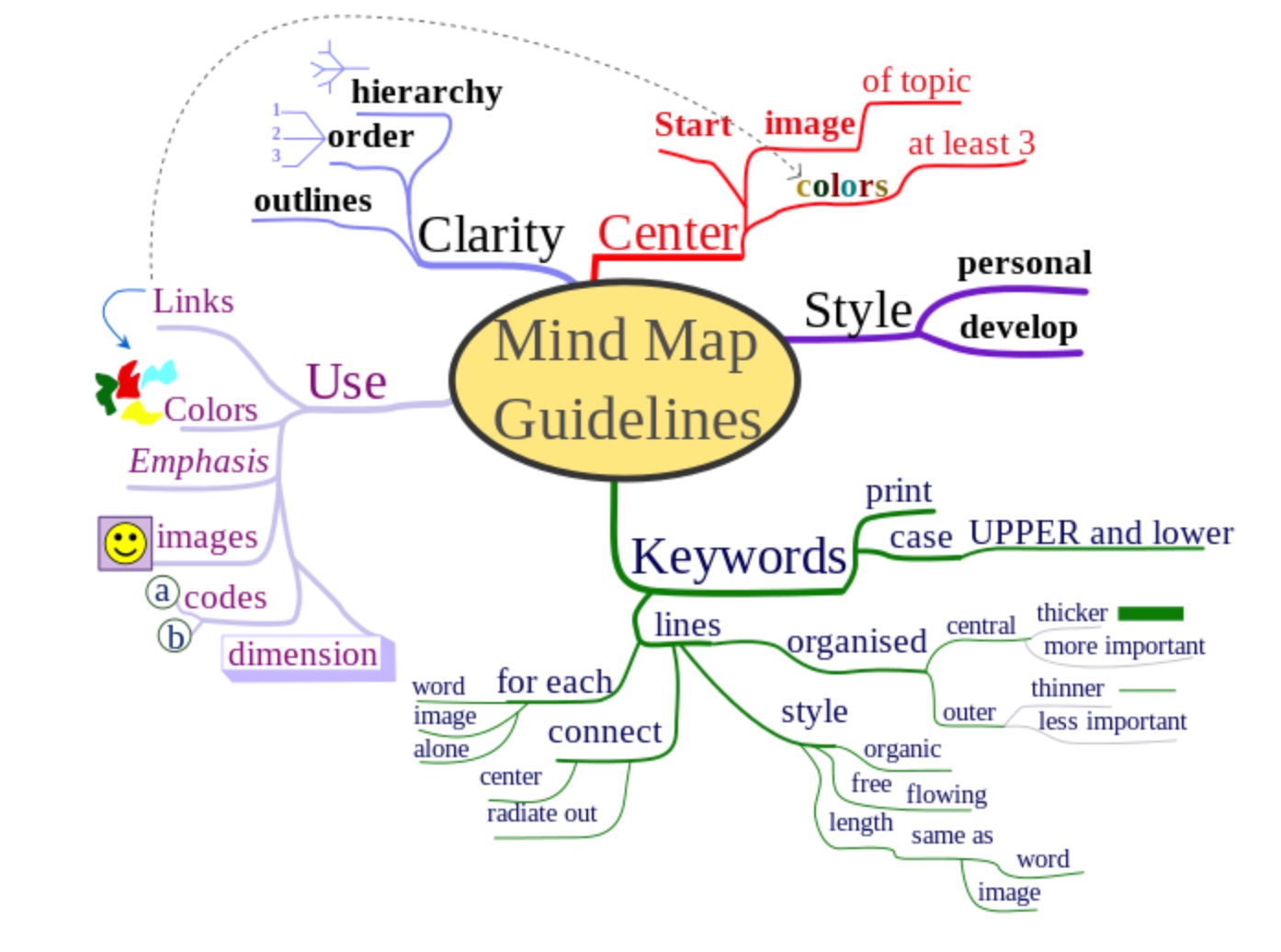
But if you want to start doing things differently you need new thinking tools. Mind mapping software falls within that category. Rather than listing ideas linearly, mind mapping allows you to graphically organize information by starting with a central idea and branching out from there. You create the relationships between concepts and relate them back to the central idea.
According to Wikipedia:
[T]he use of diagrams that visually “map” information using branching and radial maps traces back centuries. These pictorial methods record knowledge and model systems, and have a long history in learning, brainstorming, memory, visual thinking, and problem solving by educators, engineers, psychologists, and others.
And now lawyers. I know colleagues who use mind mapping software to plan examinations for discovery, to lay out the theory of their cases and to strategically outline their business plans. They are excellent for brainstorming, for organizing large amounts of information, to visualize relationships between ideas and for helping to make decisions.
Wikipedia states that mind mapping may be helpful in assisting with memory recall and can improve learning.
Lifehacker (also another fabulous web site for helping you to think differently) has an article listing the 5 best mind mapping applications.
Mind Mapping may be just part of the solution if we are going to look at change and in particular, think differently. As Steve has said, we must embrace it, change it, improve it and look for tools to help make your mark upon it.
David J. Bilinsky, Vancouver BC.
Posted on November 5th, 2015 - Editor: David Bilinsky
—
CPD Tips for the Law Society of Upper Canada
I’ll be tuning into the videocast of Barry Fisher’s 16th Annual Employment Law Summit in a few hours, so I suppose I have CPD on my mind.
Today’s post might be half rant, half tip, but I do have a few suggestions on Ontario’s CPD program for the LSUC that I will take the liberty of outlining:
- As your technology departments are capable of the miracle that brings CPD programmes directly to our video screens in real time, surely they can also develop a simple protocol to automatically post our LSUC CPD hours directly to the LSUC portal once a programme has completed. (Simply place the onus on any lawyers who didn’t attend to correct the record).
- While we are on the topic of the LSUC portal, is it really necessary to spend untold licensee dollars to send reminders by snail mail (in October) to licensees who haven’t yet posted their CPD hours? This vital communication probably could work just as well by email. And save a few dollars and trees along the way.
- I’d be interested in videocast of CPD’s offered in other provinces by other law societies. They’d broaden my perspective. Could some kind of inter-provincial CPD exchange agreement be considered?
- We need to have an on-demand videocast library. The Law Society’s CPD video library is a buried treasure that should be as important a research tool as CanLii. In fact, CPD videos should all be made available via CanLii after a reasonable period of time has passed.
- There is not enough advanced CPD content for senior practitioners.
- It is time for a survey of all licensees as to how well the mandatory CPD programme is meeting actual learning and professional development objectives.
- LSUC shold be more proactive in seeking licensee input on CPD curricula and suggested subject matter.
- LSUC should consider providing training workshops for presenters.
- The LSUC CPD programme is on balance extremely well done and state of the art. It is a real feather in LSUC’s cap, in my view. But there is still much room for making it even better…
(Sorry to readers outside Ontario that this post was a bit Ontario-centric).
– Garry J Wise, Toronto
Posted on October 29th, 2015 - Editor: Garry J. Wise
—