







All Our Tips
Handy Checklist Will Help Prevent Unauthorized Access to Your Gmail Account

In just the last few weeks, I have talked to two lawyers dealing with hacked email accounts. In the past year or so, I have seen frauds perpetrated where a hacker hacked into a client’s email account and waited until the opportune time (just as a real estate deal closed) to send instructions to the lawyer (pretending to be the client) on where to disburse funds; and a situation where a lawyer’s email account was hacked and the hacker, pretending to be a lawyer, sent instructions to a client on where to send funds. In both cases the funds went to the hacker.
A hacked email account is a big problem, especially if it is the account you use for your practice, and it can be time very consuming to deal with a breach of confidential client information and to get your account back. There is no doubt here, an ounce of prevention is worth a pound of cure.
On top of not falling for a phishing scam in the first place (giving your password to the hacker by answering an email that appears to come from someone you know and trust– see this LAWPRO Magazine article for more details on phishing scams and how to avoid them), there are a number of fairly simple steps you can take to help prevent unauthorized access to your Gmail and to secure your account if it was recently compromised. This excellent checklist from Google walks you through these steps. And while the advice here is specific to Google, you can apply most of the steps to other types of email accounts.
Please review this checklist and take the steps to lock-down and protect your Gmail account. Ten or fifteen minutes of work can make your account much more secure and save you hours and hours of unnecessary work.

What Is on Your Bucket List?

♫ Get on your boots and visit the North Pole
Try every sport until you score a goal
Follow the path of a butterfly
Go to Ground Zero and do nothing but cry
We don’t know how much time left we got left in this world
This beautiful world…♫
Lyrics and music by Nelly Furtado, Rodney Roy Jerkins, Rodney Jerkins, recorded by Nelly Furtado.

Having just returned from my summer vacation, I came across an article on Lifehack.org that struck a resonate chord deep within me. The article is entitled: The Ultimate Bucket List: 60 Things You Should Do Before You Die. Perhaps it was the all-too tragic death of Robin Williams. Perhaps it was my visit to Ground Zero this summer. Perhaps it was just the sense that life is passing by all too quickly. I do know that I wished I had written this article as I think that Thomas Mondel has done an excellent job and he should be justifiably proud of what he has crafted.
What is on the list of things that he has compiled? Here is just a sampling:
Forgive the people who treated you poorly. Thomas states that there is nothing more refreshing than to sincerely forgive someone. Just forgive then and move on – it gets rid of the anger and it frees up your mind.
Be curious about people. Thomas observes that the people who are interested in others are the most interesting people themselves. Learn to listen and learn something new from everyone you meet.
Swim Naked. In the best case this is under the crystal clear sky. Yahoo!
Email one of your heroes and Meet up with one of your heroes. Try to reach out to the people who you value or you feel inspired by. As Thomas notes, how awesome would it be if your hero actually responds?
Witness the birth of a child. I totally agree with Thomas – it is kinda magical! Thank you Lauren for being my magical moment!
I hope you read the entire article by clicking here. The time to start on our own bucket list is now…we never know how much time we have left.
-David J. Bilinsky, Vancouver BC.
Find a Pleading Precedent

I like baking. You gather all the ingredients, put them together according to a recipe and then, if all goes well, you share a tasty treat. Starting a legal action is a little bit like baking:
- you start with the facts provided by your client (ingredients)
- you put them together according to accepted rules (recipe)
- you serve your claim on the other parties (share)
The recipe for a claim can be tested with a precedent for a pleading. I was reminded today of how challenging finding a precedent can be. Sources of pleading precedents can be internal to your organization: the KM system, the documents in previous files. Precedents are also published in texts. The best precedents include assistance for why they are written the way they are, and what a user should be careful of.
Many legal texts will have sample documents that could be in an appendix with the ubiquitous title of “Forms”. There are even commercially available sets of forms and precedents. LexisNexis Butterworths has several offerings if you search their catalogue with the work precedents and content from CCH Canadian includes some precedents. A helpful text from Carswell is Bullen & Leake & Jacob’s Canadian Precedents of Pleadings.* Check out the table of contents.
Today’s Tip: Think about how to execute your pleading recipe by looking to precedents.
*Full disclosure: many of my colleagues at Field Law contribute to this work.
Use One or More Commas for a Short Pause When Dialing Phone Number Extensions
If you frequently dial someone who as at extension, it can be frustrating to wait for the main phone number to connect before you can to enter the extension number, if you can even remember it. As Canadians, we frequently have to enter a number to select English or French before we can dial the extension. What a pain!
You can easily avoid this frustration can with a comma or two. Simply enter the main contact number as you normally would, but then add a comma followed by the extension number (e.g., 4165551234,567). The comma causes a pause of about 2 seconds. If you need a longer pause, enter additional commas. You can do this for multiple extension choices (e.g., 4165551234,,1,567). This works on most types of cell phones and smartphones.
Crowdsourcing Tribunal Decision Sources
Updated:
A question and some answers came across the CALL-L listserv this week about sources for BC Utilities Commission Decisions. Like some other tribunals, the commission decisions are not available for searching on CanLII, LexisNexis Quicklaw or Westlaw Next Canada. There is a basic index function on the Commission website, but it was not adequate for the needs of the person posting the question.
Today’s Tip is thanks to the members of the CALL-L list who shared their knowledge with the crowd.
Anne Whelan of Mercer shared British Columbia Utilities Commission Online Document Library – a source that reports it is “currently being reorganized and updated”.
Jennifer McNenly of Fasken Martineau shared this useful tip:
You can try a Google site search on the decisions folder as per my example below. But you should also browse by year prior to 1980. Those early decisions are just referenced and the electronic decision is not actually on the site.
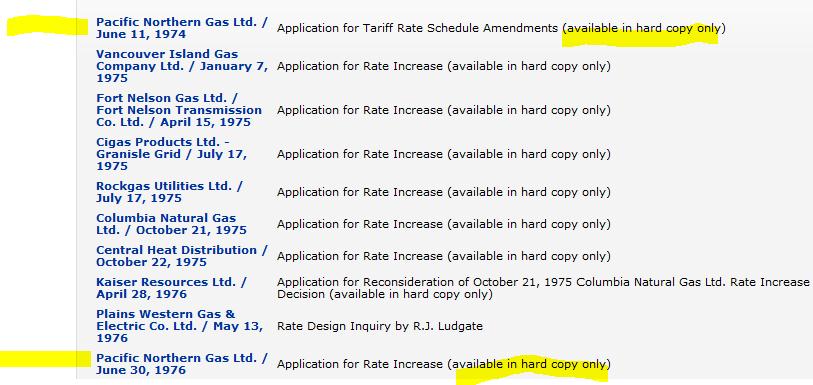
Lists like CALL-L and others are excellent avenues to learn from the experiences of others. Do you crowdsource Sources?
Update Note: I learned at some of the British Columbia Utilities Commission decisions (304 of them at a recent count) ARE available with WestlawNext Canada. Thanks to Carswell Reference Support for adding their information to the crowd!
Reflect Before You Act
Movie enthusiasts may recognize that the title of Today’s Tip is a quote from my personal Disney favourite: Mulan. I much prefer this modern interpretation of the Admonitions Scroll. Reflect before you act is excellent advice for many things, including legal research.
Cathie Best at her Best Guide to Canadian Legal Research agrees that “Plan and organize your research” is the first step in the legal research process. How can your reflect before you act on your legal research question?
Start your research memo by writing the facts as you understand them and then skip to the bottom of you document and work on your “sources consulted” list. Include the textbooks you are going to consult and what you are going to look for in the indices or tables of contents. Include your plan for the terms you will look for in Halsbury’s Laws of Canada and the CED. Write out your search strategy including your search string and plan for narrowing or expanding your results (remember to work broad to narrow for cost effective commercial database searching). Think about legislation that might apply to your issue. Think about which source to look at first – perhaps your firm has a research memo bank.
Happy reflecting.
Use Proper Dimensions to Make Photos Posted on Social Media Profile Pages Look Better
Photos are a major part of the profile pages on all the major social media sites. There are profile photos (usually your picture) and header or cover photos (the big photo that usually appears across the top of your profile or homepage).
As these photos play a big part in making a good impression with people, you want them to look good. But making this happen can be frustrating. Sometimes the photo you post will be scaled to fit in the allotted box with the result that the contents look blurry or distorted, and sometimes parts of a picture are cut off. On other occasions important parts of your cover photo are hidden behind your profile picture.
How do you prevent these problems? It is very easy – simply post photos that match the  dimensions for the particular type of photo you are posting. But every social media site is different – how do you remember all these dimensions? Use the handy infographic posted on the Mainstreethost blog: the Social Media Image Size Cheat Sheet gives you the dimensions for the various photos on the various social media sites. It even gives you the dimensions for the parts of a cover photo that will be hidden behind a profile picture. Before you post a picture, use a photo editor to resize and/or crop it to the appropriate dimensions and it will display exactly the way you want it to.
Commas
Often, I write with too many commas. A comma is a beautiful thing, in fact, all punctuation is necessary for readers to understand a piece of text. Just ask the Associated Press who sent this punctuation-less tweet:
BREAKING: Dutch military plane carrying bodies from Malaysia Airlines Flight 17 crash lands in Eindhoven.
Then there was a clarification:
CLARIFIES: Dutch military plane carrying Malaysia Airlines bodies lands in Eindhoven.
Today’s Tip: Think about your legal research responses. Are you missing a comma?
A Practice Tips Vacation Break
David Bilinsky and I are going to take our own advice about work-life balance, and will thus be taking a short summer break from our Practice Tips posts.
We will return in mid-August with our usual musings each Thursday.
Wishing all our readers a safe and happy summer.
– Garry J. Wise, Toronto (@wiselaw on Twitter)
Do You Need to Read That Document on Paper?
First let me say that I really like reading on screen for business purposes. Second, let me contradict that by complaining about my aged eyes and how I keep pulling my monitors closer to my face. Third, let me tell you how much I enjoy reading novels in print when that is a viable alternative (not traveling, my public library has a print copy without waiting for an inter-library loan). Fourthly, let me give a hat tip to John DiGilio who noted a post on Lawyerist.com that inspired Today’s Tip.
Scientific American looked at some studies comparing paper vs. screen reading and concluded that “when it comes to intensively reading long pieces of plain text, paper and ink may still have the advantage.”
My take on paper vs. screen when doing legal research is totally unscientific. When skimming through research results I like to use the navigation of seeing my terms highlighted, changing the sort order of results and quickly jumping past irrelevant hits to the next document. When digesting the now selected content, if documents are long, I sometimes choose to print and read from paper.
Today’s Tip: be aware of how you interact with text and make conscious decisions about how you need to work.


