







All Our Tips
Quickly Arrange Multiple Windows

Doing legal research increasingly means having multiple windows and applications open. You might be referring to CanLII in one window, the CRA website in another, and that email you’re working on in a third. Some of you might even have two or three screens set up beside each other on your desk!
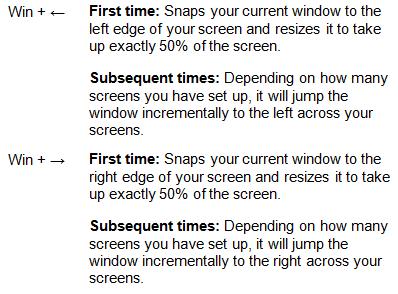
This new normal became 100% more efficient for me when I learned how to use the below four keyboard shortcuts to quickly marshal all my open windows. These first two shortcuts instantly resize your window to take up half of the screen and then snap it to one edge or the other.
These second two shortcuts will maximise or minimise your window. I use them less often than the two shortcuts above.

These shortcuts are compatible with Windows operating systems only. They were introduced with Windows 7 so you’re out of luck if you’re still on Vista! The “Win” key is often found in the bottom left of your keyboard, between Ctrl and Alt.
— Bronwyn Guiton (@BronwynMaye)

Make – and Implement – a Plan

♫ But the plan won’t accomplish anything
If it’s not implemented…♫
Lyrics, music and recorded by Built to Spill.

(image used pursuant to Creative Commons CC0 licence)
There are many questions to ask yourself and to think about before you reach your decision as to whether or not you would like to open a law practice. In talking to other lawyers, they will have some very helpful questions that will be very insightful and provide guidance as to whether you are making the right move or not. Owning a law practice is a huge responsibility, so you want to be very sure of what you are getting yourself into. You want to make sure that you are ready willing and able to do what it takes, and most importantly, you have what it takes to run that legal practice.
Ask yourself – are you are a good decision maker? Part of owning your own business means that you have to be that voice of reason and the ultimate decision maker. The buck, as they say, stops with you. You have to be the one to see that the best interests of your clients are always first and foremost. You also need to do what is best for both your clients, as well as for the practice.
Ask yourself: are you organized enough to run the business? You need many skills including a high degree of organization in order to be successful. This does not mean that you necessarily have to be equipped with those skills yourself. It is quite acceptable to hire someone to do tasks on your behalf, as long as they are going to effectively get the job done. So if that means hiring an extra secretary and an accountant, then so be it. But you are the one doing the management for the practice and as such you are ultimately responsible for everything that happens in your practice.
Ask yourself if you are willing to sacrifice what it takes to properly run your practice? You will be putting in long hours and as a result, have much less of a social life when you are starting a new practice, at least at first. You are going to want to dedicate your time concentrating on your new firm – managing it, marketing it, checking the finances and all that. You need to realize that when a person opens a new law practice, it does take away some of the time that they have with their family and loved ones. You have to be sure that this sacrifice is something that you have thought through, and accept and that your family is willing to make their own sacrifices as well.
Once you have mentally prepared yourself to run a busy law practice, there are more things to think about. You have to organize your office! After carpet and wallpaper combinations are worked out, client seating is considered, office equipment ordered and qualified staff are recruited the legal professional’s office is open for business. Bookkeeping must be done and cheques written.
As time passes, increase in business volume strains the practitioner. Even though managerial ability should be increasing, there is no time to manage effectively. Gone are the days when legal professionals handled every aspect of the day-to-day business. The accountant says business has increased but profits are down. Staff members sometimes do not get along. Information systems do not break out pertinent details of the business. The expensive marketing costs do not seem to be hitting the mark. The community begins to wonder why this educated and apparently capable individual never seems to support enough local projects. At the end of the day, there is very little time for considering the business, let alone family. Often the step overlooked when building a new practice is to develop a practical business plan from the outset.
Planning is perhaps the fundamental function of a manager. It requires understanding the components of a business and how they are interconnected. Planning begins with understanding the value a practitioner brings to their client and how best to satisfy the client’s needs. There is no better use of your time before you open your new practice than planning what it is going to look like, how it is going to operate, how it will be financed, what tools and technologies will you incorporate into your workflows and how will you manage to find time for yourself in order to avoid burnout.
Having a well drafted strategic business plan at hand means that you have a roadmap that governs not only the business direction in which you wish to proceed, it also serves as a governing document, guiding your efforts towards the clients, files and type of practice that you wish to have. It serves as the place where you have listed your business goals (in both qualitative as well as quantitative terms) and when you expect to reach them. It is an analysis of your business from many angles, including how to run the practice (Management), how to reach your chosen markets (Marketing), what systems you will need to make your practice work (Technology) as well as how you expect to be able to raise the necessary capital to start up and run your practice (Finance).
Along the way, you must learn the systems that must be incorporated into your practice to and how to properly run them to ensure that you are practicing professionally, profitably and ethically. You must also decide the legal entity under which you will practice.
Optimally you should do all this planning by crafting a well-thought out business plan before you open your doors. That is foresight. But the plan won’t accomplish anything sitting on the shelf. You must give life to the plan and seek to implement its goals and objectives as well as monitor and evaluate the results of your efforts to make maximum use of your plan.
After all your plan won’t accomplish anything unless it is implemented.
–David J. Bilinsky, Vancouver, BC.
Advice for Associates and Students
You feel nervous about publishing something, right? You should be, a bit – but don’t let it put you off.
Some things to bear in mind:
- get a partner to vet your idea and your draft, for technical accuracy
- defer to the senior person on points of law (unless you can show you’re right), but not always on stylistic matters (as an articling student, I stood my ground when a partner insisted that theirself was a word)
- check whether your firm acts for any party you’re talking about – you don’t want to say anything a client might not like
- be cautious in taking positions on public issues – your firm may represent parties with interests at stake, even if those parties aren’t mentioned specifically in your blog post or update
- humour is good, but be careful; it can backfire
- consider anti-spam legislation (basically, no commercial electronic messages to parties with whom you don’t have an existing business relationship)
- if available, have your marketing or communications people check the formatting of your piece and run a draft by you before publication
On a more positive note:
- write about something that clients will find interesting
- pitch it at a level that will engage, not alienate, your reader
- write plain, understandable prose – not Latinate legal mumbo jumbo (which will alienate your reader)
- explain why this new case or statutory provision (or whatever) is relevant: what does the client need to do, be aware of, avoid?
Now that I think of it, many of these are useful pointers for partners, too.
Now, get writing.
Next time: lose the Latin.
When the Press Comes A’Calling
In the course of your work as a legal professional, you may receive the occasional call from the media, seeking your comments or insights on a recent legal development or issue.
Handling these enquiries with expertise and grace will always be beneficial to you and your practice.
Here are a few tips on working with the media in this context:
- Generally speaking, media enquiries will initially come by email, with the journalist specifying the topic to be covered and asking for your availability to participate in a telephone interview.
- If you wish to participate, don’t delay. Journalists work on very tight deadlines, so an immediate response will always be appreciated. It will also increase the odds that you will be included in the article to be written.
- Do some research before your phone interview. Read up on the topics to be discussed, and ensure that you have the relevant statutes and caselaw at your fingertips during the interview. The more detail and precision you can provide, the more value you will be adding to the article being written.
- Be helpful. Most journalists appreciate it if you provide them with links to source materials by email. Remember, you have been contacted because of your expertise. If you can provide helpful background materials to the journalist, this will make the writer’s job easier, and also make it more likely that you will be called again, next time.
- Speak slowly and clearly during your interview, to give the writer opportunity to accurately record your comments. Pause occasionally, to allow the journalist time to catch up. Ask if you are going too fast, and listen to any cues your interviewer is providing about the pace and content of your comments.
- Be yourself. Be engaging and communicate your enthusiasm about your topic.
- If you are logistically unable to participate in a telephone interview, but still want to contribute, consider sending a comment by email. You never know – your short blurb could be exactly what the journalist needs.
- Always be mindful in your dealings with the press of your duty to maintain client confidentiality. Don’t comment on cases in which you are professionally engaged without your clients’ express permission.
- Also be mindful of your various ethical duties when dealing with the press, with special focus on the legal professional’s overarching duty to foster public confidence in the administration of justice.
- When your telephone interview is finished, always ask the journalist to send you a link to the article being written, once it’s published online.
- Ask that the online version of the article, where possible, include a link to your website.
- If you note an error in the article, once published, don’t hesitate be in contact with the writer to request a correction. This can usually be done expeditiously, particularly with online publications.
- Consider sending a thank you note or follow up email to the journalist involved with feedback about the completed article, and kudos for a job well done.
- Once published, leverage the article in your marketing efforts. Post it to your blog. Tweet and retweet it, and share liberally on social media.
What Is a Limited Revision of an Act?
The Local Government Act, R.S.B.C. 2015, c.1, came into force on January 1, 2016. If you know that the last Revised Statutes of British Columbia were produced in 1996, this citation looks a little confusing. The explanation is that the new Local Government Act is what is known as a limited revision of an act.
British Columbia’s Statute Revision Act allows the government to produce a limited revision of a single act instead of revising all the statutes. Traditionally, British Columbia’s statutes have been revised every 15 years or so, with R.S.B.C. 1996 being the last general revision; it remains to be seen if there will ever be another general revision of the Statutes of British Columbia.
These limited revision acts are cited R.S.B.C. followed by the year of revision (e.g. R.S.B.C. 2015, c.1). Just to confuse things further, British Columbia’s limited revision acts were cited S.B.C. until 2013.
British Columbia is not the only province that can produce a limited revision of an act; several other provinces (e.g. Alberta) have the power to produce a limited revision.
–Susannah Tredwell (@hannasus)
Do Something Different!
♫ So put me on a highway
And show me a sign
And take it to the limit one more time…♫
Lyrics and music: Don Henley, Randy Meisner, Glenn Lewis Frey, Donald Hugh Henley, recorded by The Eagles. Thanks Glenn for all the great music.

(image by Wade M – CC BY-SA 2.0 licence)
This is a new year’s resolution of a different sort. All of us resolve to get healthier, to live better lives and to do better this year than last. How many of us resolve to keep our minds sharp and agile? Here are some suggestions:
- Learn something different: Take a course that is completely removed from anything else that you have done. The more you learn the better your mind learns to rework its neural pathways. Taking on the challenge of the unknown is more beneficial than doing the same thing over and over.
- Start an aerobic exercise: There is a mind-body connection and the fitter the body the fitter the mind. Keeping your cardio system strong can lessen the chance of system health concerns which in turn, reduce the effects that the passage of years take on them mind. Keeping a daily aerobic exercise has been shown to beat depression, increase mental sharpness and bolster the immune system!
- Get enough sleep: Chronic sleep depravation is linked with the build up of proteins in the brain that are linked with reduced learning and cognitive decline.
- Drink your coffee: Studies have shown that two to four coffees a day may decrease the incidence of Alzheimer’s by 30 to 60 percent!
- Eat a healthy diet: There is evidence that brain and heart health may contribute to warding off dementia. You have heard it all before: stick to fruits, veggies, whole grains, healthy fats and a moderate amount of alcohol,
- Use your mind: Don’t resort to a calculator or computer. Do it in your head (you can always check it using the tech). Math strengthens reasoning and problem solving skills.
- Don’t stop learning: Evidence shows that the best classes are those that are both mentally challenging as well as socially demanding. Photography is great here!
- Do puzzles: There is a correlation between doing puzzles and increased scores on mental tests. Hey, it can’t hurt!
- Engage: When in a situation, try to turn on all your senses. Notice scents, tastes, feelings, sounds, sights in situations around you. This activates different areas of your brain at the same time.
- Use your left *(or right)* hand: My father was ambidextrous. For those of us who are not, trying to use your “other” hand challenges your mind and senses!
- Be Positive!: Maintaining a positive attitude not only helps you mentally, it also increases your social skills!
- Be Creative: Take up writing, a musical instrument, poetry, quilting or something that challenges to come up with something original.
- Help Others: No truer statement was ever written when someone said “When you help others, you help yourself”.
- Adjust: As we age, we won’t be running marathons as we used to (or whatever it was that defined your peak). Runners World magazine advised seeking new goals as we age that adjust to our life conditions such as running different runs or seeking new running partners. Redefine what is success to you.
- Give thanks: So many people are caught up in the race of comparing themselves against others. Stop. Take a breath. Now think about what you have and how fortunate you are compared to many others. Practising gratitude can be a very affirmative habit that increases your life happiness and satisfaction.
- Carry a notebook: OK your memory isn’t as good as it used to be. So write things down in a notebook that you carry with you. Albert Einstein said: “Paper is to write things down that we need to remember. Our brains are used to think.”
- Repeat things: When you meet someone new, repeat their name several times in your conversation. This will help you remember their name. Use this for other things you need to remember.
- Meditate: A lawyer that I have known for a very long while sent me a CD with meditation music saying that this was one of the best things he has ever learned. I pass his advice on to you.
- Ask for Help: Who said we need to do it all ourselves? Lawyers don’t want to seem incapable; my advice: give it up. All of us can’t possibly learn everything we need to learn in life. Mentors are worth their weight in gold.
All of us age – that is inevitable. The effects of aging however, are (somewhat) optional. By exercising our mind, we are encouraging it to stretch and in effect, challenging it to take it to the limit one more time.
–David J . Bilinsky, Vancouver, BC.
That and Which
People have trouble with the correct use of that and which.
Writing in 1926, the grammarian H.W. Fowler said the rules are ‘an odd jumble, and plainly show that the language has not been neatly constructed by a master builder’.
Fowler advocated a fairly simple rule (and people who think about these things have largely followed it) – ‘although it would be idle to pretend that it is the practice either of most or of the best writers’ (Fowler again; if you don’t have his Modern English Usage you must buy it now).
That
- use it where the information in the clause that follows is defining
- in other words, what comes after that is essential to the meaning of the sentence and limits it
- example: She gave me a list of books that had influenced her
- not just any old books, but a limited selection as defined by that
- that is restrictive
Which
- use it where there is no particular limitation in the clause that follows
- what comes after which is not essential to the meaning of the sentence
- example: I always buy her books, which have influenced me greatly
- her books, but the fact they have influenced me is merely descriptive
- which is non-restrictive
Ross Guberman, the US legal writing guru, suggests an easy and workable test: ‘Use “which” if you would pause when reading the sentence out loud. If you wouldn’t pause, use that.’
Next: advice for students and associates
Use a Screensaver to Protect Client Confidentiality
 Legal professionals properly place high priority on securing our computer infrastructures to protect client confidentiality.
Our desktop screens, however, are often overlooked, as a source of potential security breaches.
Is your computer screen visible to visitors to your office? Are wandering eyes able to catch a glimpse of confidential information on your desktop?
There’s an easy solution to avoid inadvertent lapses in confidentiality that can happen when screens are exposed.
Use a screensaver to protect the data on your screen.
Whether it’s a built-in screensaver that ships with your operating system, or one of the numerous installables that is available online, there is no shortage of options for hiding your screen when your computer is idle.
If you are marketing-minded, you can use your firm’s logo or other promotional material as a screensaver to hide your screen, while also building your brand.
You can even use your website’s home page or any live web page as your screensaver.
However you choose to do it, use a screensaver to ensure that the data on your desktop screen offers no temptation to people who enter your office, whether they be clients, cleaners or other visitors who pop in for a friendly chat.
Make a Prospective Consolidation
When we’re working with an Act that has had significant amendments passed, but not yet brought into force, I’ll often make a prospective consolidation to help our lawyers advise their clients on forward-looking strategies. Having a prospective consolidation on hand makes work more efficient and it can also reveal new implications for the amendments. I’m going to walk you through how I do this myself and share some lessons I learned along the way.
The method I use, which is described below, makes use of a blackline tool. A blackline tool is an app that compares two similar documents and then highlights any changes. I think the benefit of using a blackline tool as the last step in making a prospective consolidation is that you get to see precisely which words have been amended. Often, amendments are made by repealing and replacing whole sections or sentences as opposed to just changing the few relevant words or phrases. If you run a blackline, you can see where exactly the changes were made. This can reveal the actual intent of an otherwise puzzling amendment.
Shaunna Mireau pointed out the benefits of prospective consolidations in August 2011 here on SLAW Tips. My own experience with prospective consolidations has been in the context of new Acts being significantly amended prior to being brought into force. In BC we had a new Pension Benefits Standards Act passed in 2012, but not brought into force until September 30th, 2015. In the meantime, the 2012 Act was significantly amended in 2014. As a result, between 2014 and September 2015 there was no public consolidation of the new Pension Benefits Standards Act that lawyers could work with that reflected the 2014 amendments.*
Five steps to creating your own prospective consolidation
- Get a clean, current Word version of the of the Act being amended. Save it. Then save a copy of it. (This means you will have two copies of it.)
- Following the amendment instructions in the amending Act, edit one copy of the existing Act you saved in step 1. Save the prospective consolidation document and the unmodified version of the current Act to the same folder.
- Select both document and compare them in whatever app you use to blackline documents. (At our firm we have the Workshare Compare tool handy through the right-click menu.) Make sure that the unmodified version is set as the original or baseline document and the prospective consolidation is set as the new document to compare.
- Save a copy of the blackline output. Double check it for clarity and tweak it if need be. This is your finished product.
Tips for making this work well
- Start with the original Act in single-column native-Word format. By single-column, I mean don’t use the two-column format that bilingual legislation is offered in. By native-Word format, I mean try to start with a Word document or by copying and pasting text from a web page into a Word document. If you convert a PDF to a Word document you’re in for a world of hurt courtesy of all that invisible formatting. (By the way, Alberta’s QP Source Professional, is my go-to for Alberta statutes in Word format.)
- When the blackline app spits out your finished product, I recommend going back in and tweaking anything that looks off. Sometimes this is as simple as deleting a few rogue periods or paragraph marks. However, in other cases it’s actually quicker to go to your original clean copy of the Act, or the prospective consolidation copy, and tweak the problem areas there before re-running the blackline.
- Depending on who you think might see your prospective consolidation, I think it’s worth converting the final product to a PDF and adding either a cover page or a watermark that clearly identifies it as an unofficial consolidation generated within the firm.
— Bronwyn Guiton (@BronwynMaye)
*I do want to give credit to Quickscribe, who, in Spring 2015, put together their own prospective consolidation of the new BC Pension Benefits Standards Act for users before the BC government brought that Act into force. Quickscribe is an independent business doing awesome things with BC (and some federal) legislation!
How to Keep Those New Year Resolutions!
♫ We made our resolution for our brand new year:
No more letting days go by…♫
Lyrics, music and recorded by The Limousines.

So many of us resolve to do things better in the New Year even if we don’t make formal New Year’s Resolutions. Problem is that good intentions die hard. How can you increase your chances for a positive change and outcome? Here are a number of suggestions put forward to increase your chances for a real positive change:
- Start Small: Rome wasn’t built in a day and changes take time. By starting with a small change you can reap the benefits of achievement early and reinforce the knowledge that change is attainable.
- Start with One Goal: If your list is as long as your Christmas gift list, chances are you will get discouraged with the daunting nature of what you have taken on. Change is hard: Don’t overwhelm yourself.
- Slippage is Inevitable: Perfection is an abstract concept. By picking yourself up after a wee break, you can get yourself back on track.
- Choose New Goals: Avoid trying to achieve the goals that you previously set that may not have worked. Giving yourself a fresh goal can be invigorating and empowering.
- Keep Working at It: Change is a process and processes take time. Babies learn to walk by taking tiny steps. But they lead to big things.
- Seek Support: Don’t do it alone. Friends and family can be the positive reinforcement that you need and help get you through a dark spot.
- Reward Yourself: Reward behaviour to celebrate your success!
- Keep Trying: Keep at your new behaviour until it starts becoming part of your routine and personality.
Most of all don’t give up! We all know that change is hard but determination can overcome resistance. You made your resolution for the brand new year; now no more letting days go by!


