







All Our Tips
Delegate to Break Through That Glass Ceiling

Lawyers, you know that if you want your firms to be more efficient and profitable, you need to delegate.
You know that if you want more time with your families and the occasional good night’s sleep, you need to delegate.
You even know that if you want to grow in your role (and to allow others to do the same), you need to delegate.
So, what’s the problem?
Why are lawyers holding back when it comes to delegating?
Lots of possibilities… You’ve had some bad experiences where you ended up doing the work you had delegated yourself, at the 11th hour. You felt exposed as the work returned to you wasn’t up to your standards. You got a little too comfortable in your role as the doer (it happens). You didn’t feel sufficiently secure in your role to mentor others up your level (also happens).
Whatever it was, the result is the same. If you want to break through the glass ceiling, you need to figure out a way to delegate more.
But, how to delegate so it’s worry free and actually delivers on the supposed benefits, well, that is the question:
- Write yourself a new job description. Go ahead. Even if you’re a partner or firm principal. Job descriptions aren’t just for staff. What is it that you’d really like to be focused on that you simply cannot get to? Like rainmaking or strategic planning, to name a few possibilities. Or, maybe, dedicating yourself to a single area of practice or specific type of file that holds your interest.
- Reevalute your team. Do you even have the right talent and skill on staff to do the work you’d like to delegate? If not, put a plan together. Train. Hire. Fire. Do what you need to do to build the firm you envision, rather than just continuing with business as usual.
- Reevaluate your structure. What are your team’s expectations about doing work for others? Is the reporting structure clear… to everyone? If not, you (and anyone else that needs to delegate) will be set up for awkwardness and possibly tension. Instead of assigning work to the most appropriate individual, you’ll be asking for favours from whoever happens to be available.
- Learn how to delegate. It’s an art, from what you assign, to whom you assign it to, the briefing you provide at the outset, the guidance you provide along the way and the milestones you set in place. Seek advice and coaching on how to delegate (or how to be delegated to) from a qualified business consultant.
- Stop seeing lawyers that run firms as simply senior lawyers. You’re management. That means managing – staff, clients, files… Embracing that reality is the first step towards getting through the learning curve and setting up the systems and processes to help everyone thrive in their roles.
And one final piece of advice. Once you get all that right, don’t take back what you delegate.
Be aware that when you tell someone to leave a file with you for your comments or wait for additional information…, you’re taking back the work you delegated. And the ‘delegated’ is twiddling thumbs waiting (and hoping) that it’ll come back. Just like a boomerang.
So, this week’s tip, delegate more. Besides the improved wellbeing of the practice and your personal quality of life, you might be surprised at how much you enjoy expanding your collaboration and partnership with the rest of the team.
—
For more on the delegation process see SlawTip’s earlier post on this topic:
Delegate, Don’t Abdicate, a guest post from Rachel Spence, a law clerk with Wise Law Office
And Toronto Marketing Blog, for my post: Stop taking back what you delegate!
-Sandra Bekhor, Toronto

Capitals, Defined Terms and Acronyms

Go easy with these.
Capitals
Where there are too many words with capital letters, the visual effect is jarring and over-emphatic. Don’t succumb to what Bryan Garner calls ‘the unfortunate tendency toward contagious capitalization’ in legal writing.
Above all, Resist the Temptation to Capitalise Important Words, which can look a bit Winnie the Pooh (‘I have been Foolish and Deluded … and I am a Bear of No Brain at All.’).
By all means say ‘the Government of Canada issued bonds’, but when the reference is more general, you can lose the upper case: ‘the government wants to extend tax breaks to …’ – or ‘the federal government’. Similarly, ‘The Province entered into an agreement with…’ but ‘former president Bill Clinton’. Except as a defined term in a legal document, ‘the board, ‘the company’, ‘the chair’.
Litigators take note: outside the context of a factum or other formal document, you really don’t need to stick a capital on every instance of ‘judge’, ‘justice’ and ‘court’. Do refer to ‘Justice Cromwell’, but in your legal update it’s cleaner and more modern to write ‘The judge ordered …’ and ‘The court decided…’ A capital letter in these cases is not the sign of respect it is sometimes said to be (‘the Judge is an idiot’? – or perhaps that’s ‘Idiot’); it’s a just hold-over from the days when all nouns were capitalised in English. Nouns still take the upper case in German, but the practice began to fall out of general usage in all but lawyers’ English after about 1750.
I do like the official use of a capital T for ‘Her Majesty The Queen’, however. But you’ll need to convince me why ‘internet’ needs an upper-case I.
Oh, and no capital after a colon (unless the word would have one anyway, like Canada). The Globe & Mail does this, and it irritates me. The colon doesn’t indicate the end of a sentence: it marks the pause before ‘delivering the goods that have been invoiced in the preceding words’ (Fowler, Modern English Usage).
Defined terms
A related issue.
Remember that if you’re writing a client-friendly blog post or article, a thicket of defined terms is off-putting, and often unnecessary. You aren’t drafting a contract that needs to have airtight, interlocking terminology.
If Alvin Chang is suing Jonathan Cohen, and there are no other Changs or Cohens in the picture, please don’t do this: The plaintiff, Alvin Chang (“Chang”), alleges that the defendant, Jonathan Cohen (“Cohen”), … If the dispute with Cohen is about a contract, and one contract only, there is no need to define it as (the “Agreement”). Just call it the contract or the agreement. Heck, mix things up and call it both; it will add a little variety.
Acronyms
Acronyms can be useful, but they become annoying if overdone – or even impenetrable. Examples from Lexology:
When your brand name is a claim—NAD cleans and straightens without support from advertiser
Venable LLP
There is lore that the beauty industry does not challenge itself sufficiently before NAD, and for this reason NAD brings more monitoring challenges…
CFPB proposes to delay TRID to October 3, 2015
Maurice Wutscher LLP
As referenced in our prior update, the federal Consumer Financial Protection Bureau (CFPB) issued a proposed rule to change the effective date for…
If you’re an advertising insider or know beauty industry lore, you may also know that NAD is the National Advertising Division of the US ad industry’s self-regulatory system, administered by the Council of Better Business Bureaus – but would a law firm’s client know that (or even an ad agency’s)? And while someone in financial services may recognise CFPB, I’m not so sure about TRID. It turns out it stands for the TILA-RESPA Integrated Disclosure rule – whatever that is. Wouldn’t it be better to describe it as the ‘”know before you owe” rule for consumer lending transactions’? (And don’t use reference as a verb.)
Next up: think of your reader
Welcome the New Tipsters…
♫ Go, go, go New Justice Team
Go team, go team, team team team
Who’s that newest Justice Team…♫
Music by Christopher Tyng, Lyrics by Ron Weiner, recorded by The New Justice Team.

Changes are coming to SlawTips! I would like to introduce our new enhanced team of practice tipsters.
Our team will now include:
- Michael McCubbin, Vancouver
- Andrea Cannavina, New York City
- Stacey Gerrard, Halifax
- Sandra Bekhor, Toronto
- Mark Morris, Toronto
- Elizabeth Mah, Vancouver
- Bjorn (Barney) Christianson, Portage la Prairie
- Ian Hu, Toronto
who will be joining Garry Wise and I in posting all the best tips that we can think of to assist you in practising law.
A little about each of our newest team members:
Michael McCubbin:

Michael owns and operates a small firm with a broad focus on civil and administrative litigation and corporate-commercial law. In recent years, he has increasingly focused on regulatory compliance and risk management for businesses. He has run a paperless practice since its inception in the fall of 2011 and is a regular speaker on legal technology matters.
Michael says that the things that he would like to write about are:
- Integration of practice technology with hearing preparation
- Adopting business practices from outside the legal profession to improve service quality and efficiency
- Remote working arrangements and business/employment structures
- Jurisprudential “catch up” with technology (Equustek Solutions?!)
Andrea Cannavina:

Andrea Cannavina is the CEO and founder of LegalTypist, Inc. the premiere legal transcription, secretarial and administrative service to US based law firms. She helps attorneys and other service based professionals upgrade their business processes to digital in order to get more done with less – less cost, less time and less stress!
An executive legal assistant, Andrea worked in various sized law firms in and around New York City since starting her career in the 1980’s. Andrea has been a professional legal secretary/ assistant for 20+ years and a Virtual Assistant since 2001. ALL Andrea has focused on since opening her virtual practice is help lawyers and other legal professionals upgrade to digital in all the right places.
Her site, LegalTypist.com specializes in providing experienced cyber secretarial services and has serviced law firms of 1-120+ attorneys along with private investigative firms, insurance agencies and other high volume reporting companies.
After putting together LegalTypist’s tech, people and processes, and speaking with 100’s of attorneys, law firm administrators and legal IT types, Andrea expanded her focus in order to help any size practice. In 2005, her site LawFirmSolutions.com went live to help larger firms looking to incorporate the web into their processes and solos looking for secure technology to use in their day-to-day practice.
Andrea is passionate about digital security and has frequently presented on this and other topics, including e-mail overload and etiquette, website how to’s, projecting a professional image and upgrading to a digital workflow.
Born in Hamilton, Ontario, Canada, Andrea’s family moved to Long Island, New York during her teenage years. She graduated from Glen Cove High School, attended Nassau Community College and SUNY Old Westbury.
Andrea lives and works in Hicksville, New York, is married with two children, and has Rosie, the office dog as her constant companion. Along with making things work, Andrea enjoys camping, cooking and spending time with family and friends in the great outdoors.
Andrea says that she would like to write about:
- Systems, processes and organization of the office – people and tech.
- Law practice management.
- Getting Things Done.
- What’s it’s like being on the other side of the desk.
Stacey Gerrard:

Stacey Gerrard is a practicing member of the Nova Scotia Barristers’ Society and joined the Lawyers’ Insurance Association of Nova Scotia (LIANS) as LIANS Counsel in 2010. Graduating from the University of Ottawa’s National Program with bilingual degrees in both Common and Civil Law, Stacey relocated back to Halifax and pursued her interest in civil litigation first in a private firm and then with each of the Federal and Provincial governments until joining the Nova Scotia Barristers’ Society in 2008. In her current role, Stacey manages and handles assigned claims or potential claims against insured lawyers and provides professional support to the Risk and Practice Management program.
Sandra Bekhor:

Sandra Bekhor, MBA, BSc, is a professional practice consultant focused on growing and enhancing Canadian, small to mid-sized law, architecture, accounting, consulting, healthcare and other professional practices. A senior marketing professional since 1992,
Sandra has helped take leading entrepreneurs to a new level in the global marketplace with the introduction of business and marketing strategies as well as the enhancement of company structure and process. In September 2005, Sandra founded Bekhor Management with the intent to apply this acumen in a manner that would enable professionals to realize their vision for their practices.
Sandra Bekhor speaks, teaches and writes about practice development for various professional associations and publications, including: The Lawyers Weekly, The Bottom Line, Investment Executive, Interior Designers of Canada (IDC), Ontario Association of Architects (OAA), Ontario Association of Naturopathic Doctors (OAND), Ontario Society of Chiropodists (OSC) and Canadian Vet.
Sandra says that what she would like to write about, basically, her area of expertise, would fall into these categories:
- Marketing
- Branding
- Online marketing
- Offline marketing
- Firm level marketing
- Personal marketing
- Coaching
- Management
- Planning -strategic plans, succession plans, retreats, marketing plans
- Performance management
- Human resources management
- Partner / management meetings
- Communication
- Delegation
- Leadership
- Coaching
Mark Morris:

Mark began his career working as the Attorney General of Ontario’s Senior Policy Advisor. Following that, Mark founded Slatewood Retail Advisors, a retail consulting firm primarily focused on the restaurant and apparel market space. In that capacity, Mark transformed small local brands into national chain operations and worked to assist growing international businesses with their legal franchise work, their core branding and their operational workflows.
Presently, Mark is a co-founder of Axess Law, one of Canada’s leading retail law firms with 10 locations in the GTA. Last month, Axess Law was selected as one of the Top 5 Canadian Innovative Law Firms by the Financial Times newspaper.
Mark frequently lectures on Real Estate law and regularly teaches Real Estate Law Courses at the Ontario Real Estate College. In 2014, Mark was selected as one of Canada’s Top 25 Most Influential Lawyers and was recognized as one of the top 5 Legal Change Makers as rated by Canadian Lawyer magazine.
Mark was called to the Ontario bar in 2002 and has an M.B.A. from the Rotman School of Management, a Law Degree from McGill University and a B.A. from the University of Toronto.
Mark says he likes writing about how Law is changing as we move towards a volume based model of service delivery and about the new entrants that are making their mark on the practice. On a purely legal level, he likes writing about consumer based legal services (developments in real property conveyance, wills etc) and ways that those changes affect consumers.
Elizabeth Mah:

Elizabeth Mah is the owner of Paperclip Law, a different kind of law firm that helps families and businesses make the best (and biggest) non-litigation decisions of their lives. In her life before her 2 little girls, she enjoyed cooking and eating hot meals, reading and running without interruption, and throwing darts at a map and then travelling to them.
Elizabeth says that since having her 2 little girls, she is most interested in:
- Time efficiency: in making my (and the team’s) time the most effective and productive that it can be
- Business development/networking
- Firm administration and strategy
Bjorn (Barney) Christianson:

Bjorn (Barney) Christianson is the managing partner of the Christianson TDS offices in Portage la Prairie, MacGregor and Gladstone, offices which have operated with the Christianson name since 1970. His current practice is focused principally on transactional matters in the areas of Farm Real Estate, Corporate, Commercial, Estates, Municipal Law, and litigation relating to those matters.
Bjorn frequently presents on practice management and office technology topics; some of the victims include the Law Society of Manitoba’s CPLED and MCPD programs, the Law Society of Upper Canada SSF Conference, the Lawyers Insurance Association of Nova Scotia, the Manitoba, Central and Western Manitoba Bar Associations, the CBA’s Skilled Lawyer Series, and the ABA TechShow. He provides practice management advice to the members of the Law Society of Manitoba in his spare time. Twitter @Bjornqc
Barney says that the topics that he finds interesting and wishes to write about are:
- time management (many sub-topics)
- creating impressions for clients
- managing expectations
- civility
- importance of clarity in emails
- breaking bad news
- blunt a.o.t nice (and therefore vague)
- planning to buy and replace tech
- staffing issues
- sharpening your axe
- anything to do with running a law office.
Barney has named himself as the curmudgeon of the group; I am not quite so sure about that but I am looking forward to his wise postings!
Ian Hu:

As the face of Claims Prevention and practicePRO at LAWPRO Ian speaks, writes and blogs about practice management, claims prevention and lawyering issues. His mandate is to help lawyers succeed in the practice of law and avoid malpractice claims. Having had experience in private practice under his belt with various sizes of firms, Ian has seen some of the trials and tribulations lawyers go through.
As a former Vice President of the Federation of Asian Canadian Lawyers he has mentored young lawyers and advocated for hundreds of lawyers and students as a group. Ian also has an interest in promoting diversity in the profession and has sat on various advocacy committees.
Ian tells me that the things he is interested in writing about are:
- cognitive bias
- happiness
- new and young lawyers issues (being a professional, building career, soft skills, survival tips, managing time, etc.)
Of course Garry Wise and I will also be continuing as contributing authors and editors to this amazing team of thoughtful minds. I am very excited about this new phase in SlawTips and I (and I believe I can speak for Garry as well) look forward to seeing the thoughts, ideas and tips from our New Justice Team!
-David J. Bilinsky, Editor, Vancouver BC.
Use LexBox for Case Law Monitoring on CanLII
In 2011 Shaunna Mireau wrote about the usefulness of CanLII as a monitoring tool for the latest decisions in an area of law. I’m updating that tip by highlighting the value added by LexBox for this sort of CanLII monitoring.
As Shaunna wrote, the basic approach to using CanLII for decision monitoring is a quick three step process.
- Compose a search that will retrieve the type of decisions you’re looking to monitor for.
- Sort your results by “most recent” rather than “by relevance”.
- Click the RSS button and copy and paste the provided URL into your feed reader of choice. (I like Feedly, but Outlook has RSS capabilities too.)
The only issue with this approach however is that CanLII RSS feeds have a 1-year expiry date built into them. For example, below is a CanLII RSS URL for a search of all Alberta decisions about contaminated sites:
http://www.canlii.org/en/search/rssSearch.do?rssExpiryDate=2017-02-28&type=decision&jId
=ab&sort=decisionDate&text=contaminated20%2F5%20
(site%20OR%20soil%20OR%20property)&page=1
That expiry date means your new RSS feed will actually stop delivering results after one year. (This is a normal bandwidth management practice on CanLII’s part – no knock on them!) So, what is the solution for long term case law monitoring?
I’ve turned to LexBox because it uses the CanLII API itself so that saved searches never expire. Just install their Chrome extension and then use the LexBox “Set up alert feed” option to save your CanLII search for long term monitoring.
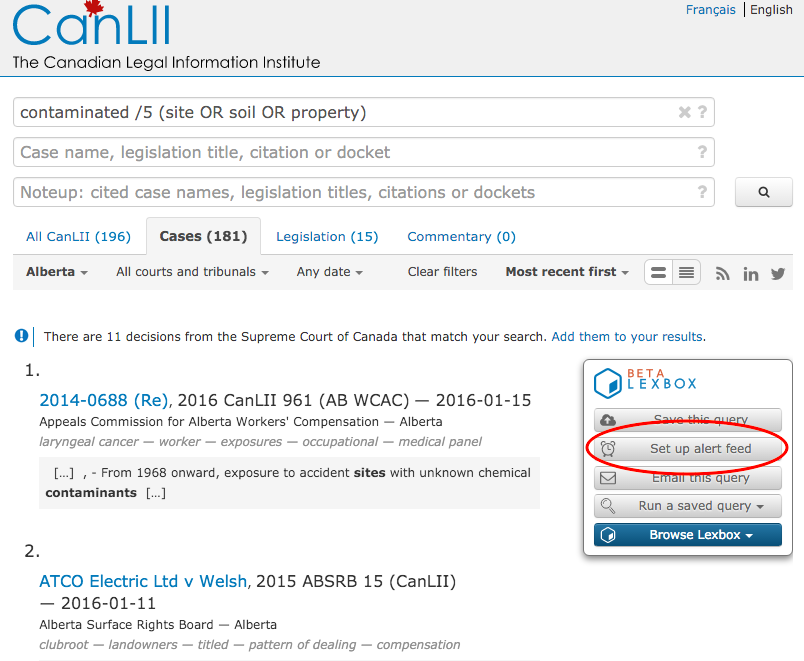
A big high five to Montreal’s Lexum for the development of LexBox! It’s a tool of many uses and this tip covers just one of the ways I leverage it on a daily basis. If you’re interested in learning more about LexBox, Nate Russell wrote a longer SLAW article about it in July 2015.
— Bronwyn Guiton (@BronwynMaye)
Should You Bother With Social Media Marketing?
Most lawyers have a profile on LinkedIn and possible one or two other social media sites. Some have made a great success of it. But many aren’t really sure what they’re doing there. So, they pop in once in a while, join some groups, post some news and share some articles, all to try and garner a bit of attention for their firms. They may even have encouraged their staff to do the same.
All the while, that little voice inside their head is asking them why they bother at all. It just seems to be such a waste of time.
And, I’m not going to lie to you. Often it is.
But, don’t blame the site. That’s like going to a networking dinner, speed walking the room in five minutes flat, handing out a deck of your business cards and then leaving because it was a bad event. Well, did you find out who was there? Did you talk to anyone? And, more importantly, did you give them a chance to talk to you?
So, today’s tip is to decide once and for all if social media marketing is a waste of your time. If it is, then stop second guessing yourself. Get on with it and focus your marketing efforts elsewhere. If it isn’t, then get serious. Just as you would for any other aspect of your practice, develop a plan to win… which may just include the need to bring on professionals for strategic advice.
To get you started, here are five steps that break this tip into manageable steps:
1. Assess where you are today. What percentage of your market is on social media? Have you connected with them? Has your team? In particular, take a close look at those individuals that you’d like to build your practice with – whether they be prospective clients, clients you’d like to keep or referrers that have been particularly supportive.
2. Find out what your target market is doing online. Are they participating in discussions? Joining groups? Posting content? What do they respond to? Do they respond to you and your firm?
3. Find out if your competitors are online. Do their posts get any traction? With whom? Why or why not?
4. Take an objective view of your firm’s social media presence, including your own. How do your profiles read? Where do they land on the spectrum, from compelling advertisement to tax form that answers questions as accurately – and dryly – as possible?
5. Be honest. Are you listening? You know the old adage, ‘we have two ears and one mouth, so we can listen twice as much as we speak’? Well here’s how it translates for social media (and I wish I knew you wrote this!!), ‘we have two eyes and one mouse, so we can read twice as much as we write’. How much do you read what others post? How much do you respond to them? What have you been posting? Would you respond?
So, now you know who is out there, whether you wish to build or pursue those relationships and how well you’ve fared to date.
Whether social media marketing has been a big waste of time to date, isn’t really the question after all, is it? If you’ve figured out how to size up the opportunity it offers your firm, the real question is, what are you going to do about it?
Banish Business Jargon
This could be a long one, but I’ll restrain myself as much as possible. And I admit, not all of these are strictly writing tips.
Many aspects of the working day are, well, kind of boring. In response, people in business seem to want to jazz up the English language – but the result , more often than not, is a collection of expressions that were often bizarre to start with and hackneyed soon after.
If everyone is using them, you don’t want to. Instead, dazzle your reader (or listener) with language that is clear, precise and original.
In the world of business jargon, some patterns emerge (my commentary in italics).
Metaphors that were once vivid
‘Once’ being the operative word – they are now just clichés.
Examples:
- drill down, suit up, deep dive, high-level, circle back, run it up the flagpole, think outside the box, push the envelope [so it falls off the desk?], open the kimono [racist, sexist, more than faintly creepy], moving parts, take if offline, bring me up to speed, dial it back, drink the Kool-aid, patch me in, walk you through it, take-aways, bandwidth, next steps, optics, herding cats, on the same page, in the loop, close the loop, bring to the table, heads-up, heavy lifting, paradigm shift, special sauce, secret sauce, connect the dots, back of a napkin, grow the business, ducks in a row, boil the ocean, window of opportunity, peel the onion, reinvent the wheel, hit the ground running, pain-point, touch-point, point-person, space [as in ‘the banking space’; just say ‘banking’], take it to the next level, gain traction, move the needle, trial balloon, hill to die on, at the end of the day, the devil is in the details, game-changer, touch base [actually, all sports analogies], fall through the cracks, low-hanging fruit, buy-in, value-add, value proposition, reach out [you didn’t reach out; you just e-mailed], view from 30,000 feet
Verbs that aren’t (or shouldn’t be) verbs
Examples:
- reference [and ‘above-referenced’ is an abomination worthy of the sixth circle of hell], leverage, trial, action, incent, liaise [like ‘incent’, not even a word], impact [except in a dental sense; probably rendered a verb in more general use because people can’t figure out the difference between ‘affect’ and ‘effect’], language [ugh], plain-language [double ugh], task, repurpose, scope, whiteboard
Weird use of nouns
- learnings [never; nor should you talk about ‘a learning’], trainings [ditto], deliverable [adjective not noun, and not to be pluralised], ask [a verb that isn’t a noun], spend [ditto; you mean ‘cost’, ‘expenditure’ or ‘spending’], value-add
Noun-accumulation
- change-management, process-improvement, quality assurance, business process outsourcing, mission statement, thought-leader …
Meaningless platitudes
- going forward [are we ever likely to go back in time?]
- it is what it is [well, yes]
- solution [in the IT sense, really just a product or service; and often a ‘solution’ in search of a problem anyway]
- functionality [instead of ‘it has these functionalities’, why not just say ‘it does x, y and z’?]
- core competencies [are we interested in peripheral ones? just say ‘job requirements’ or ‘skills’ – and not ‘skill set’]
Awful adjectives
- key [let’s leverage our key learnings! no, let’s not], core, robust [fine for coffee or red wine, but not regulatory compliance], major, granular, iconic [please stop using this word, especially when describing things that aren’t images], seamless, proactive, impactful [um, how about ‘effective’?], high-level [which just means ‘superficial because I couldn’t be bothered to think about it’]
Next time: capitals, defined terms and acronyms
Can Lawyers Be Innovative?
♫ I know that something has changed
Never felt this way
I know it for real
This could be the start
Of something new…♫
Music and lyrics by: Matthew Gerrard, Robbie Nevil, recorded by Vanessa Hudgens.

(Photo: CC BY-SA 3.0)
The American Bar Journal on April 1, 2015 posted an article on “100 Innovations in Law” by Jason Krause. It is an interesting review (admittedly from an American perspective) of how law has changed over the last 100 years or so. It makes for an intriguing read, but with all due respect to the author, I would list most of the innovations as evolutionary innovation rather than disruptive innovation. I love Twitter, for example, but I wouldn’t necessarily say that it has proven to be highly disruptive on the legal profession. Even LegalZoom.com hasn’t really opened up new markets; it may have made more services affordable to more people but at least so far I don’t see it having a hugely disruptive effect on the profession.
Why is innovation so hard in Law? Many factors can be cited here, such as law is a very conservative profession, that lawyers are not risk-takers, that lawyers have been taught to rely on precedent (old lawyer joke: “The Managing Partner wants the firm to be innovative, to do things differently” to which the Management Committee asks: “Well, who else is doing it?”) and the like. But the true story is that innovation in most professions is difficult. In fact it may be more difficult in law than other professions due to the structure of law firms.
My friend Jordan Furlong put it this way in an article entitled “Why Lawyers Don’t Innovate“:
So when managing partners ask me, “How can I get my lawyers to change?” I have to respond: You can’t make your lawyers do anything they don’t want to do. They’ll do something only if they decide they want to do it, and they’ll want to do it if encouraged by those they like, respect and trust. In a number of law firms, I’m sorry to report, building a culture of “like, respect and trust” among lawyers can be considerably more difficult than getting lawyers to adopt a new innovation. It requires a level of effort and openness and generosity that many lawyers these days feel they can’t afford. But I’m coming to think it’s the key to successful, long-term, sustainable law firm innovation. And it can be done.
I think that really the Fundamental Attribution Error is at play here. Wikipedia states:
[T]he fundamental attribution error, also known as the correspondence bias or attribution effect, is the tendency for people to place an undue emphasis on internal characteristics (personality) to explain someone else’s behavior in a given situation rather than considering the situation’s external factors.
In other words, lawyers are reluctant to innovate since the system in which they operate (the modern law firm) does not create a situation of trust that fosters innovation. They behave as they do since that is a rational response to the culture inside law firms.
I have had the great good fortune to be part of a small group tour of Google and Facebook’s campuses in Palo Alto California. There is no question that innovation is almost palpable in the air at these locations. They have crafted an environment where innovative thinking is expected and fostered.
If we truly want lawyers and law firms to be innovative, we need to change the culture. We need to know that when we enter an innovative firm, we all know that something has changed, that this could be the start of something new…
-David J. Bilinsky, Vancouver, BC.
Use a Concordance
When looking at legislation it is sometimes helpful to know if there are similar provisions in other provinces. Rather than reading through each and every statute to check for equivalent provisions, it is much faster to use a concordance.
The trick is finding a concordance for a specific act. While concordances don’t exist for all acts, they do exist for a significant number of them. Publishers often include concordances in consolidated legislation. For example, LexisNexis’s Consolidated Canada Business Corporations Act & Commentary concords the Canada Business Corporations Act with all the provincial and territorial business corporations acts.
Concordances also exist between old and new versions of legislation. For example Quickscribe includes a concordance between British Columbia’s Companies Act and Business Corporations Act (which replaced the Companies Act) in its BC Business Corporations Legislation Manual.
In addition to concordances produced by commercial publishers, governments often produce a concordance between old and new legislation when the subject is important enough. For example British Columbia provides a concordance between the Local Government Act and the Community Charter.
–Susannah Tredwell (@hannasus)
The Dash
♫ This is the end, beautiful friend
This is the end, my only friend, the end..♫
Lyrics and music by: Bruce Franklin, Eric Wagner, Rick J. Wartell, recorded by The Doors.

(© Copyright Peter Ward and licensed for reuse under this Creative Commons Licence)
Garry Wise, my co-author in our SlawTips.ca weekly column, had his mother pass away this past weekend. Extending condolences and sharing his grief is only natural; but it started me thinking about whether there were anything we can take away from the grief and try to find meaning in the loss.
Another friend of mine stated that lives are represented by the dash that appears between someone’s birthdate and the day they passed away, as in [1930] – [2016]. Entire lives, loves, joys, marriages, births, heartbreak are contained in that dash. When someone close to you passes away, can you learn something from the grief? Marsha Tousley, RN, MS, FT, DCC in an article entitled “Finding Meaning in Your Loss” stated that there are lessons to be learned from grief. She stated:
Losing someone you love teaches you to:
- Stop, examine and appreciate what really matters, what’s important, what’s truly valuable in life.
- Live fully in the present, knowing that the past is gone and the future is not yet.
Appreciate the value and wonder of every precious moment, without taking them for granted. - Accept the freedom and joy of spontaneity, to play, to relax and to have fun.
Find valuable insights buried in the give and take of daily life, to slow down, daydream and fantasize. - Simplify your life, so you have more time and energy to share with those you love.
Accept what’s happened to you, roll with the changes and keep on growing, believing that you’ll make it. - Be patient with yourself, allowing the grieving process to happen in whatever way it will.
- Keep and develop your connections with others, knowing that you are not alone.
- Share your thoughts and feelings with others openly and honestly, and sooner rather than later.
- Rethink your attitude toward death as a natural part of the cycle of life.
- Be grateful for the love you shared, however briefly, and appreciate what you have left.
- Define yourself as a survivor rather than a victim.
- Share what you’ve learned with others. At some point in your grieving process, you may feel the need to channel your pain, as well as the time and energy once devoted to your relationship with your loved one, into something productive and meaningful. As one who truly understands the grieving process, you may feel ready to reach out to others who are suffering the pain of loss. Once you’ve found your own way through grief, you will have a great deal to share with other grievers: you can identify with their struggles, empathize with their sorrows and doubts, and offer valuable information and support.
Joel Readence writing in The HuffPost on “Death, Dying and Finding Meaning in Loss” stated:
For those of us left behind, it’s important we ask ourselves what our loved ones would want for us after they die. Would they want us drowning in the grief and despair of their loss, or would they want us to mourn, make peace with and move past their deaths? We also need to remember our time here is limited. We need to stop putting off until tomorrow, those things that will add value and meaning to our lives today. Don’t let fear of failure, success or judgment by others keep you from realizing your full potential. Give yourself permission to be all that you can be and unapologetically move in the direction of your dreams.
When someone near and dear to us reaches that final end point, realize that we still have some time left. The passing of another can be used to find meaning and to push beyond the pain to find greater value in our lives.
Lose the Latin
Bryan Garner, editor of Black’s Law Dictionary and a legal writing expert, recently blogged on the exciting topic of when italics should be used for Latin words and phrases and when they can be in roman (plain) type. It must have been a slow day in the blogosphere.
His ‘fuzzy rule’ is that you can skip the italics when the word has become fully naturalised into English. So, ‘habeas corpus’ and ‘prima facie’, but ‘sensu stricto‘ and ‘in pari materia‘.
In a waspish mood, I left a comment on Garner’s blog, asking whether it wouldn’t be better to write ‘strictly speaking’ and ‘on the same subject’ for the last two of those, since our clients don’t generally converse in Latin.
Mr Garner doesn’t seem to have liked the comment, because it is still ‘awaiting moderation’ months later – but I stand by it.
If you’re acting for the Vatican or writing for an audience of learned monks, Latin is fine. Otherwise, use it only when it’s absolutely unavoidable or so widely understood that it doesn’t look like a dead, foreign language.
Lawyerly use of Latin has its pitfalls too, if you get things wrong. US lawyers use scienter as a noun (‘degree of knowledge that makes a person legally responsible for the consequences of his or her act or omission; the fact of an act’s having been done knowingly, esp. as a ground for civil damages or criminal punishment’: Black’s Law Dictionary, ed. B. Garner). But scienter is really an adverb (‘knowingly’ or ‘skilfully, expertly’).
Better to stick to the language you and your readers know than to try looking all edjumicated.
Next week: banish business jargon


