







All Our Tips
Finding Unconsolidated Legislation

One challenge with legislative research is when you need to find an older act that, although still in force, has not been included in the last statute revision. The most obvious examples of this are private acts, but there are other pieces of legislation that fall into this category.
If you are looking for an older federal act and cannot find it in the 1985 revision you should check the Table of Private Acts and the Table of Public Statutes and Responsible Ministers. The Table of Public Statutes includes “a certain number of public Acts, passed before January 1, 1985, that were not consolidated in the Revised Statutes of Canada, 1927, 1952, 1970 or 1985.” For example, you can see that the Canada Shipping Act, R.S.C. 1970, c. S-9 is listed in the Table of Public Statutes, despite not having been consolidated since 1970.
British Columbia produces a Table of Private, Special and Local Acts and Unconsolidated Public Acts that lists all private and other unconsolidated acts along with their amendments. Most other provinces produce similar tables, e.g. Ontario’s table of Private Statutes.
The next step is to find the full text of the act as it currently reads. In some cases you may find you have to consolidate the act yourself using the original act and its amendments. In others you may find the jurisdiction already provides a consolidated version. For example British Columbia provides consolidations of a number of private acts.

Cashflow 101: Getting Out From Under the Lifestyle Trap

“Measure Cash flow by how much you keep not how much you earn,” Lifehacker 09/08/2014
Lawyers have a notorious reputation for appreciating the finer things in life. High end cars, vacations, a beautiful home in a desirable location, designer clothing and other luxury items are often some of the perks lawyers associate with being successful in their profession.
Unfortunately many lawyers often do not realize what their lifestyle is costing them. Very few track their spending to see if the money being spent is actually in line with their priorities. I encourage you to take a closer look at your spending in order to hone in on your values. Ask yourself, does my spending reflect my priorities; am I spending most of the income I earn? The truth is, if you do not have a sense of where your money is going, you are likely to spend more of it, even if your income continues to increase. This leaves you vulnerable in getting caught in the lifestyle trap of always having to work to create income.
As you become more successful and mature as a legal professional, the lifestyle trap means you could be earning a significant income, have all the trappings of wealth, but no real wealth or savings to rely on in the future.
—Jackie Porter (@askjackieporter)
U and Non-U
I refer here, not to Nancy Mitford’s use of these terms in Noblesse Oblige (a very funny if dated guide to the sociolinguistics of the English class system, circa 1955*).
I mean the troublesome letter U that divides US spelling from UK. As ever, Canada (British North America?) falls somewhere betwixt.
The basic pattern
Let’s start with honour/honor as typical.
The word comes from Latin, which spells it honor without a U. The word came to English via the Normans (1066 and all that), which meant that when it became acclimatised in England it retained the U of the French honneur.
Noah Webster, the nineteenth-century American lexicographer, wanted US English to be closer to its roots in (republican) Rome, so promulgated the non-U spelling that has stuck in the Untidy States ever since.
Canadians, originally more British than Yankee, tended to go with Britannia’s honour rather than Uncle Sam’s honor — but one now sees both spellings north of the 49th parallel. The dominance of US spelling in all things computer-related is wearing away the Anglo; the default settings for spell-check and auto-correct are invariably US English, not our Canuck variant. If you haven’t, please change this; it’s often these little cultural things that really make us different from our neighbo(u)rs to the south.
Complications
Honour begets honourable, and honor honorable.
That much is easy. But you would be deluding yourself if you thought English spelling followed regular rules.
Honour, labour etc. weren’t always the invariable British spellings. The Elizabethans would often leave out the U if they were feeling Latinate: Shakespeare’s play was originally published as Loues labors lost not Love’s Labours Lost. Certain words were routinely spelled with a U until the late 1700s (governour, horrour) but have now lost it.
And in modern British/Canadian English (as in the US), the correct form is honorary, not honourary — although in Canada one often sees the latter on the part of people who are so keen to wave the maple-leaf flag (or perhaps the Red Ensign) that they ignore (or don’t know) what’s correct.
The Yanks are not immune to this either: a number of years back, Ralph Lauren launched a perfume called Glamourous with an extra (but incorrect) U that was presumably intended to make the product look British, posh and … er … glamorous.
Similarly, one correctly writes colour, colourful, colourise/colourize and colourist but coloration; odour but deodorise/deodorize; humour but humorous; vapour but vaporise/vaporize; vigour but invigorate.
No one said it was easy.
Next: miscellaneous little things that annoy me, part 2
*In that book, U stands for ‘upper class’ (napkin not serviette, died not passed away etc.)
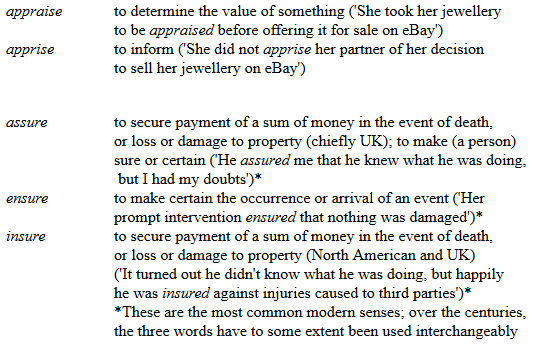
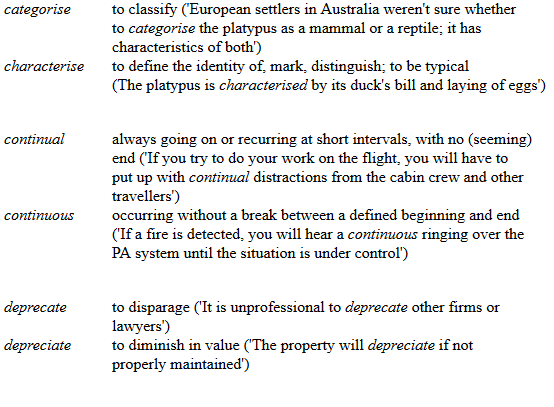
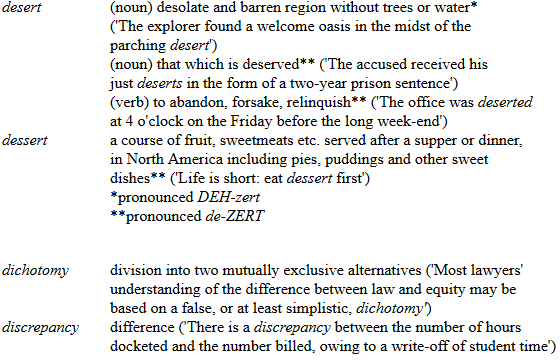
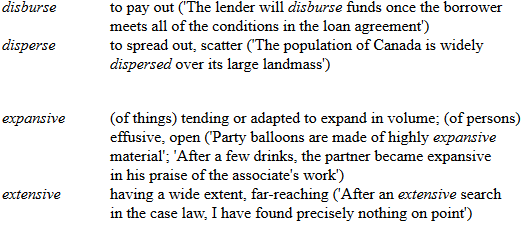
Confusing Pairs, Part 3
The return of a popular series.
Next: U and non-U
Avoid the (Difficult) End of Day Meeting
A client insisted on meeting me in the midst of a busy day. Fully booked, I reluctantly agreed to meet the client at the end of the day. We began happily enough with the usual pleasantries. But once we sat down, a monster arose from the deep. One problem after another fell on my lap, and I began to parry. Despite all my best efforts, we began to talk in circles. Exhausted, my better judgment, along with my defences, fell, and tempers flared. After hours passed by, we bid adieu, accomplished nothing, each left stewing at the other. Despite all the other good interactions we had, the argument left a lingering bad taste. When the file resolved, I was, I’m sure, as relieved as the client was, to part ways. There are better ways to practice law.
Decision fatigue is the theory that we begin the day with a full tank of decision-making gas. With every decision we make, we burn up a little more gas. By day’s end we are running on empty, and we fall into two precarious states: conservativism, by which we stick with the status quo simply because it is the path of least resistance; or irrationalism, by which we make poor choices. Any one who has eaten a bag of potato chips at midnight understands this plight.
So the tip: avoid the end of day meeting if there is any potential for conflict. It is better at the beginning.
–Ee, –Or
Not the donkey from Winnie the Pooh, but a pair of word endings.
First, –ee.
As in trustee, lessee, mortgagee, bailee, drawee, payee, attendee, mentee and the like.
This ending is common in law, often indicating the indirect object of some action. For example, the person to whom property is entrusted (trustee) or leased (lessee), the person to whom a mortgage is given (mortgagee).
It can also be the direct object of an action: for example, the person you employ (employee) or train (trainee).
So far, so good. But let’s not go crazy. Tippee (person in receipt of an (illegal) stock tip) is well-established, but not really necessary: one could as easily say the tipped or the recipient of a tip.
Worse are attendee, invitee, coachee and mentee. The first is illogical in relation to trustee or employee; the person who goes to something attends it, not is attended. Why not just say guest or participant? Invitee passes the logic test, but it’s rather ugly; here again, guest is preferable. Coachee is unlovely. Refugee, yes – but as for asylee, ugh.
Mentee is the one that really gets your humble scribe’s goat, however. It assumes that the word mentor, from which it is derived, comes from a verb in the way that other –ee words do.
Not so! Mentor is the name of the chap (but really the goddess Athena in disguise) who, in Greek mythology, tutored the young Telemachus while his dad went off to besiege Troy and then sail around the eastern Mediterranean. Mentee assumes that a mentor is someone who ments, but that isn’t a word at all, and certainly isn’t the root of either Mentor or mentor.
Admittedly, the alternatives for mentee aren’t great. I sometimes hear protégé(e), but that sounds at once pretentious and faintly creepy. How about just student, associate or junior?
Now, –or.
Lawyers like this one too: mortgagor, settlor, advisor. In non-lawyer English, -er is just as frequent, and sometimes one can use both (payer, payor). Adviser is perfectly correct (and actually the term of art used in Canadian securities legislation). Sometimes only the –er form is possible (employer).
One thing that has always puzzled me (OK, I may have time on my hands) is the difference in pronunciation between mortgagor and obligor. Under the normal rules of English pronunciation, those Gs before the Os should both be hard (as in gore). But it’s OB-li-gore (hard G) and MOR-gaj-or (soft G). In the US, the emphasis is more usually on the final syllable: mor-gaj-OR and ob-li-GORE – but still those inconsistent Gs.
There are, in fact, the older but now less common variants obligeor and mortgager. They have the same legal meanings as their –or equivalents; an obligeor is also ‘a person who performs a service or kindness’. Pronounced MOR-gaj-er and o-BLIGE-er.
Now you know.
Next up: confusing pairs, part 3
Searching Google Efficiently and Effectively

The Internet is home to a growing body of high quality materials such as research guides, government reports, and legal commentary. Accessing this material is as easy as typing keywords into Google and hitting enter, right? Wrong!
The challenge to using Google efficiently is wading through the overwhelming volume of results retrieved. Fortunately, there are tools to help pinpoint what you are looking for. There is far more to searching Google than you might think.
Identify the Core Concepts
The first step to searching effectively is selecting effective search terms. Identify the core concepts. These will become your search terms. Remove vague terms from the query. They do nothing to improve the quality of the results. Do not type a full question in the search bar. Focus on the core concepts and eliminate everything else.
Search Operators and Filters
Operators and filters enable you to search with precision. Advanced searches can be conducted with Google’s advanced search page or by incorporating operators and filters directly into Google’s search bar. I recommend incorporating them into the search bar. The real power of operators and filters comes from combining them together. The search bar enables you to combine them with ease. It is awkward to combine them with the advanced search page.
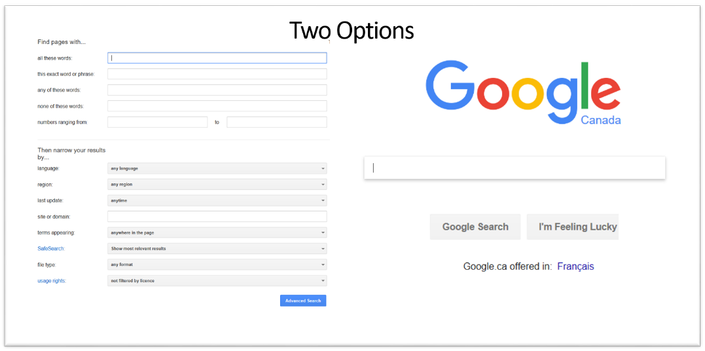
Here are the most useful operators and filters:
AND: AND separates terms that are distinct concepts, such as robbery AND weapon. It narrows a search by retrieving results that contain both terms. It is Google’s default operator. As such, it is not necessary to type AND. A space between terms is automatically interpreted as AND: robbery weapon.

OR: OR is used to separate terms that are synonyms of the same concept, such as (armed OR weapon OR knife). It broadens a search by retrieving results that contain any of the search terms, but not necessarily all. Enclose OR statements in brackets.

NOT: NOT is represented by the minus sign. It excludes results that contain a particular term. For example, tort -defamation will not retrieve results that contain the term defamation.
PHRASE: To search for an exact phrase, enclose the phrase in quotes. For example, “child of the marriage”.
SITE: Site limits the search to results from a certain website or domain. For example, divorce site:gc.ca only retrieves results from the Government of Canada domain. divorce site:plea.org retrieves results from plea.org. This makes it easy to locate results from trustworthy websites.
ALLINTITLE: Title limits the search to results that contain the terms in the title. For example, allintitle:legal regulation will retrieve results with these words in the title. If your terms appear in the title of a document, it is likely relevant.
FILETYPE: File type limits the results to a certain file format. For example, lsat filetype:pdf will retrieve results in PDF. lsat filetype:ppt will retrieve results in PowerPoint.
Combining Operators and Filters
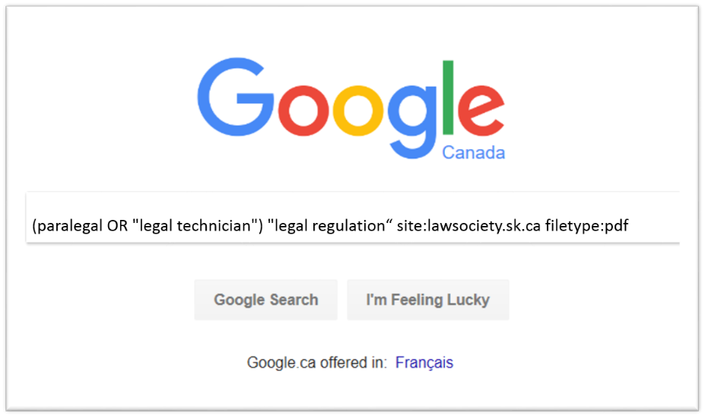
Combining operators and filters together will enable you to craft powerful queries and locate good results. For example, (paralegal OR “legal technician”) “legal regulation” site:lawsociety.sk.ca filetype:pdf will retrieve PDF documents from the Law Society of Saskatchewan domain on paralegals and legal regulation.
Evaluating the Results
Not everything Google retrieves is credible. It is up to you to evaluate the results. Consider authority, objectivity, and authorship. Recognise that the order of the search results is not based on authority. It is based on Google’s search algorithm. The results most relevant to you may appear much farther down the results list. Consider searching Google Scholar if you need scholarly and academic resources.
We have only just scratched the surface of Google today. Please contact the Law Society if you have any other questions.
[This tip by Alan Kilpatrick originally appeared on the Law Society of Saskatchewan Library’s Legal Sourcery Blog]
Does Your Law Firm Need More Leadership?
While interest in the role and importance of leadership in law firms continues to grow and solidify, it may not yet be obvious to many when investing in such improvements should become priority. If you’re starting to wonder if your law firm needs more leadership, you may find that before you can answer your own question, you first need a better understanding of the various dimensions and implications of leadership.
So, what is leadership within the context of a law firm?
Well, there are two ways of looking at it – internally and externally. Internally refers to leading others within the firm. Externally refers to playing a leadership role with clients, referrers and the general community, outside of the firm.
Either way, to begin making an assessment about the firm’s current leadership level, start asking yourself questions about vision, engagement and reputation. To get the discussion rolling:
- Do others follow the firm’s leaders, even when they don’t report to those individuals?
- Do the partners, lawyers and staff feel like they have a sense of purpose?
- Do the firm’s leaders have influence with others in the firm? Outside of the firm?
- Can you describe the firm culture and its impact on employees and clients?
- Is staff turnover a concern? Is client turnover a concern?
- Are employees engaged?
- Do people work well with each other?
- Does the firm have a positive reputation (for its work and otherwise) with referrers and in the general marketplace?
If you conclude that your firm is lacking in any of these areas, likely it would benefit from more leadership. So, where should you begin?
There are many ways to facilitate this change. But the right way for your firm will depend on where on the organizational chart leadership is lacking. If it’s at the top, a strategic plan might be in order. If it’s needed throughout or only a priority with specific individuals (key players or managers lacking experience), a combination of mentoring, training and coaching may be the answer.
So, today’s tip? Start asking probing questions to assess if your law firm needs more leadership. If the answer is yes, begin the process of planning for change!
—
For reading related to leadership, see these past articles on SlawTips:
Also, see the following articles by Sandra Bekhor at Toronto Marketing Blog:
What Are Marginal Notes?
Marginal notes (also known as head notes) are “the short notations appearing above or beside each section […] of an Act or Regulation” (Sullivan on the Construction of Statutes, 6th ed., §14.59). These notes are intended to help readers identify pertinent provisions in the legislation. The name comes from the fact that they originally appeared in the margins of legislation next to the relevant provisions.
Despite appearing in an act or regulation, marginal notes are not actually part of that legislation. Sullivan is rather disapproving of this:
“Although technically marginal notes are not considered part of legislation, in fact they are physically present and may well constitute the most frequently read component of many Acts and regulations. To ignore whatever light they shed on the meaning of legislation seems artificial and appropriate.” (§14.60)
That said, there are several cases in which marginal notes have been used for legislative interpretation (e.g. R. v. A.D.H., 2013 SCC 28) but this is not uniformly the case. For example, in Imperial Oil Ltd. v. Canada; Inco Ltd. v. Canada, 2006 SCC 46, it says at paragraph 57 “although marginal notes are not entirely devoid of usefulness, their value is limited for a court that must address a serious problem of statutory interpretation.”
Because marginal notes aren’t officially part of legislation, the process of amending them does not necessarily involve an act or regulation. For example, in British Columbia they are amended by the publications staff, not the legislature:
“On this basis, marginal notes are not amended by legislation. They are changed editorially by our publications staff in consultation with legislative counsel. This is done most commonly in conjunction with a legislative amendment to the relevant section, so that the marginal note will better reflect the content of the section.” (A Guide to Legislation and Legislative Process in British Columbia)
This leads to situations in which the only way to know if a marginal note has changed is by looking at the most recent copy of the consolidation produced by that jurisdiction’s Queen’s Printer (or equivalent).
Navigating Social Media
For those who need a brief refresher on social media (or an introduction), here is a succinct guide to the various platforms:
(I would spell that ‘doughnut’, though – and ‘donut eating’ should be hyphenated.)
In terms of how to post information, you might bear the following points in mind.
Choose your distribution channel appropriately
The best social media for business and professional purposes are LinkedIn and Twitter.
Use Instagram and Facebook for pics of vacations, amazing restaurant meals, your kids, the dog.
Manage your presence
If you have a social media presence that is purely personal (vacations, amazing restaurant meals etc.), that doesn’t mean it can be un-professional.
Don’t post things via a non-work account that you wouldn’t want your employer or your clients to see. Everybody has Google, and someone is bound to find those pics of you at the kegger with your pants down.
Don’t reveal confidential client information or say negative things about a client (or your employer). You should also exercise caution in speaking out on public issues that a client may have an interest in – even if this does have the effect of clipping the wings of your commentary. An ‘all views my own’ disclaimer may not be sufficient when someone is upset.
Join appropriate groups on LinkedIn.
Don’t feel you have to accept every LinkedIn connection request. There are a lot of spammers and other opportunists out there. And think about the people you do connect with: it was a bit off-putting when a professional contact of mine connected on LinkedIn (and perhaps elsewhere) with an adult film star. Similarly, adding every legal recruiter in town to your LinkedIn contacts will send a signal.
Keep it short
Twitter famously limits tweeted messages to 140 characters, although there have been rumours that this may be eased. That would be a shame: the beauty of a tweet is its very pithiness, and a word-limit imposes a healthy discipline.
Keep your posts on other platforms on the short side, too. No one is on social media to read the Encyclopaedia Britannica, and most will be looking at your update on a mobile device with a small screen.
Don’t overdo it
Regularly posting updates is an effective way to remind your friends, colleagues and clients that you haven’t fallen off the face of the earth – but no one needs minute-by-minute live-tweeting of you doing document review.
And don’t post for the sake of posting: have something meaningful to say.
Use existing content
Retweet items from trusted sources to your legion of followers. Like or repost updates on LinkedIn.
The only way to build a true personal brand, however, is to post original (and, ideally, thoughtful) content of your own.
Link appropriately
If you are saying nice things about someone, include a link to that person’s LinkedIn profile. Include that person’s Twitter handle or a hashtag with a company name or keyword.
Next time: –ee, –or


