








Administrator’s note: thanks to Lexum for sharing this tip by first appeared on the Lexum Blog.
All Our Tips
Good Counsel (Plus Thanks and a Request)
Counsel is an ancient term for one’s legal advisers as a body (The accused did not have the benefit of counsel when he was interrogated) or for a single legal adviser (Maria acted as counsel to the federal government, for which she was made Queen’s Counsel).
A judge will address a Canadian barrister as Counsel (if not by name); in the US, it would more usually be counselor (with a single American L).
The OED says counsel is ‘rarely’ pluralised; ‘should never be’, in my view (and Fowler’s), but I see it.
As a job title, legal counsel is a redundancy. Just counsel (although investment counsel might disagree).
In US firms, many (typically grey-haired) professionals are described as being of counsel – that is, still practising, but no longer a partner and too senior to be an associate. As a description, that’s fine – but as a job title it is not (How many Of Counsels does your firm have? Yuck.)
Counsel and council were historically to some extent interchangeable; over time, council came to mean a board or assembly and its members councillors (Privy Councillors, municipal councillors) – although the members of such a group could also be one’s counsellors if they offered advice, whether legal or general.
Thanks and a request
Since publishing Guthrie’s Guide to Better Legal Writing, I’ve received many comments and suggestions from readers. Thanks!
I’ve used a lot of them in these post-book blog posts, and I hope they’ll find their way into a second edition of the Guide (that’s a hint, Irwin Law!)
Until that time, I’d like to acknowledge these readers in particular: Matt Aleksic, Ari Blicker, Jim Frank, Matthew Helfand, Anne Marie Melvie, James Reed, Angela Swan, Douglas Tsoi and Lionel Tupman.
If there are things I haven’t covered that you’d like me to, drop me a line on Linkedin or at the e-mail address given in the front matter of my book. I also check the comments here at Slaw Tips.
Deposition Two Ways
One of the best headlines of 2018 was ‘Stormy Daniels’ Attorney Wants to Depose Donald Trump’. He’s not the only one …
Of course the CBC was using depose in its US legal sense, which is to examine a witness for the purposes of discovery or a later trial. Most Canadian non-lawyer readers would, however, have interpreted depose as overthrowing a bad king.
In Canada, we would not depose a witness or take a deposition – we would examine a witness for discovery.
Launch New Google Drive Files From Your Browser Address Bar
While scrolling through my Twitter feed the other day, I learned a fantastic little trick for creating new files in Google Drive. Do you know this one?
You can start a new Google document, form, spreadsheet, site, or presentation simply by typing one of the following shortcuts into your browser’s address bar and hitting enter.
- Docs: doc.new, docs.new, document.new
- Forms: form.new, forms.new
- Sheets: sheet.new, sheets.new, spreadsheet.new
- Sites: site.new, sites.new, website.new
- Slides: slides.new, deck.new, presentation.new
Pretty slick, eh?
(h/t qz.com)
We Were Born Free, and Everywhere We Are in Email Chains
Thanks to technology, we have habits no previous generation has ever had. You probably wake up in the morning and pick up your cell phone first thing. You check your emails before you brush your teeth. You sit down at your desk in the office and check your emails before you check your to-do list. You hear a chime and look at your phone and check your emails in the middle of a contract you’ve been drafting for the last hour. You think there’s got to be a better way. And there is. Now, I don’t yearn for the way things once were – paper letters are, increasingly, welcome curiosities in this modern age. Work-by-email is a miserable form of existence. Emails create the impression of urgency but, often, without the importance. And there is a difference between what is urgent and important. Your to-do list can be decided intentionally, not dictated by companies whose well-being depends on your addicted habits to their devices. So give yourself licence to break free from the chains.
Wake up and refuse to check your emails. Calmly enter your day with your own thoughts. Come into work, sit down, and think about what you want to do first. And when the time comes – based on your choice, not as a response to a beeping stimuli, check your email. Consider scheduling a time to check emails – 10am? 2pm? 5pm? And then be done with it. The always-on technology does not mean you must always be on, a recipe for disaster. Take a break from the tech and take hold of the reins. For we are inspired from the great Jean-Jacques Rousseau: we confess our addiction to email, and we throw away the chains.
Yet More Bad Business Jargon
Baked in
This is (regrettably) now used to mean something like integral.
Does it have its origin in that vacuous remark by the sometime MP Belinda Stronach about baking ‘a bigger economic pie’ (whatever that was intended to mean)? I don’t know, but please stop talking about things being baked in; you’re a lawyer, not a baker.
C Suite
This was once, I suppose, a fresh way to describe senior management at a company. It is now past its sell-by date.
Flip
Not as in flip your lid but rather flip me an e-mail.
I’ve never liked its suggestion of haste and lack of thought.
Just send (or maybe forward, although I’m not sure it’s that important to make the distinction).
Impactful
No, no, a thousand times no! Use something like forceful or effective instead.
Relatable
Not sure this is a term from the business world, but it’s certainly jargon.
It is used to mean ‘easy to relate to’ (as in My job as an actuary may not be very relatable, but I find it interesting) – so why not just say ‘easy to relate to’?
Relatable is better used to express, neutrally, the ability to be narrated (related), brought into relation with something else or to possess mutual relation.
Stakeholder
This one always makes me think of Dracula.
It’s terribly shopworn – although admittedly a less tired one-word synonym doesn’t come easily to mind.
Create Your Own Personal Pension Plan
2019 is here and rather than lament about funds you already spent in 2018, now is the time to get back on track and set savings goals. Statistics say the average millionaire saves at least 20 percent of what they earn. Are you on track to create real wealth for yourself in 2019? If you are an incorporated professional pay close attention to this tip: There are still ways to save for retirement using your corporation even with the recent tax changes. Consider the benefits of creating your very own personal pension plan.
WHAT IS AN INDIVIDUAL PENSION PLAN ?
An Individual Pension Plan (IPP) is a defined benefit pension plan. If you are a legal professional who owns a professional corporation, an IPP offers maximum tax relief and a maximum retirement pension. The result is an owner of a legal corporation no longer has to rely on Registered Retirement Savings Plan’s (RRSPs) performance to provide for a long and happy retirement. That’s because IPPs also offer guaranteed lifetime income and any surplus in the plan belongs to you.
WHY ARE IPPs SO POPULAR?
Incorporated legal professionals like the fact that the pension they will receive is known well in advance of their retirement date. They also like that at age 50 the maximum contribution to an IPP is $7106 dollars higher than a traditional RRSP and is also creditor protected. They can also include past service to an IPP for years they did not contribute all the way back to 1991. This can significantly increase what can be contributed to the plan along with increasing their tax deduction. IPPs can also be set up for the legal professionals spouse if the spouse is an income –earning employee of the corporation. Set up Fees are also tax deductible to the corporation.
WHAT IS THE TAX SAVING OPPORTUNITY?
High Income Earners
Legal professional corporations who have income over $130000 will pay taxes over the 46 percent rate for each dollar they earn over that amount. If your income is over$220,000 you are now in the highest tax bracket of 52 percent. If you plan to maximize your RRSP contributions anyway this is an excellent vehicle to provide additional tax deductions and save for retirement while making the most of your tax bracket.
Sale of a Business
Most law firms are sold to family members or partners. The proceeds from these types of asset sales are treated as taxable income. By setting up an IPP now using terminal funding, a deduction can be created against this income.
Early Retirement
Legislation requires funding projections to be based on a retirement at the age of 65.
However, anytime after attaining age 60, a member of an IPP can retire and supplement the benefits provided in the plan by adding unreduced early retirement benefits, cost of living increases and bridging benefits. These early retirement benefits can provide a significant additional tax deduction for the company.
Ideal Candidates
- Legal professionals who own a professional corporation
- Individuals age 40 or older
- People who earn employment income reported on a T4 of at least $132,300 from the company sponsoring the Individual Pension Plan
—Jackie Porter (@askjackieporter)
Further Confusing Pairs
I forget where we are in the series. Part 8? Anyway…
Avert/advert
One averts one’s gaze from something unpleasant; one adverts (turns one’s attention) to other matters. The two have been confused since the Middle Ages.
Forgone/foregone
My friend Ross Guberman has noted Warren Buffet’s confusion of these two words: the Sage of Omaha wrote to this followers that ‘Investing is an activity in which consumption today is foregone in an attempt to allow greater consumption at a later date’.
A nicely expressed observation, but for the error; Buffet means forgone (‘relinquished’, ‘given up’) not foregone (‘preceding’, as in foregone conclusions or foregoing reasons). Historically, though, the two spellings were more or less interchangeable.
Both have nice past tenses one ought to see more of: for(e)went.
Led/lead
The first is the past tense of the verb to lead (She led an expedition to the South Pole); the second, as a verb, is the infinitive form (to lead) or the present tense in the first or second person (I now lead the derivatives group at my firm or You lead and I follow).
Mistaken use of lead as the past tense of to lead is said to be one of the commonest errors on CVs: http://www.businessinsider.com/common-spelling-mistakes-resume-2017-11
Pedal/peddle
You pedal your bicycle; Donald Trump peddles more fake news than the so-called Fake News he decries.
Someone who pedals is a pedaller (if you’re American, pedaler); who peddles, a pedlar.
Tenet/tenant
I’ve heard these confused, but I don’t think I’ve seen the crime in writing. Yet, anyway.
A tenet is a doctrine or principle; a tenant is a renter of property.
Be Best
There are many reasons to pity Melania Trump (although maybe she knew what she was signing up for and got what she deserved – hard to say, really).
Mrs T got into some linguistic hot water with the slogan for her campaign for children’s health and happiness, launched in May 2018: Be Best.
As Tim Hill has pointed out in The Guardian, this doesn’t hold up to what he calls ‘the laws of English grammar’ (I’d soften that a bit and call them rules; English is more flexible than laws would suggest).
One can be good and one can be better, but one really ought to be the best, not just best. That said, it would be idiomatic (and correct) to say It would be best not to do that.
The origin of Melania’s little solecism? Her not always grammatically correct husband, perhaps. Or a desire to outdo, with a superlative, Michele Obama’s exhortation in 2016 for men to be better. Or possibly a staffer’s subtle mockery of the First Lady’s somewhat shaky command of English and its use of definite articles (which are foreign to her native Slovenian).
Not, by any means, the greatest failing of the reign of Trump, but worth noting.
How to Save a Specific Paragraph From a Decision From CanLII on Lexbox
Lexbox was designed to make your legal research faster and easier. To help you use Lexbox to the best of its ability, we are sharing Lexbox tips with you from time to time. Here’s one if you are using Lexbox on the CanLII website.
Today’s tip is about saving a specific paragraph from a decision on Lexbox, so that you can include it in your research record, and revisit it anytime.
- If you are not already logged in, login or create a Lexbox account here.
- On CanLII, go to the case that you are interested in and find the paragraph you want to save.
- Click on the blue paragraph number in square brackets.
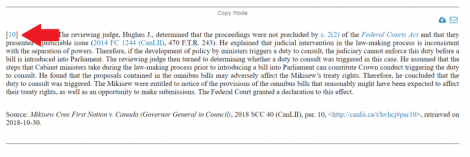
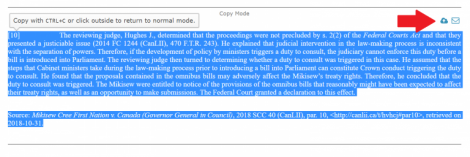
- The paragraph is highlighted and a blue upload cloud button appears on the top right of the paragraph. Click on this upload button.
- A box appears that allows you to edit the case name, file it into a folder, and add notes. All saved items come with metadata, such as a citation, issuing court, decision date, and keywords.
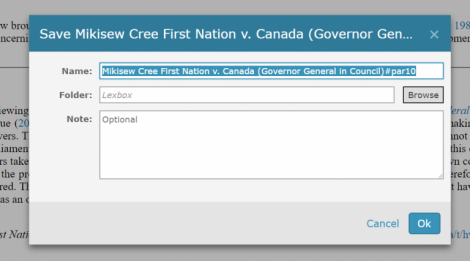
- Once you click “Ok”, your paragraph is saved to your Lexbox account! You can access it from the drop-down located under your username, or by clicking on the Lexbox logo.

- Within your Lexbox account you now see the corresponding decision listed under the folder structure you selected. When clicking on the title, you are redirected back to that exact paragraph in the decision.

The Verb Summons: A ‘Horrible Expression’?
Summons is one of those odd nouns that ends in –s in its singular form; so the plural is summonses.
Odder still is the use of summons as a verb, meaning to command someone’s appearance in a court of law by way of a summons. Verbs don’t typically end in –s either.
Not everyone is happy with this state of affairs: Glanville Williams wrote in Learning the Law, 11th ed. (1982) that ‘the horrible expression “summonsed for an offence” (turning the noun “summons” into a verb) has now become accepted usage, but “summoned” remains not only allowable but preferable’.
A little digging in the dictionary (Oxford, of course) shows, however, that summons is older than Williams suggests – if not entirely reputable.
The usage citations in OED go back as far as 1780, with a quotation from Martin Madan’s Thelyphthora: ‘A woman had but to summons her seducer before the judges’. Madan (1726-1790) was a barrister (and a clergyman), but a controversial one; Thelyphthora scandalised its readers in advocating polygamy as a remedy for the ‘female ruin’ brought about by what he called whoredom, fornication and adultery. Perhaps not the best authority, then?
Next in the citations comes a line from Dickens’s Nicholas Nickleby (1828), where the sadistic schoolmaster Whackford Squeers (oh, those Dickensian names!) ejaculates, ‘Say another word and I’ll summons you for having a broken winder’. The dialectical winder may suggest that summons, too, is non-standard.
And the final example is from the novels of Marie Corelli, a forerunner of Barbara Cartland and EL James (so not exactly an exemplar of great literature): ‘You can summons me … if you feel so inclined’ (God’s Good Man (1904)).
All in all, not an impeccable pedigree for the verb summons, but it isn’t as newfangled a word as Glanville Williams suggests. I agree, though, that to summon is the better way to go.


