







All Our Tips
Screenshot Entire Webpages With FireShot

Here’s a handy browser extension to add to your toolbox: FireShot, an add-on that captures entire webpage screenshots – even scrollable areas.
Install FireShot in just a few seconds, then screenshot any website just by clicking the “S” icon in the top right corner of your browser and selecting an option:

Once you click an option, there will be a short pause, and a new tab will open up, allowing you to work with your screenshot: edit, save to various formats, add text annotations, share, copy to clickboard, print, etc.
The first time I saved an image, I was prompted to allow FireShot to manage my downloads. Then a “Save As” prompt appeared where I could chose the name and destination to save my screenshot. Here’s what the output looks like (click to see a larger version):

FireShot Lite is free; a pro version with more functions is also available. Works with Chrome, Firefox, and several other browsers.

Miscellaneous Misuses

Shut down, shutdown
Don’t confuse these.
You shut down your computer in anticipation of the firmwide shutdown by the IT department. On a similar footing, log in and login.
Surveil
This is like the awful liaise.
Surveil is a misguided back-formation from surveillance, but an ugly and unnecessary one; just say watch or follow.
Well wishes
Where on earth did this expression come from? You wish someone well, but send good wishes. Well wishes awkwardly places an adverb where only an adjective should go.
Impressed
The partner was impressed by the associate’s memo.
OK, but was the impression favourable or unfavourable? We generally mean impressed in a positive way, but if you think about it the word means that something elicited a reaction, whether negative or positive.
That said, She was not impressed would never be taken to mean neutrality or lack of response. Avoid anyway, not least because it’s a journalistic/Wikipedia-entry kind of word.
The below
For the love of all that is beautiful and true, no!
Please see above (or below) or the paragraph above (or below) would be fine, but the below in reference to something set out lower down is inelegant.
Whatever happened to ‘on’ and ‘about’?
People now say around or even surrounding when a simpler on or about would do. Issues surrounding, questions around, rules around – stop this!
Finding RSS Feeds for Podcasts and YouTube Channels/Playlists
Is there a podcast or YouTube channel you’d like to keep track of or display using RSS? Determining the RSS feeds for videos and podcasts can be tricky. Here are a couple of tips on how to find the RSS feeds for YouTube channels and playlists, and podcasts on iTunes or Soundcloud.
To determine the RSS feed for a YouTube channel:
- View the page source for the YouTube channel (right click on the page and click “view page source”
- Do a search for the text “channelID” and copy the value next to it. It will look something like this: UCqoH4oSIEttrjmasHPBx5Ug
- Paste that Channel ID value into this URL: https://www.youtube.com/feeds/videos.xml?channel_id=YOURCHANNELIDHERE
To determine the RSS feed for a YouTube playlist:
- Go to the playlist homepage you want the feed for, and copy the playlist ID from the end of the URL. It will begin with PL, and will look something like this: PLoKLMZAP5PVfgB9d7IpdZRO4E1m4WFXBM
- Swap in the playlist ID in this URL: https://www.youtube.com/feeds/videos.xml?playlist_id=YOURPLAYLISTIDHERE
To determine the RSS feed for a podcast on iTunes or Soundcloud:
- Go to getrssfeed.com, paste in an iTunes or Soundcloud URL and hit enter – it will determine and display the public feed, which you can view by clicking on the RSS button.
Do you have any other handy RSS hints? Please share in the comments!
That Awful Extra ‘of’
You’ve already been advised in a previous post not to say outside of or inside of. The of is both unnecessary and incorrect in each case.
Of creeps in elsewhere, where it should not. As in the shudder-inducing off of, Please, just off. Or perhaps from (I got it from the internet, not off of).
Or as in It’s not that big of a deal. You mean It’s not that big a deal (although not much of a big deal).
Where you should be using of is with the verb enamoured: you are enamoured of (not with) someone if you are in love with that person (enamoured by the person if you are loved back).
Restore Support for RSS in Firefox
Not long ago, as I was working with some RSS feeds, I was dismayed to discover that suddenly, Firefox wouldn’t display them. Instead I was being prompted to save or open the file using another program. What a pain!
Turns out that with the release of Firefox 64, Mozilla dropped support for feeds and live bookmarks.
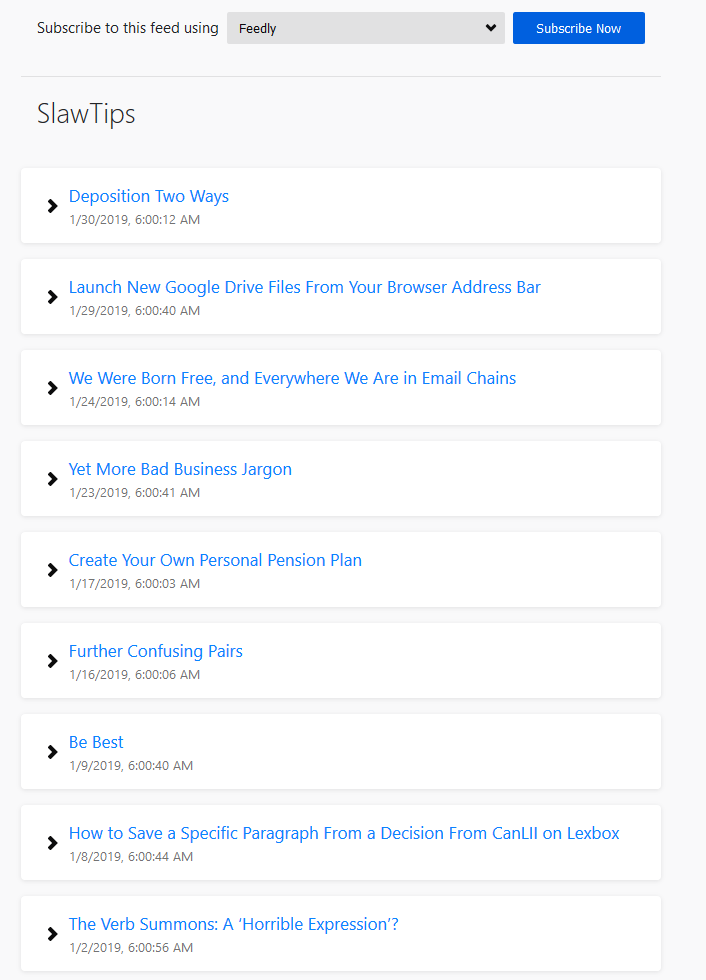
Luckily I found a solution without much hassle. There are several add-ons that will restore this functionality to Firefox. I picked one called Feed Preview that had good reviews. So far, so good; feeds are displayed cleanly and elegantly. Here’s what the Slaw Tips feed looks like with the Feed Preview add-on.
Henry VIII Clauses
The general rule of thumb is that acts are amended (or repealed) by acts and regulations are amended (or repealed) by regulations. Some acts do explicitly state that they can be amended by regulation, although what can be amended is usually minor (e.g. making changes to a schedule to an act).
An example of this can be found in British Columbia’s Workers Compensation Act:
(4.1) The Board may, by regulation,
(a) add to or delete from Schedule B [of the act] a disease that, in the opinion of the Board, is an occupational disease,
(b) add to or delete from Schedule B a process or an industry, and
(c) set terms, conditions and limitations for the purposes of paragraphs (a) and (b).
Such provisions are known as Henry VIII clauses. The name is based on Henry VIII’s reputed fondness “for legislating directly by proclamation rather than through Parliament.”
Upgrade Your Device Charge Cables
I recently made a couple of small purchases that made a big difference: new charge cables for my phone and tablet. And as soon as I started using them, I was kicking myself for not having bought them sooner.
My old cables had been on their very last legs: they still worked, but one was starting to become loose at a connection point, and the other had actually lost a piece of casing. They weren’t charging as quickly as they once had. Plus, their lengths weren’t ideal either–both had always been just a bit too short for the locations I used them in, which meant there was always either a phone falling off its charging surface (thank heavens for OtterBox!) or a cable pulled just a bit too tight. Not great for my devices OR the cables. I knew continuing to use them wasn’t safe or practical.
I took a few minutes and browsed the options and reviews on Amazon before treating myself to some quality cables that are double the length of and much sturdier than the originals.
Now I don’t put off charging my devices, because I can easily leave them plugged in and still bring them over to where I want to use them, and I suspect they will also last a lot longer because they’ll be under less stress.
If you’ve got cables that don’t charge as quickly as they used to, or are looking damaged, or are too short, why not treat yourself to some new ones? You’ll wonder why you waited so long. Happy charging!
Plug Into Law Podcasts

If you were paying attention to the last installment of the Canadian Law Blog Awards (aka Clawbies) this past December, you probably noticed that podcasts are more popular than ever. The top prize even went to a podcast this year!
Today’s tip is to expand your professional development horizons past print and in-person, and check out a podcast.
A good place to start is with the outstanding productions that were mentioned in the 2018 Clawbies:
- The Docket by Michael Spratt and Emilie Taman
- IdeaBlawg podcast by Lisa Silver
- Lawyer Life Podcast by Darlene Tonelli and Mike Anderson
- Diversonomics Podcast by Gowlings WLG
- Jumping off the Ivory Tower Podcast by Julie Macfarlane and Dayna Cornwall
- Hull on Estates podcast by Hull & Hull
- Intrepid Podcast by Stephanie Carvin and Craig Forcese
- Paw & Order Podcast by Peter Sankoff and Camille Labchuk
- Of Counsel Podcast by Sean Robichaud
- Cases That Should Have Gone to the SCC But Didn’t by Kyla Lee [vlog]
- Stereo Decisis Podcast by Robert Danay, Oliver Pulleyblank and Hilary Young
- Objection! By Kelly Doctor and Nadine Blum
Other great podcasts (including more Clawbies winners) can be found in the lawblogs.ca Podcasts & Vlogs section.
For more recommendations, including a bunch from beyond Canada, check out Connie Crosby’s recent post: Legal Knowledge Professionals’ Podcast Roundup – Jan 18 2019
So Basic
Basis is, basically, bad. Why, you ask? It’s one of those words that lawyers love to use, but one that renders their prose flabby and verbose. Instead of on a temporary/permanent/daily/whatever basis, just write temporarily, permanently, daily etc. While adverbs are not a hallmark of vigorous prose, a single word is better than four.
A related word is based: Where are you based?, people ask; I’m based in Toronto. Doesn’t this sound affected? Why can’t it just be live? Perhaps based sounds more cosmopolitan and jet-setty (put another way, pretentious)?
More along the lines of basis are manner and fashion. Only a lawyer would ask for a memo to be delivered in a timely manner (promptly or even soon would be plainer and better). And in an orderly fashion? Please trim the fat and just say something like in order, neatly, regularly …
What You Need to Know About Crossing the Border With Electronic Devices
With travellers at Canadian airports and border crossings subject to increasing scrutiny,[1] it is important for lawyers and Quebec notaries to have an understanding of how the privacy interests of their clients may be impacted by legislation and policies developed to address public safety issues. Legal counsel should also understand that their profession does not make them immune to policies and processes that could impact information otherwise subject to solicitor-client privilege.
Canadian lawyers and Quebec notaries travelling internationally with electronic devices face increasing uncertainty about how those electronic devices will be treated by border agents on apprehension by Canadian Border Security Agency (“CBSA”) officers on return to Canada, by border agents in the U.S., or by border agents in other international destinations. Searching the electronic device (including smart phones, laptops, and USB sticks) of a legal professional may infringe solicitor-client privilege when that legal professional crosses borders.
A new advisory, Crossing the Border with Electronic Devices: What Canadian Legal Professionals Should Know, developed by the Policy Counterpart Group of the Federation of Law Societies of Canada (the “Federation”) with the assistance of law society practice advice counsel, describes the risks of travelling with an electronic device when returning to Canada, going through pre-clearance with U.S. border officials on Canadian soil, and when travelling to the U.S. and beyond. This advisory also identifies relevant professional responsibilities, and concludes with suggestions and advice for Canadian lawyers and Quebec notaries on minimizing those risks.
[1] Office of the Privacy Commissioner, “Your privacy at airports and borders,” (October 2018), online: https://www.priv.gc.ca/en/privacy-topics/public-safety-and-law-enforcement/your-privacy-at-airports-and-borders/
[This tip originally appeared on on the Law Society of Saskatchewan Library’s Legal Sourcery Blog]


