







All Our Tips
A Quick Firm Checkup: How’s Your Billing Realization?

Running a law firm means ensuring that your financial boat is able to weather the storms that blow your way. One way to stay afloat is to ensure that your billing realization rate isn’t leaking dollars!
Billing realization is the percentage of recorded attorney or paralegal time that actually ends up on the bill sent to the client. For example, if $1,000 worth of time is recorded on the time sheet, but is later whittled down and billed out for $900, the billing realization rate on the matter is 90%, meaning that the firm has billed out only ninety cents of each dollar of time recorded as having been worked. You don’t want to allow your billing realization rate to slip below this mark if you can help it, and higher is better.
It is important for firms to monitor not just the aggregate dollars written off as billing adjustments, but to also monitor the billing realization percentage. The direction in which this measure is trending can tell you a lot about your firm’s health.
Usually, when a firm’s billing realization rate starts to slip, this is an indication that the firm is using ineffective procedures to do the work, or the responsible time biller isn’t as familiar with the area of law as he or she should be, or both. Either way, it means it’s time to take a look at who’s doing the work and how he or she is doing it, to determine whether training or the implementation of new work processes is needed. It may also mean that the firm needs to develop a new method for reviewing and approving the writing down of recorded time.
Most attorneys are at first put off by the thought of someone else, like a billing committee member or “billing czar,” dictating the final content of a client’s bill. But it is always advisable to have another attorney make the billing attorney accountable for discounts given beyond a modest limit everyone agrees to in advance. This is one area which can yield tremendous additional profit for the firm without individual members having to work harder, simply by tightening up billing practices and ensure that you are not spending time in a leaky financial boat!

Hyperlinking Citations With CanLex

I was asked to retrieve list of cases recently which reminded me about CanLex. As I wrote on Slaw a couple of years ago, CanLex is a website that hosts some Open API’s which offer tools that marry CanLII’s Content with LexUM’s Technologies.
I like using the Reflex-API which lets you plug in a list of neutral citations and create an HTML output file with links back to CanLII. It is a quick way to gather a hyperlinked list of material to then download or print.
This week’s tip is to use tools to make research gathering tasks faster and easier. Click the submit a tip link in the footer of this blog to share your tips.
Use Google Alerts So You Aren’t the Last to Know

The Google Alerts service is one of many very helpful Google apps. It allows you to monitor the web for interesting new content and it will send you an email update of the relevant Google results (web, news, etc.) based on your choice of query or topic.
Some handy uses of Google Alerts include:
- Being aware of your name or your firm name appearing in the new or on the web
- Monitoring a developing news story
- Keeping current on a competitor or industry
- Getting the latest on a celebrity or event
- Keeping tabs on your favourite sports teams
To create an alert, go to the Google Alerts page (www.google.com/alerts) and enter a text string that contains the name of the person or topic that you want to monitor (e.g., your name, your firm name, a client’s name or industry). Google Alerts will send an e-mail alert to you of Google news or Web search results based on the terms that you specified. You can configure it to deliver the alerts to you instantly, daily or weekly. On the news side, it searches several thousand news sources that the Google news page indexes. On the Web search side it searches all the Web pages that the Google search engine indexes.
On the Google site there are some great tips for getting just the alerts you really want to see.
Google Alerts is a great way to make sure you are aware if there is news or content posted on the Web that is about you, your clients, your firm or other topics of interest to you. In the past I have found it faster and more thorough than some of the commercial clippings services I have used.
New Tricks for Old(er) Dogs…er…ex-Partners
♬ Pennies from heaven.
Don’t you know each cloud contains
Pennies from heaven.
You’ll find your fortune falling
All over town… ♬
Music by Arthur Johnston, lyrics by Johnny Burke, recorded by Bing Crosby.

Of course the best way to avoid large unpaid accounts receivable is to always have funds in trust, ready and waiting to pay an invoice that has just been rendered to a grateful client. Well we all know that many times, this is but a dream and lawyers are forced into the less-than-pleasant task of having to try to collect their accounts receivable after working hard on a file. So what advice is there for those who want to clean-up their aging accounts receivable?
This tip actually was passed onto us from an attendee during one of our in-person presentations on law firm finance and we are in turn, passing it along to you (paying it forward, as it goes…).
Seems that this particular firm retired a partner but the ex-partner’s wife got tired of him hanging around the house – so he went back to the old firm and asked if there was something – anything – that he could do for them.
SO….they thought about it and gave him the job of collecting on the firm’s account receivables. After all, from all his years being around the firm he knew the firm’s clients and he knew the lawyers. So he started making phone calls….
According to the fellow who relayed this tip to us, the firm’s accounts receivable never looked so good…
So while we still say that you still should ask for ernest money up front from a client (and keep the trust account balance in the black by repeatedly asking for replenishment of the trust retainer over time), the next best thing may be to bring in a retired partner and give him or her the task of putting the accounts receivable into order. You may just find pennies from heaven and your fortune falling all over town….
Don’t Forget the Print
Everything is not on the interweb. Though it is great to be able to sift through Sopinka on Evidence via LexisNexis Quicklaw or click quickly through the Irwin Law Essentials ebooks or copy and paste your favourite statement from the Westlaw Canada version of Waters Law of Trusts in Canada, not all great Canadian legal texts are online.
This weeks tip: remember to look at print.
My reminder came via referencing my well worn copy of Parties to an Action by Meagher, (Butterworths, 1988) to a student just last week. What is your favourite print only reference?
Don’t Use Email When a Face-to-Face Conversation Is More Appropriate
An email exchange is not the same as a phone call or a face-to-face conversation. At the top of the hierarchy of human communications are face-to-face meetings, then phone calls, then voice mail, and lastly email. Face-to-face meetings have the most impact. Not only can you hear and talk back to the other person, you also have the ability to see gestures and facial expressions etc. On the phone you don’t see gestures, but you can hear the tone and emotion in the speaker’s voice. Email has the narrowest communications bandwidth – it is only black and white words on a screen.
Make sure the mode of communication you use fits the circumstance. When the news is big or bad, pick up the phone, walk down the hall or meet with your colleague or client face-to-face when more personal contact is called for.
There's G'No Cash Like GnuCash….
♬ I’m a Gnu
I’m a Gnu
The g-nicest work of g-nature in the zoo
I’m a Gnu
How do you do
You really ought to k-now w-ho’s w-ho’s…♬
Lyrics and Music by Michael Flanders & Donald Swann, recorded by Flanders & Swann (on YouTube).
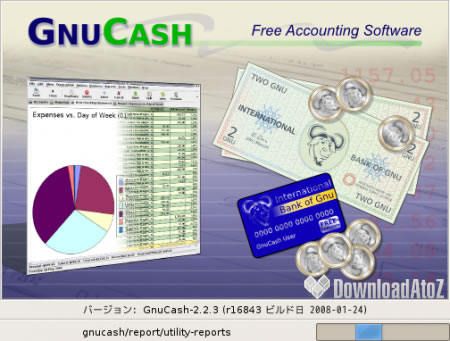
GnuCash
These days the legal world seems to be all aflutter about “The Cloud” and cloud computing offerings. While the legal accounting offerings in the cloud appear to be inexpensive, (the cheapest starts at about $50 per user per month), that’s still $600 a year. For those just starting out in practice, especially those who are trying to pay off student loans, that is real cash they simply may not have.
Fortunately there are G’new alternatives centered around . The GNU license allows users to download and use the software, and most of the time it’s free. that open source software has resulted in savings of $60 billion dollars a year to consumers.
In other words, while cheap is good, free is better! Do not believe that open source software is somehow second-class. At the 2011 ABA TECHSHOW in Chicago, Rodney Dowell and Dennis Kennedy will demonstrate “The Open Source Powered Law Firm!“
Since this Tip is about law firm finance, our tip is GnuCash – a free and open source accounting solution for lawyers (and other individuals and businesses). GnuCash is available for Windows, Mac and Linux. The GnuCash Help Manual is online and a great resource on how to get started with GnuCash, and PracticeLaw.org lists multiple resources including: “Keeping Trust Accounts with GnuCash 2.4.4.” (They also have resources for keeping trust accounts with QuickBooks).
The GnuCash software, together with these resources, should present a great alternative for lawyers looking for a solid accounting system at low cost.
After all when you are just starting out (or looking for an alternative to your existing accounting system) a few good and g’new ideas are really what you are looking for…
CLE Papers as a Research Source
Papers presented at continuing legal information seminars are good research sources. They are prepared by recognized, often local experts in an area of law. They may offer a timely update on a topic. Best of all they are pretty easy to find. First, pick your jurisdiction. Then find a catalog source. Search and retrieve.
Alberta CLE material from our Legal Education Society of Alberta are catalogued by the fine folks at the Alberta Law Libraries. Each paper from a seminar is individually available by using a keyword search for a title word or writer name through their library catalogue.
Ted Tjaden’s website, a companion to his , has an excellent selection of links for
Switching Programs With Alt+Tab
Switching between open programs is one of the most frequent things we all do as we work on our computers. For this task most of us use a mouse to select a button on the task bar. There is a much faster way.
Pressing Alt+Tab (or on a Mac Option+Tab) will open a rectangular grey pop-up window in the centre of your screen. It will have an icon for each program that is running on your computer.
Press and hold down the Alt key, and then repeatedly press Tab to jump from one icon to the next in this pop-up window. To help you find the program you want, the text from the title bar of each window appears in a box at the bottom of the pop-up. Simply release both keys simultaneously when you get to the program you want.
And note: In this pop-up window, the icons are presented, from left to right, in the order you last looked at the respective programs. This means that the window you were in previous to the current one is just one Alt+Tab click away. This lets you jump back and forth between two programs in the blink of an eye. This is real handy if you are comparing info or cutting and pasting information between two programs.
Every lawyer and staff person in every law office should know this keyboard shortcut. Go and tell others at your firm about this tip.
And look for more keyboard shortcuts in future Slaw Tips on tech. Odds are your hands are on the keyboard most of the time. Taking them off to reach for the mouse just breaks your rhythm and slows you down. With keyboard shortcuts you can do almost everything you can do with a mouse much more quickly– the key is learning the shortcuts for the various programs you use. Stay tuned.
A Financial Magic Cauldron?

“When shall we three meet again
In thunder, lightening, or in rain?
When the hurlyburly’s done,
When the battle’s lost and won.
That will be ere the set of sun.”
The three witches from Act 1, Scene 1 of Shakespeare’s Macbeth
If there were a bubbling cauldron or crystal ball that could reveal your firm’s future financial health, would you take a look? Actually, there is. But very few law firms bother to make the time needed to read the tea leaves and gaze into the future.
If you consistently and accurately log your time, your work in progress report is like an oracle, allowing you to take information in your financial system and turn it into a reasonably accurate prediction of what your cash flow situation will be like in the weeks to come. Since today’s WIP turns into tomorrow’s billed time, keeping a regular eye on it lets you know what your potential income in the coming months may (or won’t) be, plus gives you the information needed to better regulate your case intake process, accepting more marginal cases when WIP is low and being more discriminating when it is high. Not all WIP is created equal, however, and you need to look carefully into the swirling fog of the smoking cauldron to correctly divine the messages from the financial world.
Decreasing WIP does not bode well. Increasing WIP, on the other hand, is usually a good thing, but you also need to know why it’s increasing. For example, time being logged on contingency files for cases that have been carefully screened and will likely pay big dividends in the future is something you’d like to see, but WIP that is increasing due to firm lawyers’ failure to bill regularly can predict big, big future problems when it comes to collection. Unlike some other things (wine comes to mind), WIP does not benefit from ageing. The longer after delivery work is billed, the harder it will be to collect.
Divide you WIP over 180 days old by your total WIP. The results should be between 20 and 40 percent. If it’s over 40%, it’s time to get some bill out, and find out why they weren’t sent out sooner. If your financial software can’t give you this information, don’t seek out your nearest fortune teller. Go shopping, instead, for a good accounting package – one that allows you to better monitor your financial health. After all, you don’t want to find out only after the hurlyburly’s done, whether the battle’s lost or won.


