All Our Research Tips
Pop Culture References for Legal Research
I posted at Slaw about my need for pop culture references for legal research training for law students. When I tweeted about my post Sarah Glassmeyer responded with the wiki I’ve got a hit. Wow!
A wiki describing video clips, songs and print illustrations from pop culture that can be used in class to demonstrate research techniques or legal concepts
What? Why? What?
Three excellent questions, to paraphrase Buffy. When preparing for class, we’ve all occasionally found ourselves wanting to throw in a little something which illustrates that lecture’s core concept — a brief example that will stick in the students’ minds or relieve the monotony of a 75-minute lecture. But trying to find the right one isn’t always easy. Then again, our own law professors did it; our colleagues do it from time to time too. Why not harness the hive mind and ask everyone to contribute ideas?
Way to go Deborah Schander and the law librarians at Georgia State University.
To illustrate how groovy this site is, follow the navigator in the right panel to Mandatory versus Persuasive Authority and check out the Good Will Hunting clip regarding a legal argument using Common Law.
Posted on June 13th, 2012 - Editor: Shaunna Mireau

—
Run-on Sentences
I was reading the proclamation for beginning the 1st Session of the 28th Legislature recently, which made my mind turn to run-on sentences. The Proclamation reads in part:
WHEREAS it is deemed expedient for certain causes and considerations to convene the Legislative Assembly of Our Province of Alberta for the First Session of the Twenty eighth Legislature, WE DO WILL that you and each of you, and all others in this behalf interested, on Wednesday, the 23rd day of May 2012, at the hour of 1:30 in the afternoon, at Our City of Edmonton, personally be and appear, for the despatch of business, to treat, act, do and conclude upon those things which, in the Legislature of Our Province of Alberta, by the Common Council of Our said Province, may, by the favour of God, be ordained.
The the Microsoft Word 2010 grammar default settings pass the above paragraph with no problems. A revision to the Proofing Options (found under the File tab – also called the Backstage View) tells me that this is a Long Sentence and I should consider revising it.
There are fee for service sites, like Grammarly.com that will automate proofreading. Anyone using tools like these to improve your legal research output?
Posted on June 6th, 2012 - Editor: Shaunna Mireau
—
Annotated Acts
One extremely useful type of source for legal research is an annotated act. An annotated act looks at a piece of legislation and consolidates the interpretation of that section by section and sometimes they include expert commentary.
Annotated acts are not available for every piece of legislation, but when they are available, it is a great place to start. Most annotated acts are only available in print – some exceptions being the Canada Business Corporations Act and the Criminal Code. Check your local bar association, courthouse or law society library for annotated acts.
Sorry to all the students who have asked me for an annotated Alberta Insurance Act over the years. The only annotation of insurance legislation is Ontario specific.
Any authors out there?
Posted on May 30th, 2012 - Editor: Shaunna Mireau
—
United Nations Documents
Today’s Tip: Monitor UN documents with RSS
Since I last looked, the United Nations Documents site has a new look and feel. For what the site is trying to deliver, it feels very browsable.
One new (to me) feature is the ability to have an e-Subscription.
At the UN’s e-Subscription page you are now able to select what documents you want to receive by email or RSS feed. Available documents include the UN Journal, as well as documents from the General Assembly, Security Council, Human Rights Council, Economic and Social Council and others.
Watch for those little RSS symbols.
Posted on May 23rd, 2012 - Editor: Shaunna Mireau
—
Just the Facts
Today’s research tip is about facts.
When research is assigned to juniors (and librarians for that matter) it is important to share facts that are critical to the research. It can also be difficult to remember to share everything that might be pertinent.
This tip is a reminder to researchers to ask for facts. The ask might be looking in the file – whether electronic or paper, or it might be talking to the assistant who works on the file. It might be going back to the responsible lawyer to ask for more information. It may prove necessary to get more information from the client.
Regardless of how you get the facts, it is better to have the right information than to base your answer to the research problem on only part of the story.
Posted on May 16th, 2012 - Editor: Shaunna Mireau
—
Will That Research Site Work on a Mobile Device
Today’s top: Be prepared for mobile.
Sarah Glassmeyer of CALI shared a tip from her session at the Canadian Association of Law Libraries Conference yesterday. You can test a website to see how it will act on a mobile device. visit http://www.howtogomo.com to check your research websites before you try and use them with your phone.
Posted on May 9th, 2012 - Editor: Shaunna Mireau
—
Talk to Your Librarian
Today’s tip: “talk to your law librarian” is in honour of all the new legal summer students that are starting at law firms. For those of you who don’t have access to a person or team in house, law society and bar organizations have your back.
The Nova Scotia Barristers’ Society Library offers:
- through the provision of reference and research assistance;
- current awareness to the membership;
- document delivery and interlibrary loan services;
- research and resource guides;
- online services;
- training to the membership;
The Great Library website offers an Ask a Law Librarian page which states:
Experienced staff are available to answer reference questions, advise on research strategy and assist in locating and using resources in the Great Library.
The Toronto Lawyers Association Library and Research folks offer organization of training session with LexisNexis Quicklaw and Westlaw Canada trainers and offer a Criminal Sentencing Research session. If you have ideas for other training topices, they take requests.
The Courthouse Libraries BC offers in person, and online training and How To videos.
The above list merely scratches the surface. Every jurisdiction has a law librarian who is willing to help.
Posted on May 2nd, 2012 - Editor: Shaunna Mireau
—
News to Documents
Often a news item will mention a document, sometimes a decision, agreement or other type of document that you need to access. Today’s tip is a reminder to go to the source.
For example, a recent radio broadcast mentioned a memorandum of agreement between the City of Edmonton and Harbin, China to help design a waste managment system. This document does not appear on the City’s website. To get a copy, I need to find a source. Some choices follow that you can apply to your research scenario:
- Find the contact information for the radio newsroom and phone to ask for the background document, or their contact
- Find print news sources and call the author for a copy of the document, or their contact for it
- Call the originators office, or communications branch (there is usually a contact phone number on a news release
- Use a public body’s website to try and identify the most likely branch that will have the information you are seeking and call a general phone number
All of these tips sound a little like my previous Phone a Friend tip, but in this case you have to start by finding and making a friend.
Posted on April 25th, 2012 - Editor: Shaunna Mireau
—
An Alternative Source to Find UK Lawyers
Do you find yourself in need of a Barrister in the UK? Do you have access to JustCite from Justis Publishing? Even if you do not have access at your desk to JustCite – which is an excellent index that that allows you to search multiple jurisdictions to find leading cases, articles and legislation and see how legal documents cite and relate to each other – you can use their Barristers search.
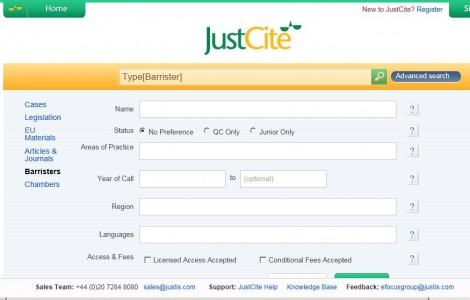
The search result includes contact information, practice areas, case history generated by Justis and representative cases and a biography if the barrister chooses to add to their profile.
Rather than show you a sample search result, I will leave ou to follow the links to the Advanced search at JustCite.com and check it out.
Posted on April 18th, 2012 - Editor: Shaunna Mireau
—
Searching Court Dockets
In Canada, legal researchers do not have many opportunities to search dockets of courts. That is not the case in the US. Manay of us will search US Court dockets infrequently. Today’s Tip: learn from the experts.
The American Bar Association Law Practice Magazine had an article last year titled Finding Info Like a Pro: Investigating Court Docket Databases. The article offers some tips, and it references a book that offers more.
Happy Searching.
Note: The Supreme Court of Canada Case Information database is available to searchers at http://www.scc-csc.gc.ca/case-dossier/cms-sgd/search-recherche-eng.aspx
Posted on April 11th, 2012 - Editor: Shaunna Mireau
—