All Our Research Tips
Words That Lead to Sources
Emond Montgomery Publications, a respected Canadian Legal publisher, has a super resource available (with a free login and password) for going from a legal word to sources of legal commentary. It is found on the EMP website using the “Click for free legal glossary” link in the site header to get to the Glossary of Legal Terms.
Unlike many legal dictionaries, the terms are not just defined, or defined using judicial decision references, rather the definitions are derived from within the catalog of Emond Montgomery Publications.
Following the source links under a definition will net you possibilities for purchasing the title (including buying it with an immediate download option.
Sample glossary term:
accelerate demand immediate payment
Source: http://www.emp.ca/books/281-2
Today’s Tip is about using this resource (and glossaries in general) to help identify the specific area of law that the key term is leading you to. EMP, like other legal publishers, offers up the table of contents for their titles so that you can see details (keywords) about the type of book that would contain the glossary term.
Irwin Law’s Canadian Online Legal Dictionary is another online legal dictionary that offers legal textbook references.
I would much start with author commentary on a legal term than judicial commentary. Textbooks lead to decisions, but decisions don’t always lead back to texts.
Posted on October 30th, 2013 - Editor: Shaunna Mireau

—
Note Up Legislation – Old School
Yesterday I whined a little about how hyperlinks and convenient search tools may be making for lazy researching. Today’s Tip is a reminder about how to search for judicial consideration of a statue section without using those convenient tools in CanLII, Quicklaw and Westlaw . If you are looking for cases that consider section 119 of the Health Professions Act, RSA 2000, c H-7 you could use the legislation note up shortcut tools that are provided with your favourite service OR you can search within any full text case law database with this formula:
“name of act” /10 #
Stated in words, the search is: act name as a phrase within 10 words of the section number. Using my example, the search looks like this:
“Health Professions Act” /10 119
Here are the CanLII results filtered for Alberta for the above search.
Posted on October 23rd, 2013 - Editor: Shaunna Mireau
—
Look for Groups
I like to learn from others. Stories and experiences and pain points that are described by other people inspire ideas for projects or methods that can be adopted to make things better/faster/more efficient in my organization.
Conference attendance is an important aspect of group interaction for me. There are other ways to connect with groups rather than in person.
- Newsletters and other reading material from special interest groups
- Local events
- Webinars
- LinkedIn groups
What is your favourite source for inspiration from a group?
Posted on October 16th, 2013 - Editor: Shaunna Mireau
—
Get That URL From Someone Else
My very first Slaw Tip back in January 2011 was titled Read that URL. Today’s tip is a reminder of that along with a twisty question.
- Libraries provide links to web sources (The sources are things on the web which means they move around)
- Libraries update their links when websites move (Quickly, because we use the links that we provide for our own research work)
- Why are you keeping extensive bookmarks that you have to update yourself?
Read the URL you are navigating to AND don’t waste your time looking for things that are on your firm’s intranet or your local law library links page. Don’t have an intranet at your shop? Check out the Practice Portals from the Courthouse Libraries BC for a great example of link collecting work that you can leave to others.
Posted on October 9th, 2013 - Editor: Shaunna Mireau
—
Revisit
I read novels more than once, which is a family trait in my household. We also watch television programs and movies more than once. There have been instances of multiple format consumption as well – I like the text version of To Kill a Mockingbird a whole lot more than the audiobook and movie.
We recently acquired a new LED HDTV with blah blah blah (options that make it provide remarkably clear, disturbingly life-like, images). The features are not important, but the takeaway illustrates something useful: a new method of viewing or using something may make it worth the time investment to revisit it.
An example, you have read a particular text that is now part of an online service, revisiting the content using a new format may cause you to see the content that you think you know differently. The consumption experience can change the way you remember the content consumed.
We have been watching Episodes I – VI of Star Wars on our new TV. Though this is the third or fourth time through revisiting this content, I am seeing (learning) new information that I have not noticed in the past.
Posted on October 2nd, 2013 - Editor: Shaunna Mireau
—
CanLII Forums
I get by with a little help from my friends – so say the Beatles, and I agree.
I was happy to see that help from my friends on New CanLII has been facilitated with CanLII Forums. Check out Feedback on the new CanLII and Évaluations du nouveau CanLII.
The folks at CanLII know:
I want somebody to love
Posted on September 25th, 2013 - Editor: Shaunna Mireau
—
New CanLII and Your Browser
Like the best programmed websites, the newly launched CanLII works well on mobile devices and in a wide variety of browsers, Chrome, FireFox, Safari, and Internet Explorer.
One thing to note for Internet Explorer (version 9) users is the IE Compatibilitiy View. If you are having difficulties with a research website, try turning off Compatibility View (in IE under Tools on the menu).
Some sites require Compatibility View to be “on”. It is worthwhile knowing that this function is available and to select or de-select it as needed.
Posted on September 18th, 2013 - Editor: Shaunna Mireau
—
Watch for Moving Targets
Building on last week’s tip about managing current awareness, today’s tip is about watching for source changes. A whine at my research blog shared a recent experience with the change of an RSS feed address. If you are monitoring information using automation to help, make sure you pay attention to when information should appear.
If you are considering watching Government of Canada news releases with RSS feeds, here is a handy list.
Posted on September 11th, 2013 - Editor: Shaunna Mireau
—
Add Current Awareness Reminders to Your Calendar
One of the really important aspects of lawyering is to have the right information at the right time for your clients. Sometimes this means watching a resource that has a regular publication schedule like the Canada Gazette Part II (the source of new federal regulations and proclamations). Canada Gazette Part II is published every second Wednesday. My Recurrence dialogue box for a “Check Gazette Part II” Outlook appointment looks like this:
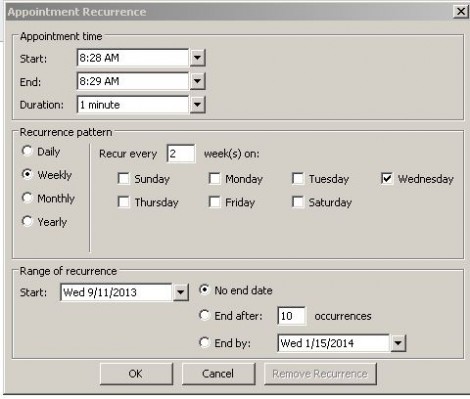
A one minute appointment every two weeks scheduled to not block a time when others may wish to schedule meetings with me. The body of the appointment has a link to the latest issue of Canada Gazette Part II. Happiness is not missing out on potentially important information.
An added benefit is the ability to invite a colleague to your appointment to make it a “meeting” – works great for short term assignments for vacation coverage!
Posted on September 4th, 2013 - Editor: Shaunna Mireau
—
Think About the Reader
I have had the benefit of working on a writing project with others from my firm recently. One of the key things that I have learned from this is that writers, especially if the work is intended to convince others to act, must put themselves in the shoes of the reader.
The next time you are reviewing a research memo, opinion letter, brief, or argument (or even an email), try to review your work as if you were a member of the intended audience.
This type of review is harder to practice than it sounds. It is especially hard to do when you have just finished the gathering stage of a research project. All of the information that you took in while you were researching makes it difficult to assume the mantle of the fresh eyed reader. It is also difficult to ‘be’ your audience if you don’t ‘know’ your audience.
This is one of those tips where I ask for comments … advice anyone?
Posted on August 28th, 2013 - Editor: Shaunna Mireau
—