All Our Research Tips
Why Can’t I Login to the Database?
A quick checklist for when a user tells you that they cannot access a particular database:
- User account hasn’t been set up
- Using the wrong username
- Using the wrong password
- Trying to log into the US version, not the Canadian
- Trying to log into the legacy version, not the new one (or vice versa)
- Someone else is already logged in using that username and password
- Access is through IP authentication and the user is trying to log in from a location that the database doesn’t recognize (like the user’s home)
- No longer have a subscription to the database
- Still subscribe to the database, but access has been accidentally cut off
— Susannah Tredwell
Posted on September 6th, 2017 - Editor: Susannah Tredwell

—
Miscellaneous Little Things That Annoy Me, Part 2
I keep a running list of these, jotting them down as I see or hear them. (You’re on notice.)
The both of you/us
Adele may sing in ‘Hello’ about ‘thuh B-O-O-O-O-TH of UH-UH-ss’, but don’t you be doing it.
It is both of you and both of us, with no definite article – not even when it’s from the UH-ther SI-YIDE.
British case
There is no such thing in law. You mean an English case (or perhaps a Scottish one).
(Great) Britain, which came into being when James VI of Scotland inherited the English throne on the death of Elizabeth I in 1603, consists of England (and Wales) plus Scotland. England and Scotland have separate legal systems and courts, so there can never be a British case: it’s either English or Scottish, but not both; British is not synonymous with English. (And it’s Great Britain to distinguish it from that lesser Britain, Brittany in France.)
I suppose there could be a UK case, since the United Kingdom Supreme Court hears appeals from all the constituent parts of the UK (Great Britain plus Northern Ireland), and the law lords make it clear when a judgment is applicable to all of the parts (as in Donoghue v Stevenson, a Scottish case the House of Lords did not confine to Scots law). But it’s purer to describe cases by their jurisdiction of origin.
All of this may unravel in the wake of Brexit, however…
Caselaw
This always suggests coleslaw to me.*
It isn’t statutelaw, commonlaw or customarylaw, so why would it be caselaw?
As The Solicitor General’s Style Guide, 2d ed (Washington, DC, 2015) uncompromisingly puts it, caselaw is a ‘barbarism’ requiring ‘total extirpation’.
It’s case law (add a hyphen to make that an adjective: case-law research).
Mid
This doesn’t always have to have a hyphen after it.
It’s mid-year review, because you’re making a compound adjective out of mid and year; but it’s I’ll see you in mid March (no hyphen). You don’t write I’ll see you in early-March or I’ll see you in late-March. Ergo…
Seven days notice
That’s an Apostrophe Catastrophe™ if ever there was one! It needs to be seven days’ notice, obvi.
‘Til
Please, no.
There are two English words that mean the same thing: until and till. ‘Til, an unnecessary modern variant of the latter, must (like caselaw) be exterminated.
Next tip: respect and regard
–Neil Guthrie (@guthrieneil)
Posted on August 30th, 2017 - Editor: Neil Guthrie
—
CanLII Tips Summer Roundup
Over the summer, the Legal Sourcery blog is publishing its most popular research tips. On that note, here are Legal Sourcery’s most popular CanLII tips:
If you have any questions, ask a Law Society Librarian! We are pleased to provide high-quality legal research services to Saskatchewan members in person, on the telephone, or by email.
[This tip by Alan Kilpatrick originally appeared on the Law Society of Saskatchewan Library’s Legal Sourcery Blog]
Posted on August 24th, 2017 - Editor: Law Society of Saskatchewan Library
—
Finding Unconsolidated Legislation
One challenge with legislative research is when you need to find an older act that, although still in force, has not been included in the last statute revision. The most obvious examples of this are private acts, but there are other pieces of legislation that fall into this category.
If you are looking for an older federal act and cannot find it in the 1985 revision you should check the Table of Private Acts and the Table of Public Statutes and Responsible Ministers. The Table of Public Statutes includes “a certain number of public Acts, passed before January 1, 1985, that were not consolidated in the Revised Statutes of Canada, 1927, 1952, 1970 or 1985.” For example, you can see that the Canada Shipping Act, R.S.C. 1970, c. S-9 is listed in the Table of Public Statutes, despite not having been consolidated since 1970.
British Columbia produces a Table of Private, Special and Local Acts and Unconsolidated Public Acts that lists all private and other unconsolidated acts along with their amendments. Most other provinces produce similar tables, e.g. Ontario’s table of Private Statutes.
The next step is to find the full text of the act as it currently reads. In some cases you may find you have to consolidate the act yourself using the original act and its amendments. In others you may find the jurisdiction already provides a consolidated version. For example British Columbia provides consolidations of a number of private acts.
— Susannah Tredwell
Posted on August 23rd, 2017 - Editor: Susannah Tredwell
—
U and Non-U
I refer here, not to Nancy Mitford’s use of these terms in Noblesse Oblige (a very funny if dated guide to the sociolinguistics of the English class system, circa 1955*).
I mean the troublesome letter U that divides US spelling from UK. As ever, Canada (British North America?) falls somewhere betwixt.
The basic pattern
Let’s start with honour/honor as typical.
The word comes from Latin, which spells it honor without a U. The word came to English via the Normans (1066 and all that), which meant that when it became acclimatised in England it retained the U of the French honneur.
Noah Webster, the nineteenth-century American lexicographer, wanted US English to be closer to its roots in (republican) Rome, so promulgated the non-U spelling that has stuck in the Untidy States ever since.
Canadians, originally more British than Yankee, tended to go with Britannia’s honour rather than Uncle Sam’s honor — but one now sees both spellings north of the 49th parallel. The dominance of US spelling in all things computer-related is wearing away the Anglo; the default settings for spell-check and auto-correct are invariably US English, not our Canuck variant. If you haven’t, please change this; it’s often these little cultural things that really make us different from our neighbo(u)rs to the south.
Complications
Honour begets honourable, and honor honorable.
That much is easy. But you would be deluding yourself if you thought English spelling followed regular rules.
Honour, labour etc. weren’t always the invariable British spellings. The Elizabethans would often leave out the U if they were feeling Latinate: Shakespeare’s play was originally published as Loues labors lost not Love’s Labours Lost. Certain words were routinely spelled with a U until the late 1700s (governour, horrour) but have now lost it.
And in modern British/Canadian English (as in the US), the correct form is honorary, not honourary — although in Canada one often sees the latter on the part of people who are so keen to wave the maple-leaf flag (or perhaps the Red Ensign) that they ignore (or don’t know) what’s correct.
The Yanks are not immune to this either: a number of years back, Ralph Lauren launched a perfume called Glamourous with an extra (but incorrect) U that was presumably intended to make the product look British, posh and … er … glamorous.
Similarly, one correctly writes colour, colourful, colourise/colourize and colourist but coloration; odour but deodorise/deodorize; humour but humorous; vapour but vaporise/vaporize; vigour but invigorate.
No one said it was easy.
Next: miscellaneous little things that annoy me, part 2
*In that book, U stands for ‘upper class’ (napkin not serviette, died not passed away etc.)
–Neil Guthrie (@guthrieneil)
Posted on August 16th, 2017 - Editor: Neil Guthrie
—
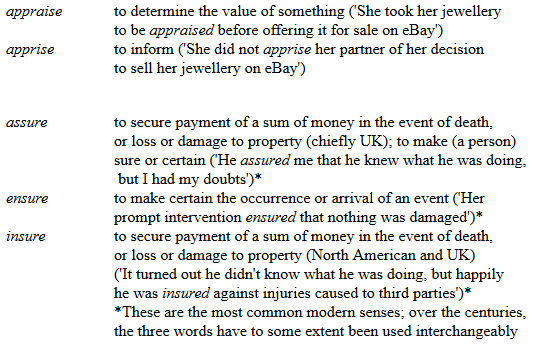
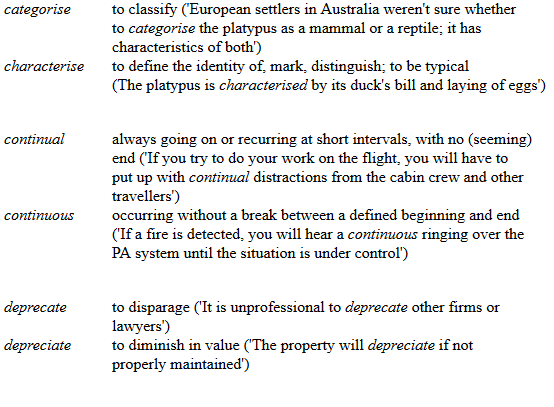
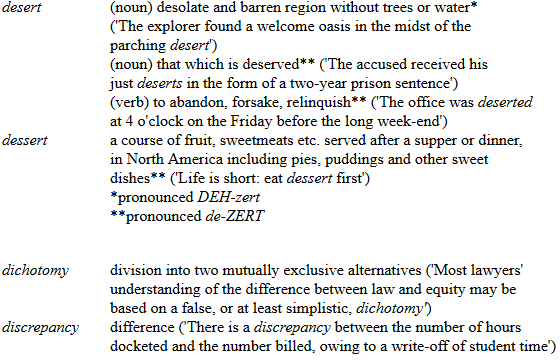
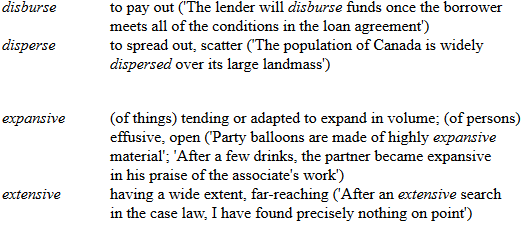
Confusing Pairs, Part 3
The return of a popular series.
Next: U and non-U
–Neil Guthrie (@guthrieneil)
Posted on August 2nd, 2017 - Editor: Neil Guthrie
—
–Ee, –Or
Not the donkey from Winnie the Pooh, but a pair of word endings.
First, –ee.
As in trustee, lessee, mortgagee, bailee, drawee, payee, attendee, mentee and the like.
This ending is common in law, often indicating the indirect object of some action. For example, the person to whom property is entrusted (trustee) or leased (lessee), the person to whom a mortgage is given (mortgagee).
It can also be the direct object of an action: for example, the person you employ (employee) or train (trainee).
So far, so good. But let’s not go crazy. Tippee (person in receipt of an (illegal) stock tip) is well-established, but not really necessary: one could as easily say the tipped or the recipient of a tip.
Worse are attendee, invitee, coachee and mentee. The first is illogical in relation to trustee or employee; the person who goes to something attends it, not is attended. Why not just say guest or participant? Invitee passes the logic test, but it’s rather ugly; here again, guest is preferable. Coachee is unlovely. Refugee, yes – but as for asylee, ugh.
Mentee is the one that really gets your humble scribe’s goat, however. It assumes that the word mentor, from which it is derived, comes from a verb in the way that other –ee words do.
Not so! Mentor is the name of the chap (but really the goddess Athena in disguise) who, in Greek mythology, tutored the young Telemachus while his dad went off to besiege Troy and then sail around the eastern Mediterranean. Mentee assumes that a mentor is someone who ments, but that isn’t a word at all, and certainly isn’t the root of either Mentor or mentor.
Admittedly, the alternatives for mentee aren’t great. I sometimes hear protégé(e), but that sounds at once pretentious and faintly creepy. How about just student, associate or junior?
Now, –or.
Lawyers like this one too: mortgagor, settlor, advisor. In non-lawyer English, -er is just as frequent, and sometimes one can use both (payer, payor). Adviser is perfectly correct (and actually the term of art used in Canadian securities legislation). Sometimes only the –er form is possible (employer).
One thing that has always puzzled me (OK, I may have time on my hands) is the difference in pronunciation between mortgagor and obligor. Under the normal rules of English pronunciation, those Gs before the Os should both be hard (as in gore). But it’s OB-li-gore (hard G) and MOR-gaj-or (soft G). In the US, the emphasis is more usually on the final syllable: mor-gaj-OR and ob-li-GORE – but still those inconsistent Gs.
There are, in fact, the older but now less common variants obligeor and mortgager. They have the same legal meanings as their –or equivalents; an obligeor is also ‘a person who performs a service or kindness’. Pronounced MOR-gaj-er and o-BLIGE-er.
Now you know.
Next up: confusing pairs, part 3
–Neil Guthrie (@guthrieneil)
Posted on July 19th, 2017 - Editor: Neil Guthrie
—
What Are Marginal Notes?
Marginal notes (also known as head notes) are “the short notations appearing above or beside each section […] of an Act or Regulation” (Sullivan on the Construction of Statutes, 6th ed., §14.59). These notes are intended to help readers identify pertinent provisions in the legislation. The name comes from the fact that they originally appeared in the margins of legislation next to the relevant provisions.
Despite appearing in an act or regulation, marginal notes are not actually part of that legislation. Sullivan is rather disapproving of this:
“Although technically marginal notes are not considered part of legislation, in fact they are physically present and may well constitute the most frequently read component of many Acts and regulations. To ignore whatever light they shed on the meaning of legislation seems artificial and appropriate.” (§14.60)
That said, there are several cases in which marginal notes have been used for legislative interpretation (e.g. R. v. A.D.H., 2013 SCC 28) but this is not uniformly the case. For example, in Imperial Oil Ltd. v. Canada; Inco Ltd. v. Canada, 2006 SCC 46, it says at paragraph 57 “although marginal notes are not entirely devoid of usefulness, their value is limited for a court that must address a serious problem of statutory interpretation.”
Because marginal notes aren’t officially part of legislation, the process of amending them does not necessarily involve an act or regulation. For example, in British Columbia they are amended by the publications staff, not the legislature:
“On this basis, marginal notes are not amended by legislation. They are changed editorially by our publications staff in consultation with legislative counsel. This is done most commonly in conjunction with a legislative amendment to the relevant section, so that the marginal note will better reflect the content of the section.” (A Guide to Legislation and Legislative Process in British Columbia)
This leads to situations in which the only way to know if a marginal note has changed is by looking at the most recent copy of the consolidation produced by that jurisdiction’s Queen’s Printer (or equivalent).
Posted on July 12th, 2017 - Editor: Susannah Tredwell
—
Navigating Social Media
For those who need a brief refresher on social media (or an introduction), here is a succinct guide to the various platforms:
(I would spell that ‘doughnut’, though – and ‘donut eating’ should be hyphenated.)
In terms of how to post information, you might bear the following points in mind.
Choose your distribution channel appropriately
The best social media for business and professional purposes are LinkedIn and Twitter.
Use Instagram and Facebook for pics of vacations, amazing restaurant meals, your kids, the dog.
Manage your presence
If you have a social media presence that is purely personal (vacations, amazing restaurant meals etc.), that doesn’t mean it can be un-professional.
Don’t post things via a non-work account that you wouldn’t want your employer or your clients to see. Everybody has Google, and someone is bound to find those pics of you at the kegger with your pants down.
Don’t reveal confidential client information or say negative things about a client (or your employer). You should also exercise caution in speaking out on public issues that a client may have an interest in – even if this does have the effect of clipping the wings of your commentary. An ‘all views my own’ disclaimer may not be sufficient when someone is upset.
Join appropriate groups on LinkedIn.
Don’t feel you have to accept every LinkedIn connection request. There are a lot of spammers and other opportunists out there. And think about the people you do connect with: it was a bit off-putting when a professional contact of mine connected on LinkedIn (and perhaps elsewhere) with an adult film star. Similarly, adding every legal recruiter in town to your LinkedIn contacts will send a signal.
Keep it short
Twitter famously limits tweeted messages to 140 characters, although there have been rumours that this may be eased. That would be a shame: the beauty of a tweet is its very pithiness, and a word-limit imposes a healthy discipline.
Keep your posts on other platforms on the short side, too. No one is on social media to read the Encyclopaedia Britannica, and most will be looking at your update on a mobile device with a small screen.
Don’t overdo it
Regularly posting updates is an effective way to remind your friends, colleagues and clients that you haven’t fallen off the face of the earth – but no one needs minute-by-minute live-tweeting of you doing document review.
And don’t post for the sake of posting: have something meaningful to say.
Use existing content
Retweet items from trusted sources to your legion of followers. Like or repost updates on LinkedIn.
The only way to build a true personal brand, however, is to post original (and, ideally, thoughtful) content of your own.
Link appropriately
If you are saying nice things about someone, include a link to that person’s LinkedIn profile. Include that person’s Twitter handle or a hashtag with a company name or keyword.
Next time: –ee, –or
–Neil Guthrie (@guthrieneil)
Posted on July 5th, 2017 - Editor: Neil Guthrie
—
Bardal Factors Employment Law Tool
Researching employment law? You will be excited to learn about a new employment law resource, bardalfactors.ca. Designed to be used by lawyers and self-represented litigants, this tool enables you to quickly and easily identify reasonable notice periods for termination and dismissal.
Specifically, the tool allows you to locate cases that have applied the Bardal factors. What are these factors exactly? The factors come from the 1960 decision Bardal v. Globe & Mail Ltd. (1960), 24 DLR (2d) 140. They include age, length of employment, character of employment, and availability of similar employment. According to the website, the factors:
Represent the starting point in determining reasonable notice. And since there are over 1,000 rulings from Canadian courts expressly laying out precisely how the factors were applied, everyone – from employment lawyers to employers to employees – can look through the rulings and form a pretty good guess of how a court might rule.
However, bardalfactors.ca cautions that employment law is very complex and the factors are only a basic starting point for determining legal entitlement to notice. More research is always needed. The tool is still under development and is available in beta.
[This tip by Alan Kilpatrick originally appeared on the Law Society of Saskatchewan Library’s Legal Sourcery Blog]
Posted on June 28th, 2017 - Editor: Law Society of Saskatchewan Library
—