






All Our Tips
Small Things

Small and incorrect, that is.
Thank-you
This isn’t wrong when used as a noun (She sent a bottle of wine as a thank-you) or as an adjective (That thank-you bottle was much appreciated).
It is wrong when you are using the words to thank someone, as I saw in an e-mail recently: Thank-you for your help.
In that instance, Thank you is just a truncated version of I thank you, and no hyphen is necessary (or correct) in that kind of short sentence.
Fear and loathing?
This was the opening to a recent e-mail bulletin: I was loathed to admit …
OK, if by that the author meant he was detested – but that was clearly not the intention.
Auto-correct could be at work here, since many people say (and write) that they are loathe to do something (pronounced to rhyme with clothe).
That’s wrong too, though; the correct word is loath, sometimes (historically) spelt loth. They rhyme with growth and mean ‘unwilling, reluctant’.
Feedbacks and softwares
Like learning and training, these should never be pluralised.
NEVER.

Thanks (Again)
I wrote previously about thank-you (with the hyphen, it’s noun or adjective only – not the actual expression of thanks).
Someone I follow on Twitter (@BrendanCormier) identified another problematic usage involving gratitude: thanks in advance, which he calls ‘one of the most insidiously awful phrases in the english language’.
I agree wholeheartedly with that sentiment.
Even though it’s grammatically unassailable, stylistically it’s deplorable.
Presumably your request also incudes please, so the anticipatory thanking is redundant. Thanks in advance is also becoming a shop-worn cliché (so to be avoided for that reason alone).
But more than that, the phrase suggests that the writer won’t necessarily bother to thank you when you do fulfil the request.
This is just rude and more than a bit passive-aggressive.
Please don’t use this dreadful phrase, and just thank when appropriate.
Thanks.
An Apostrophe Catastrophe™ From Someone Who Ought to Know Better
Seen in an e-mail from one of the big legal publishers (there are really only two, so that narrows it down; emphasis added):
“Tailor a motion or argument to a specific judge by reviewing the cases, phrases, and judge’s a judge is most likely to rely upon.”
Judges is a plural noun here, not a possessive. Obviously.
Did they fire all the copy-editors?
Finding Older Newspaper Articles
While recent newspaper articles are reasonably easy to find (give or take a paywall), older newspaper articles can be a bit more challenging to locate.
If a newspaper article you are looking for is not available through the paper’s website, the following resources may be useful in tracking articles down:
- The newspaper resources offered by your public library.
- Check out your local university’s publicly available databases; you may find resources akin to UBC’s B.C. Historical Newspapers database.
- Google News Archives Search – this provides access to archives of newspapers, both scanned and text-based. Searching is free, but there may be a charge to access the full text.
- Lexis Advance Quicklaw – LAQ offers access to a number of newspaper titles although access will depend on your subscription
- Library and Archives Canada’s Canadian News Online – this provides links to “a sampling of news resources” including historical newspapers.
- Newspapers.com from Ancestry – this provides access to scanned newspapers covering the 1700s-2000s. While searching is free, you will need an account to see the results.
Social Media
Increasingly, I’m seeing this with a singular verb: Social media is …, Social media has …
While the phrase can logically be regarded as a singular concept encompassing different components (LinkedIn, Twitter and their ilk), I still don’t like it.
Why? Media is a plural, the singular form of which is medium.
Just like data, which is the plural of datum – although I guess I can see big data as singular if it means a monolithic construct rather than the sum of its parts.
The French don’t do this better. Where we would refer to the media (and improperly use a singular verb), in French one would say les médias. Even my 1903 Larousse dictionary, which doesn’t list médias at all (not thought of as a category back then, presumably), gives médiums as the plural of médium.
The medium is the message, as a wise man once said.
Fonts: The Forensic and the Forward-Looking
First, the forensic.
In Re McGoey, 2019 ONSC 80, a bankrupt argued that two properties had been placed in trust for his children in 1995 and were not part of the assets available to his creditors in 2018.
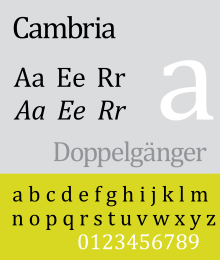
The trustee in bankruptcy produced an expert in design and typography, who testified that the fonts of the purported trust deeds (Cambria and Calibri, respectively) were developed by Microsoft in 2002 and not released to the public until 2007. No one in 1995 could have used them.
On the strength of that evidence, the judge concluded that the trusts were a sham, and fraudulent preferences intended to defeat creditors.
On a more positive note, lawyers should think about fonts in their own documents – obviously not in order to deceive, but rather to make their written work easier to read and more compelling.
Guidance can be found in Matthew Butterick’s Typography for Lawyers: Essential Tools for Polished and Persuasive Documents, 2d ed. (Houston, Tex.: O’Connor’s, 2015). My copy of the first edition was a gift from the late Simon Fodden, Slaw’s founder.
Some fonts are more readable on a screen than on a printed page, and vice versa. Others are better suited to contracts than presentations. Some fonts look professional, others (Comic Sans) do not.
Butterick hates Arial; and, while ‘it’s not that Times New Roman is a bad font’, he doesn’t exactly love it (the United States Supreme Court forbids it).
The book also discusses punctuation marks, spacing, formatting and lay-out, with elegant sample documents and practical advice.
Gross Negligence
As a follow-up to my last tip, which was on strictly prohibited and strictly forbidden, what about gross negligence?
This is a term we have imported from US law. Canadian (and English) judges and authors were not keen on it initially.
Linden et al in Canadian Tort Law (2018) cite Baron Rolfe, a famous 19th-century English jurist (later Lord Cranworth LC), who said that gross negligence is merely ordinary negligence ‘with the addition of a vituperative epithet’. A sceptical American judge ‘is reputed to have compared the differences among negligence, gross negligence and recklessness to the distinctions among a fool, a damned fool and a God‑damned fool.’ (Still a fool.)
Over the years, Canadian case law has come to recognise that the term has its uses, however.
Sir Lyman Duff CJ thought gross negligence usefully described ‘a very marked departure from the standards by which responsible and competent people in charge of motor cars habitually govern themselves’, adding that it is ‘not difficult of application by a jury whose minds are not confused by too much verbal analysis’ (Murray v McCulloch, [1942] SCR 141).
As one student suggested to me, it would be grossly negligent to leave Homer Simpson in charge of operations at the nuclear power plant, but probably only negligent to entrust things to any other employee at the same level.
That made perfect sense.
Finding UK Docket Materials
I’ve previously talked about how to find docket information about Canadian courts.
If you’re trying to find information about the status of current British cases, there are a few options:
- The HM Courts & Public Tribunals website offers docket information for the Queen’s Bench Claims and Appeals (London only) and the Business and Property Courts. It is free to search once you create a login. Coverage is as follows:
- Business and Property Courts (London only): 1 January 2016 (for new cases)
- Queen’s Bench Claims and Appeals (London only): 5 November 2018
- Business and Property Courts (outside of London): 25 January 2019
- Case Tracker allows users to search for information on applications or appeals in the Court of Appeal, Civil Division (free)
- Supreme Court of the United Kingdom provides information about current and decided cases (free)
- v|lex is a paid service that offers UK docket information
- GlobalX is another paid service that provides UK court searches and document retrieval
Strictly Ballroom?
Strictly Ballroom is the title of a 1992 movie by Baz Luhrmann.
What has this to do with legal writing? The word strictly.
Like all adverbs, strictly is weak, even when it is meant to sound tough.
Think of strictly prohibited, which is frequently seen in toothless e-mail notices: ‘This e-mail message is privileged and confidential. Any unauthorized use or disclosure is strictly prohibited.’ By what? Sender, the horse is out of the barn door.
Strictly prohibited seems to be especially popular in the regulations of Nova Scotia. Some choice excerpts from the Boxing Authority Regulations, NS Reg 155/2002, for example (emphasis added):
184 It is strictly prohibited for boxers to practice “blood boosting”, the intravenous administration of blood or blood products to enhance the boxer’s performance, for non-medical or recreational purposes.
185 (1) The administering or use of drugs or stimulants, including smelling salts or ammonia, either before or during a boxing match, to or by a boxer is strictly prohibited.
187 The use of iron-based coagulants such as “Monsel’s Solution” or any of its derivatives is strictly prohibited and the use of any such coagulant is cause for immediate disqualification.
As opposed loosely prohibited, somewhat prohibited, only a little bit prohibited?
Just say something is prohibited and set out the penalty for violating that.
As bad is strictly forbidden, often seen in warnings not to reproduce or download material – and in the English versions of Quebec regulations:
A common drinking-cup is strictly forbidden. [Regulation respecting sanitary conditions in industrial or other camps, CQLR c S 2.1, r.5.1, s 11]
Adding strictly runs the risk of exposing your threat as empty, if you can’t back it up.
Just who is policing shared use of cups in the industrial camps of Quebec anyway?
Complete Comma Confusion
Commas can be confusing, and one of the most common misuses is this:
Join partner, Eleni Papadopoulos for this informative seminar on …
Sometimes another comma will be placed after the person’s name as well.
Both are wrong where there are more partners than one.
Offsetting someone’s name with two commas suggests she is the only partner (which is impossible at law), and using only one comma just doesn’t make sense.
To recapitulate, My friend Ed… means I have a friend called Ed, but also some other friends. My friend, Ed, … means I’m a bit of a loser and have only one friend. He’s called Ed.
Here are some even more puzzling commas that have crossed the radar recently:
- Make culture, part of your Performance Management.
- It is my hope, with the current modernization efforts that are being implemented, this tradition of exemplary customer service, will blossom and flourish for generations to come!
- The Canadian Bar Association, recommended that …
- Moses will be supporting, Jennifer and Eli in the corporate group.
The first is a corporate slogan seen on LinkedIn. The comma is presumably intended to create an emphatic pause, but it’s wholly unnecessary (as are the caps on performance management).
The second is a rather florid customer testimonial in an ad for public transport in Toronto. The writer probably got a bit confused by a relatively complicated sentence, which he thought needed more breaks than it actually does. The third comma is superfluous.
The last two examples are more puzzling, but are perhaps also meant to be in the ‘emphatic pause’ category.
The errant commas in examples 3 and 4 could just be typos, but the fact that they emanate from the same lawyer writer suggests that some remedial comma training would be in order.