







All Our Tips
Should That Be –Able or –Ible?

Or even –uble?
Perhaps not one of the burning questions of the day, but I bet you’ve hesitated over this at least once.
I did recently, when trying to Google an antiques dealer who had a well-priced early 20th-century silver snuffbox. The dealer used the form collectibles in its business name, it turned out.
This is the (mostly) US spelling of the preferable (but disappearing) collectable, which means ‘that may be collected’ (Violators are subject to a fine collectable on summary conviction) or ‘(thing) worth collecting, sought after by collectors’ (Silver snuffboxes are highly collectable – really!).
Is there a general rule for determining which ending to use? Most of the time it’s –able, and usually if the stem is a complete word in itself (bill/billable, as opposed to feasible or tangible, which aren’t formed from feas and tang).
The more detailed rules are a bit arcane.
The default position is –able, unless the word is derived from a Latin verb ending in –ere or –ire, or where there is a well-established –ible form (like collectible?) in English already.
If your Latin is a bit rusty, you’ll just have to remember a list of words like this:
- demonstrable (–able replaces the final –ate in demonstrate, as with abominate, alienate, appreciate, calculate etc.)
- enforceable (the final –e of enforce stays so the following consonant stays soft; same thing for manageable, pronounceable etc.)
- forgivable (the final –e in forgive drops out because it isn’t necessary for pronunciation; same thing for movable, usable and the like)
- justifiable (the final –y gets converted to an i)
- predictable
BUT
- convertible
- incorrigible (compare uncorrectable)
- incredible (compare unbelievable)
- irresistible
- perceptible (perceivable)
- responsible
- reversible
- soluble and insoluble (a soluble substance, an insoluble problem – although unsolvable is also possible for the latter)
Where the stem ends in a hard C or G, or a consonant that gets doubled in the adjectival form, go with –able (amicable, navigable, forgettable).
New words have tended not to go with the –ible ending.
Sometimes there are two forms, not always with the same meaning: extendable and extendible are interchangeable; but contractable (‘able to be caught’, like a disease) isn’t the same as contractible (‘capable of being made smaller’).
Totally confused now?
Next: your queries answered, part 3

Irwin Law’s Canadian Online Legal Dictionary

Are you familiar with Irwin Law’s Canadian Online Legal Dictionary (COLD)? COLD is a free online legal dictionary and is composed of all the terms featured in the legal textbooks published by Irwin Law. COLD is described in more detail on Irwin Law’s website:
We are a collaborative dictionary comprised, initially, of terms defined in the glossaries of Canadian law books published by Irwin Law. The dictionary will be maintained by an Irwin Law editor. Members of the public are invited to submit new defined terms, edit existing terms and supply citations, sources and related terms — simply request to become a COLD contributor when you create your Irwin Law account. We look forward to receiving your submissions!

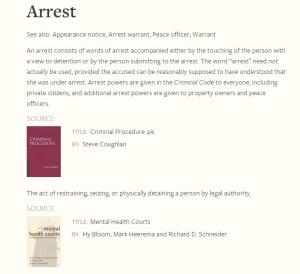
COLD can be searched by keyword or browsed by topic area. Searching COLD for a definition may lead to multiple definitions of the same term as COLD will highlight all of Irwin Law’s textbooks that have defined the term. For example searching for the term arrest will lead to two definitions as two separate Irwin Law texts, Criminal Procedure and Mental Health Courts, have defined the term:
I encourage you to check out this free resource. You can access COLD online at https://www.irwinlaw.com/cold. Let us know what you think about it.
[This tip by Alan Kilpatrick originally appeared on the Law Society of Saskatchewan Library’s Legal Sourcery Blog]
Search Your Name!

You’ve probably done it before. And maybe there were no surprises. Nothing to worry about. That’s great. But how long has it been? This internet that we love so much? It’s not really known for ‘staying put’. Blink once and something will happen.
And while you’re developing new habits, it wouldn’t be a bad idea to also search your firm name and the names of your associates and staff, particularly if they’re meeting with clients.
You may be pleasantly surprised. Some new, complementary reviews that you didn’t know about? Great. Post them on your website. Thank the generous clients and referrers that wrote them. Ask if they wouldn’t mind cross posting the same comments elsewhere. LawyerRatingz. Google Plus. LinkedIn…
Or, you may find less than pleasing results. It happens. Bad reviews. Strange or inappropriate information about your team.
Either way, it’s helpful to know what’s out there before your clients do. That way, whether it’s good news or bad, you can position yourself to make the most of the situation.
Legal Research Video Series From Courthouse Libraries BC
Are you looking to develop more effective legal research skills? Consider checking out Legal Research Essentials: Finding Cases on Point from Courthouse Libraries BC. This is a hands-on legal research course consisting of several video modules. The video modules visually demonstrate how to search free legal resources like CanLII. You can find the course online at Courthouselibrary.ca.
The course is hosted by Alex McNeur, a reference librarian with Courthouses Libraries BC. Alex explains in the introductory video that the course is designed to help practising lawyers learn how to locate case law based on a particular fact pattern. The course has four teaching objectives:
- How to identify strong keywords for efficient research
- How to use the keywords to find relevant cases
- How to find related cases by noting up your case
- How to check if the cases found are still good law
 Each video of the course works towards resolving a particular legal scenario: Does the engagement ring need to be returned if the wedding is called off? Some of the course content has been specifically created for British Columbia lawyers. However, members of the Saskatchewan Legal community should still find Legal Research Essentials: Finding Cases on Point extremely useful.
Did you know that the Law Society of Saskatchewan Library has also created a series of video tutorials that demonstrate how to search CanLII and the Saskatchewan Cases Database? Please comment below if you are familiar with any other helpful legal research video tutorials.
[This tip by Alan Kilpatrick originally appeared on the Law Society of Saskatchewan Library’s Legal Sourcery Blog]
It Could Go Either Way
English is a very difficult language to learn – and not just for those whose mother tongue is something else.
Native speakers may, in fact, have a harder time, because they may have picked up the rules (more or less accurately) by osmosis, rather than having them clearly articulated.
This is complicated by English spelling, which is fluid. Before the early 1700s, you could spell things more or less how you felt – which largely meant phonetically. There were, for example, 20-odd variants of Shakespeare in use during the playwright’s lifetime (and his own spelling of the name was inconsistent).
Even modern writers are faced with choices, and there isn’t always a clearly preferred spelling – as the following examples will attest.
Dreamed or dreamt?
Many verbs used to have past-tense forms ending in both –ed and-t. In modern English, one form or the other may survive, or sometimes both. It isn’t always clear which one is better: go by instinct.
No one still writes stopt or curst, but on the other hand you would always use crept, dealt, felt, kept, meant, slept and swept.
Verbs that could go either way: bereave, burn, dream, kneel, lean, leap, learn, smell, spell, spill, spoil.
Amongst and whilst are still with us, although the latter is not often seen in North America. Someone plumped for betwixt in response to the tip on between versus among, but don’t go there.
Preventive or preventative?
Both OK, shorter form better?
Roofs or rooves?
Both are correct. My instinct would have been to go for rooves, but the Oxford English Dictionary Online and Fowler’s Modern English Usage prefer roofs. Not sure I agree…
Similar words that could go either way (and Fowler prefers –fs except as noted): hoof, oaf, scarf (-ves better), staff (staffs when it’s about personnel, staves when musical), wharf.
And then, of course, there are the Toronto Maple Leafs, for whom there is no linguistic (or perhaps other) explanation. (The rapper Snoop Dogg likes Leafs for a different reason.)
Next time: should that be –able or –ible?
More Tips on Using Microsoft Word
The most popular blog post on Legal Sourcery since our launch in 2014 is Cross-referencing footnotes in Word by Reché McKeague. This post has been read 11,012 times since posted on April 29, 2014. That’s an average of almost 400 times each month. Here are a few more interesting posts on Word tips and tricks from other law blogs:
5 Microsoft Word Tips to Make Lawyers’ Lives Easier (FindLaw)
Get the Most Out of Microsoft Word (American Bar Association, Law Practice Magazine)
Master Class: Microsoft Word Shortcuts for Lawyers (LexisNexis Business of Law Blog, video)
If you have already upgraded to, or considering upgrading to Office 365, here’s an article with useful tips:
15 Amazing Features in Office 365 That You Probably Don’t Know About (Business Insider)
[This tip originally appeared on the Law Society of Saskatchewan Library’s Legal Sourcery Blog]
The Power of a Deep Breath – Find Yours
Start right now.
Place your hand on your heart. Notice your heart beat beneath the palm.
Think of someone or something that brings you happiness. You can’t help but gently smile.
Take a slow, deep breath. Feel your chest rise as you inhale. Feel your heart beat against the palm of your hand.
Hold for one or two counts.
Exhale slowly.
Repeat three to five times.
Remember, this practice is for you. Find your own pace, one that feels good to you. Time your inhale and exhale to the count of five or more if you prefer.
Close your eyes, or leave them open. Which is more natural to you?
If you are in a public place and don’t want to put your hand on your heart, that’s ok, leave that out.
Join me in practicing this simple pause to breathe three times a day. How hard can that be?
Really hard sometimes, until it becomes habit.
As a shallow breather by default, I now practice deep breathing three or more times a day to help counteract this natural propensity.
When I become immersed in my work, I stop breathing from my diaphragm. This increases both physical and mental tension.
Taking mini breaks during the day to consciously breathe helps me clear my head and body, and regain my focus.
Deep breathing also sends a signal to the brain I am relaxing and flips my mental switch from stressed to relaxed.
In a relaxed state we all have enhanced cognitive capacity and enhanced decision-making skills. We can better handle all the environmental distractions and triggers around us.
Join me in adding this simple deep breathing practice to your day.
Notice and enjoy the benefits.
Send me an email to let me know what you discover!
When Do Regulations Come Into Force?
Regulations generally come into force on either a date specified in the regulation itself or, if no date is specified, on the date that regulation was filed. (Note that this is not the case for Newfoundland, Prince Edward Island, or Québec.)
The coming into force provisions for a regulation are usually found in the Regulations Act (or equivalent) of a jurisdiction:
- Federal: “Every enactment that is not expressed to come into force on a particular day shall be construed as coming into force … (b) in the case of a regulation, on the expiration of the day immediately before the day the regulation was registered pursuant to section 6 of the Statutory Instruments Act or, if the regulation is of a class that is exempted from the application of subsection 5(1) of that Act, on the expiration of the day immediately before the day the regulation was made.” (Interpretation Act, RSC 1985, c I-21, s 6(2))
- Alberta: “Unless a later day is provided, a regulation comes into force on the day it is filed with the registrar and in no case does a regulation come into force before the day of filing.” (Regulations Act, RSA 2000, c R-14, s 2(2)).
- British Columbia: “A regulation or portion of a regulation comes into force on the date of its deposit unless (a) a later date is specified in the regulation, or (b) an earlier date is specified in the regulation and the Act under which the regulation is made authorizes the regulation to come into force on an earlier date.” (Regulations Act, RSBC 1996, c 402, s 4(1))
- Manitoba: The Statutes and Regulations Act, CCSM c S207, s 20
- New Brunswick: “A regulation or any provision of a regulation comes into force on the day that it is filed with the Registrar unless (a) a later day is specified in the regulation, or (b) an earlier day is specified in the regulation and the Act under which the regulation is made authorizes the regulation to come into force on an earlier day.” (Regulations Act, RSNB 2011, c 218, s 3)
- Newfoundland: “Unless another day is provided, subordinate legislation comes into force on the day it is published under section 11 but in no case does subordinate legislation come into force before the day of filing unless it is provided in the Act under the authority of which the subordinate legislation has been made or approved.” (Statutes and Subordinate Legislation Act, RSNL 1990, c S-27, s 10(2))
- Northwest Territories: “A regulation or part of a regulation comes into force on the day on which it is registered unless (a) a later day is specified in the regulation, or (b) an earlier day is specified in the regulation and the Act under which the regulation is made authorizes the regulation to come into force on an earlier day, in which case the regulation comes into force on the later or earlier day, as the case may be.” (Statutory Instruments Act, RSNWT 1988, c S-13, s 8)
- Nova Scotia: Regulations Act, RSNS 1989, c 393, s 3(6)
- Nunavut: Statutory Instruments Act, RSNWT (Nu) 1988, c S-13, s 8
- Ontario: “Unless otherwise provided in a regulation or in the Act under which the regulation is made, a regulation comes into force on the day on which it is filed.” (Legislation Act, 2006, SO 2006, c 21, Sch F, s. 22(2))
- Prince Edward island: ”Every regulation which is not expressed to come into force on a particular day comes into force on the day the regulation is published in the Gazette.” (Interpretation Act, RSPEI 1988, c I-8, s 3(4))
- Québec: “A regulation comes into force 15 days after the date of its publication in the Gazette officielle du Québec or on any later date indicated in the regulation or in the Act under which it is made or approved.” (Regulations Act, CQLR c R-18.1, s 17)
- Saskatchewan: “A regulation or part of a regulation comes into force on the date of its filing unless: (a) a later date is specified in the regulation; or (b) an earlier date is specified in the regulation and the Act pursuant to which the regulation is made authorizes the regulation to come into force on the earlier date.” (Regulations Act, SS 1995, c R-16.2, s 5)
- Yukon: “Unless a later day is provided, a regulation shall come into force on the day it is filed with the registrar.” (Regulations Act, SY 2002, c195, s 2(2))
There are, of course, exceptions; for example in Alberta, section 1(2) of the Regulations Act lists legislation which is not considered to be a regulation for the purposes on the Act.
Uncivil Conduct Can Be Cured With Civil Conduct
For several years I worked in a small-ish town in a small-ish bar where everybody knew your name. Stepping into an examination for discovery was almost as familiar as stepping into Cheers. During an examination for a discovery of my client, defence counsel – a lawyer who was typically patient and good-natured – became frustrated and raised his voice. I let it go. But the anger continued into the next question, louder still, demanding my client answer the question with more clarity. I stuck out my hand, fingers up, palm out, to indicate to my client not to answer. Defence counsel whipped around, facing me, eyes digging into me, “What? I’m entitled to an answer!” To which I answered, poker-face, in as calm and measured as a tone as I could muster while maintaining eye contact, “For the record, defence counsel’s voice has raised to an unacceptable level in my view. Let’s take a break. I could use a coffee.” I nodded to my client and we stood up and walked over to grab a few snacks. Defence counsel followed suit, nary a word between us. When we returned to the room, the discovery continued civilly.
After the discovery I received an email from defence counsel apologizing for his conduct. He was going through some problems outside of work. It was unnecessary but a nice gesture – whatever wrong was done was forgiven quickly. Uncivil conduct can be cured with civil conduct. I try and remind myself whenever I see someone treat me poorly that “it’s not personal”. It is likely a bad day for that person, or it is how that person treats everybody. Somehow that helps me forgive and soldier on. It’s a small thing, but I hope it helps you too.
Between and Among
This one may surprise you.
Purists often say that between must – MUST! – refer only to a relationship involving two parties or things, and no more. The –tween bit does have the same origin as the number two, after all.
Among, the purists say, is to be used when the relationship involves three or more persons or things.
The purists are too pure. The Oxford English Dictionary and Fowler’s Modern English Usage have long warned that this supposed distinction between between and among is mere ‘superstition’.
According to OED, ‘between has been, from its earliest appearance [at least as far back as the year 931], extended to more than two’ – and ‘it is still the only [emphasis added] word to express the relation of a thing to many surrounding things severally and individually; among expresses a relation to them collectively and vaguely…’
One would therefore correctly say:
- The space lying between the three trees
- A treaty between three states
- A difficult choice between three candidates
- You are among friends
- Among many choices, he took the easiest option
- She is a keen tennis-player, among other things
In contractual drafting, however, you may be better off saying The agreement among X, Y and Z – if only to keep the (misguided) purists at bay.
As Ross Guberman observes in Deal Struck: The World’s Best Drafting Tips (2014), debating the point with the purists is probably ‘not constructive’.
And while we’re on the subject…
Never between you and I. Always between you and me.
Next: it could go either way


