






All Our Tips
My Favourite Apps – Part III

I love planning trips almost as much as going on the trip itself. So, I am always on the lookout for cool travel apps.
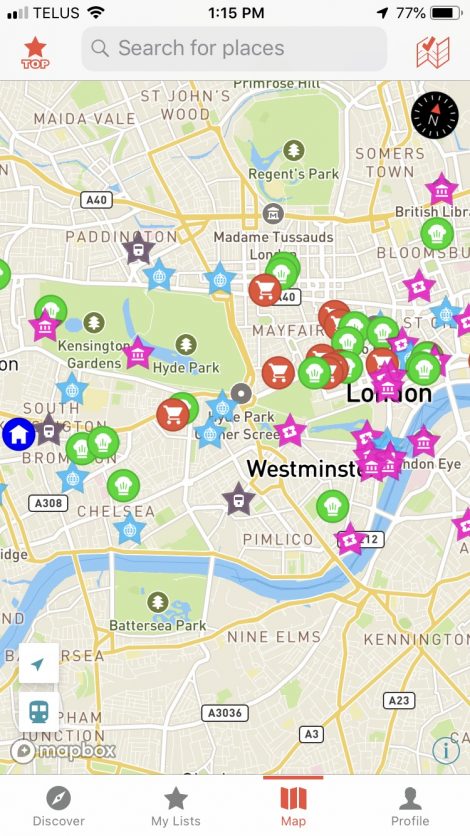
Ulmon CityMaps2Go is now my key tool for planning (and executing) city trips. You can use different coloured markers to map out all of the tourist attractions, restaurants and shops that you want to visit. I find the visual grouping of sites makes it easy to plan a day. Or, in the midst of a trip, to determine where to go next.
Ulmon also enables you to share your great ideas with travel companions. Once I have mapped out an upcoming trip, I send it to my spouse (who unlike me does not share my love for trip organization). She then has a quick overview of our plans for the trip and can click on any of the
markers to learn more about a particular venue.
I should also note that all of the maps can be downloaded for offline use. So, no need to incur expensive cellular charges.
I recently visited London. Here’s a quick snapshot, including our home base marked in blue.
Lesha Van Der Bij (@LVanDerBij) is CEO & Founder of Optimize Legal – keeping law firms and businesses up-to-date on changes to the law.

Go to Live Events

Technology has made life better in oh so many ways. Today, we can even make new connections with colleagues and clients, without leaving the comfort of our home or office.
But there’s been a price to pay.
We’ve become less inclined to get out there, in person. The truth is, it’s just so much easier not to. No traffic. No subway closures or delays. For lawyers, that translates into joining webinars instead of attending live conferences and other educational programs.
That’s a shame because there are so many good reasons to make the effort to show up in person. Here are just three!
- Your phone can’t replace the energy of a room. While, you may hear the same content, somehow you won’t have the same experience. Live is better. Every time. A live program will make a bigger impact and stay with you longer.
- You never know who you will meet. Sometimes the most ordinary event can result in the most important of connections. You won’t know, if you don’t put yourself out there.
- Solutions to the issues you’re struggling with don’t happen in isolation. When you meet up with a group of peers, discussions about shared challenges and opportunities tend to happen organically.
So, the next time you receive an invitation or a newsletter or someone asks if you’d like to join them at a professional event, make the effort! Better yet, be the someone asking others to join you.
—
For more reading related to networking for lawyers, see these past articles on SlawTips and Slaw:
- Law Firm Marketing: Finding an Online/Offline Balance
- Networking for Introverts
- Networking Online or Off: The Same Rules Apply
Also, see the following related articles by Sandra Bekhor, Practice Development Consultant:
- Finally! A social media group for lawyers that’s actually social. (Press Release)
- Make it rain on LinkedIn
- Climbing the Social Media Tree
Who Said It?

This doesn’t exactly count as legal research, but I periodically get asked for to confirm that a given person was the source of a quote. Most of the time, it’s fairly easy to track down, but in other cases, I end up using https://quoteinvestigator.com. It’s a wonderful resource for those situations where the quote you’ve been given might have been said by a number of different people and not in those precise words. Note that you will need to scroll down a little bit before you find the search box on the left hand side.
Getting Cross With Affidavits: Think About Specifying Whether the Affiant Swore or Affirmed
As an enlightened country with an enlightened legal system practised by (hopefully) enlightened legal professionals, we are accustomed to certain neutralities that make no preference for religious beliefs. One such neutrality is the legal equivalence between swearing and affirming an affidavit. Accordingly, the form affidavits provided by courts in every Canadian common law jurisdiction contain a jurat with the words “Sworn (or Affirmed) before me at . . .”, with the options of “swearing” or “affirming” both accounted for in the template language.
However, while an affiant may be free to choose between swearing and affirming, it may be good practice to ensure the jurat specifies which option was used. Leaving the form language unchanged (that is, containing both “sworn” and “affirmed”) may be frowned upon (or worse… technically improper).
This issue arose in British Columbia v. Adamson, where Chief Justice Hinkson of the BCSC suggested that affidavits containing the language “sworn (or affirmed)” within the jurat (that is, without specifying which was used) were “improper” and would have been rejected were they not being adduced in the context of an interim application (see para. 19). The Chief Justice may have been disappointed that counsel had apparently neglected to review the “Guide to Preparing Your Affidavit,” provided by the BCSC on its website, which stresses that a jurat should make clear whether it was sworn or affirmed: “You do one or the other, not both. Cross out or delete the one that does not apply to you.”
Some (though not all) Canadian jurisdictions and institutions provide express guidance that a jurat should specify whether the affidavit had been either sworn or affirmed. Saskatchewan’s Guidelines for the Use of Commissioners for Oaths, for example, states that a proper jurat should identify whether the affidavit was sworn or affirmed, and only contain one or the other (at p. 7). The Northwest Territories’ Information and Instructions for Commissioners for Oaths and New Brunswick’s Commissioner of Oaths Handbook give similar instructions.
While it is perhaps a questionable invasion of privacy to force affiants to specify whether their evidence was sworn or affirmed, consider removing any form language in an affidavit that refers to both “sworn/affirmed” options before it is signed. If it is known in advance whether the affiant will swear or affirm, consider whether the corresponding language should be used in the jurat. If the affiant’s preferences are unknown at the time the affidavit is drafted, consider crossing out the inapplicable language once the affiant makes their election and then initial the alteration.
Shawn Erker (@ShawnErker) is Legal Writer & Content Manager at LAWPRO.
Yet More Bad Business Jargon
Deck
Can you flip me the deck?
No, but I’ll happily send you the slides.
Page-flip
When people talk about doing a page-flip through a document, it always make me think it will be a superficial job.
Let’s be less casual, more thorough and less jargon-y: read, review or go through that document.
Skill up
Using skill as a verb is unobjectionable in constructions involving its past participle, skilled: Nancy is a skilled practitioner of municipal law.
But that’s really the only verb form you should be using. Don’t skill up; instead, be trained, get training, learn skills.
Time-frame
This can usually be avoided by merely using some formulation with time or when.
Not What’s your time-frame? but simply When do you need it? Or perhaps What’s your timing? Instead of within this time-frame, just during this period (or time).
Touch base
Apparently this derives from baseball.
It is used in business English to mean something along the lines of ‘make brief contact with someone, in order to gauge a reaction or just to say hi’.
Useful as shorthand for that, but definitely a business cliché. Try to avoid.
And it now has a NSFW definition you may not wish to invoke.
Whistleblower
In law and business, this now means an employee who snitches on bad practices by co-workers (especially the higher-ups) but who is protected from recrimination by legislative provisions like s 27 of the federal Digital Privacy Act and s 66.1 of the Competition Act, or, in the US, s 922 of Dodd-Frank.
Think Edward Snowden, but without the subsequent need to live as a fugitive.
All well and good (unless you’re Edward Snowden), but I’m weary of the word.
And it’s imprecise: in a sporting match, the whistle is blown not by a player, but by the referee – so by a neutral third party rather than someone in the scrum (or what have you). Or, if the word derives from policing, the blower of the whistle is a cop, not someone directly involved in the activity giving rise to the calling of a foul.
Whistleblower does have the advantage of sounding positive, in a way that alternatives like informant or informer probably do not (much less, snitch or rat).
And it’s certainly shorter than statutory formulations like ‘Any person who has reasonable grounds to believe that a person has contravened or intends to contravene a provision of …’
But it’s still shopworn.
Miscellaneous Misuses, Part 2
Countless
If this word appears in your bio, please remove it immediately. (Search the website of a major Canadian law firm for the word and you’ll probably come across a silly example.)
It’s unlikely that Bob has authored countless case comments and articles. We could count them (if we wanted to).
And, while we’re at it, let’s change authored to written and admit that articling students did most of the work.
Grab
This is frequently used in more casual e-mail correspondence (and in speech): Let’s grab lunch/drinks/coffee.
Isn’t it impolite to be grabby? Have or meet for would be nicer.
And I get very annoyed when the barista asks me, Can I grab your name? No, but you may have it.
Me thinks
One sees this occasionally as a jocular archaism.
Those familiar with Hamlet will know it should be one word, not two: Methinks the lady doth protest too much.
It would be nice to see the past tense methought now and then (Methought I was done for!)
No-one
This is seen, but it’s better to write no one, in part to prevent the inevitable drift from no-one to noone (which looks like an Elizabethan spelling of noon).
My Favourite Apps – Part II
This is my second post in a series on my favourite smart phone apps.
Here’s one for folks who are seriously pressed for time (aren’t we all?) but who are still trying to keep up with non-fiction reading. Blinkist provides access to 15-minute summaries of books on a range of topics, including leadership, politics, marketing, parenting, nutrition, technology, psychology and so forth.
The summaries are prepared by Blinkist’s team of experts – they refer to themselves as “life librarians” – who read about 1000 books per year and distil each book into its key insights.
I tested it out on a book that I had already – “Bold” by Peter Diamandis – and I have to say, the summary did capture the key points of the book.
Blinkist includes both written and audio reviews of books. If you’re not sure where to start, Blinkist is continually highlighting top reads in each genre.
There is a fee, as this is a premium app, but you may find it’s worthwhile if you want to expand your options for continual learning.
Lesha Van Der Bij (@LVanDerBij) is CEO & Founder of Optimize Legal – keeping law firms and businesses up-to-date on changes to the law.
Slaw Tips Reaches 1000 Tips!
As noted on Slaw – this week, Slaw Tips reached a big milestone: 1000 tips!
From the Slaw post:
Launched in 2011, the site’s very first tips dealt with turning off pop-up email notifications, finding moved web pages and preventing your firm’s star performers from being poached–all still relevant today.
Our current and past contributors are a talented team of practicing lawyers, librarians, consultants and entrepreneurs–smart folks who generously share their wisdom with our 15,000 monthly visitors.
We tip our hats (pun fully intended!) to all our past and present Tips authors: thank you for sharing your insight, skill, humour and enthusiasm with the Slaw community.
Would you like to join the Slaw Tips team? We’re looking for contributors to write short and sweet tips in the areas of law practice, technology, and research. Tips are posted to Slaw Tips, featured in a weekly roundup on Slaw.ca, and publicized via Twitter and the Slaw Tips email subscription list.
Interested? Please get in touch via the Slaw contact form.
Italics
Slanted type like this, with a number of distinct uses.
Used in these posts to set off a word or phrase that is being discussed. Quotation marks would serve that purpose just as well, although things might look a bit cluttered and fussy.
More commonly, italics are used for emphasis. Go easy with emphasis of any kind: if everything is emphasised, the force is diminished.
In the old days of manual typewriters with only roman (non-italic) typeface, underlining stood in for italics. Underlining can still be used, especially where you’re quoting something that already contains italics but want to add your own editorial emphasis (indicate that in square brackets with something like underlining mine or underlining added).
Italics are also used to indicate foreign expressions. In these, the law abounds: ultra vires, sine die, cy-près, autrefois acquit, to mention but a few.
Two observations, though. First, you’re better off not (or perhaps that should be not) using dead languages at all if there is a good English equivalent. Secondly, after a certain point, foreign words and phrases become fully part of English and lose their italics. We don’t write etc.; it’s now naturalised and needs no italics.
In literary writing, there is a new movement to drop the italics for any ‘foreign’ word or expression, on the grounds that differentiating typefaces creates ‘a monolinguistic culture of othering’ that presupposes the primacy of English and fails to reflect the experience of bilingual and multilingual people: https://quartzy.qz.com/1310228/bilingual-authors-are-challenging-the-practice-of-italicizing-non-english-words/. That has yet to hit the law, however.
A final legal use of italics is in styles of cause, aka case names. Traditionally, these were rendered like this: Hadley v. Baxendale. The v for versus is NOT in italics because when you italicise something containing an element that already has italics, you convert that element to roman type. Because switching back and forth between typefaces was a bit of a pain, we now italicise everything and also drop the period after the v (both to the horror of traditionalists). By the bye, the traditional way to refer in speech to a case is Hadley AND Baxendale, not Hadley VEE Baxendale or even Hadley VERSUS Baxendale.


