







All Our Tips
Another Nail in the Coffin of Two Spaces After a Period

Microsoft has decided that it will officially join the ranks of those who consider it an error to put a double space after the end of a sentence.
(Although when I recently typed a sample paragraph in Word with the offending two spaces, no red squiggly line appeared; maybe the change has yet to be implemented, or I need to update my version of Word.)
Double versus single spacing is one of those long-running controversies that get people — not just word nerds — all hot and bothered. There are those who get positively irrational about it, as often happens with things that don’t actually matter (like whether or not to use an Oxford comma, in most circumstances).
The explanation usually given for moving away from double spacing is the fixed (or monospace) nature of typewriter fonts, which no longer applies in the more flexible digital world, although this article from the people at the Chicago Manual of Style suggests that it is a bit more complicated than that.
Whatever the history, the first thing most professional editors will do with the piece you have submitted is to use ‘find and replace’ to reduce end-of-sentence spacing from double to single.
If you insist on keeping two spaces, Microsoft may still allow you to bypass the new default rule (if you can find where to do that in your settings — I can’t seem to), or you could use the hacks in this post.
Better yet, go with the cool kids and use just one space between sentences.
Thanks to John Hightower of Lanier Ford Shaver & Payne PC and Jennifer Prouse of Minden Gross LLP for the resources!

‘When We Return to Normalcy’ — or Is That ‘Normality’?
Properly, it’s normality.
Just as formal leads to formality and final to finality.
But one does also see normalcy, as in this recent New York Times piece.
You won’t see the word normalcy as much outside the US, however. (And whether one has seen the concept there since 2016 is another question entirely.)
Although normalcy was used as early as 1857, the word really only came into its own in 1920, when Warren G. Harding used a return to normalcy as his campaign slogan in that year’s presidential election. He meant the conditions that had existed before WWI and the Spanish flu pandemic that came in its wake.
Harding was ridiculed by the word nerds of the day, but he won the election handily — and the word gained currency.
Normality has a slight edge in terms of history: the earliest example cited in the OED is 1839. But it’s also close to the post-classical Latin normalitas (‘the state of being governed by rules or norms’), seen as far back as the 11th century.
I’d go with normality (and let’s hope it returns soon).
Know the Difference Between Consolidated Acts and Annual Acts
One question that comes up on a regular basis is “why can’t I find a copy of this act on CanLII?”
One possibility is that the act is an annual statute that only amends another act (or acts), e.g. the Human Rights Code Amendment Act, 2018, S.B.C. 2018, c. 48. Not all amendment acts appear on CanLII; it depends on the jurisdiction.
If you’re not having any luck finding an act on CanLII, and its citation does not begin with “R.S.” (for Revised Statutes), you will probably want to look at the annual statutes for that jurisdiction on the appropriate Queen’s Printer or legislature’s website.
Note that CanLII does include a number of annual statutes, e.g. Canada (back to 2001), Alberta (back to 1906!), New Brunswick (back to 1974), Quebec (back to 1996) and Saskatchewan (back to 1996).
SVBEV
Oh, Mary Beard! Everyone’s favourite classicist.
She perceptively notes that old-fashioned correspondence offered subtle gradations in formality, which we haven’t quite got right with electronic mail. Beard finds e-mail inappropriately informal, strangely unpersuasive, often annoying, not conducive to genuine expressions of thanks.
Writing a letter also involved a helpful cooling-off period because you had to make the effort to find a stamp and then post your letter; this gave time for second thoughts about sending it at all.
To save her from those late-night missives sent after one glass too many, Beard wishes her laptop had a function that blocked sending anything after 11 pm, followed up by an ‘Are you sure?’ message in the morning, or a built-in breathalyser.
Like Professor Beard, I tend to dread receiving that message that opens with ‘I hope this e-mail finds you well’.
Not least because it’s usually from someone I don’t know who wants to sell me something.
But mostly because it’s such a hackneyed, insincere and vapid intro.
Really, have you nothing better to offer than this dreadful platitude? Cut to the chase and tell me what you want.
As it turns out, however, it’s not much different from the SVBEV (or SVBEEV) used as as an opener by writers of letters in ancient Rome, which stood for Si vales bene est[ego] valeo (‘If you’re OK, that’s good; I am too’).
Mary asks, are the old clichés the best clichés?
I actually think not — they’re all terrible and to be avoided; but do listen to Professor Beard on the etiquette of e-mail, letter-writing and telegrams:
https://www.bbc.co.uk/est [/play/b098ns34
Fight Fake News and Information Overload in the Age of COVID-19

Our personal and professional lives have been dramatically impacted by COVID-19. We’re all trying our best to stay informed, remain physically and mentally healthy, and to live and work in this brave new world. I am not alone in suggesting that staying informed about this pandemic and experiencing this constant barrage of information about COVID-19 through the media, social media, and web has become mentally and physically exhausting. How do you stay informed, prevent information overload, and remain mentally well all at the same time?
As a law librarian, one of my skill sets is navigating, curating, aggregating, and communicating sources of information and content. In my workplace, the Law Society of Saskatchewan, we are doing our best to guide you towards reliable sources of information about COVID-19 and its impact on your physical and mental health, the practice of law, and the judicial system.
In this vein, we offer some suggestions that may help you to stay informed:
1. Fight Fake News:
Misinformation and unsubstantiated stories about COVID-19 are rife. Don’t forget to critically evaluate and assess the content you view. In this infographic, the International Federation of Library Associations suggests you evaluate the source, check the author, consider the supporting sources, and more.
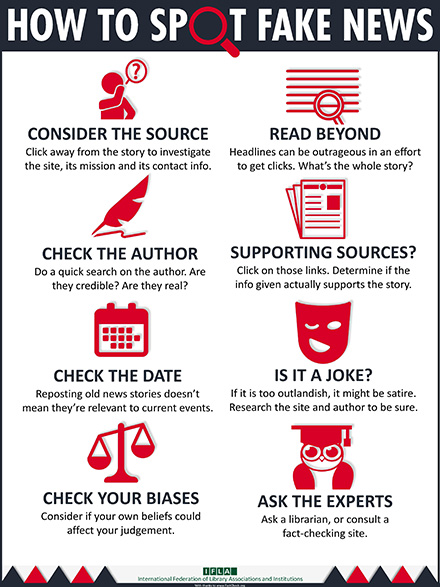
2. Follow These Information Sources to Learn More:
We encourage you to follow these excellent resources for frequent posts and accurate information regarding COVID-19 and the practice of law:
- Coronavirus Guidance / LexisNexis Practice Advisor
This document provides practical guidance regarding the virus’s impact on Canadian employment law, commercial law, corporate law, and litigation practices. This material is only available to those with access to LexisNexis Quicklaw.
- Court and Law Firm Updates and Roundups / Canadian Lawyer Magazine
Canadian Lawyer provides a daily post aggregating updates from Canadian courts and law firms.
- COVID-19: Emergency Measures Tracker / McCarthy Tétrault
Lawyers at McCarthy Tétrault are monitoring and reporting on all emergency measures being taken by Canada’s Federal and Provincial governments during the pandemic.
- COVID-19 Legal Materials / WestlawNext
WestlawNext is collecting and curating all case law, decisions, and legislation related to COVID-19. Scroll to the bottom of the Westlaw Next homepage and select the “COVID-19 Legal Materials” link.
- COVID-19 Resource Hub / Canadian Bar Association
The CBA resource hub provides legal and justice system updates, a great collection of mental health resources, and a variety of professional development resources you may want to take advantage of during the pandemic.
- COVID-19 Updates / The Lawyer’s Daily
One of the leading news sources for news about the legal and justice systems during COVID-19, follow The Lawyer’s Daily for multiple posts per day about the coronavirus.
- Law21 Blog / Jordan Furlong
How is the pandemic driving innovation in the legal sector and the justice system? Follow Jordan Furlong’s Law21 blog to learn more!
3. Take a Break!
Finally, don’t be afraid to take an “information break” from the news media, social media, or any other sources of information about coronavirus. This is an overwhelming situation and we are experiencing a global pandemic, after all.
A version of this tip by Alan Kilpatrick first appeared on the Law Society of Saskatchewan Library’s Legal Sourcery Blog.
Reflections on Language From Confinement
I often feel like a grumpy old schoolmaster, rapping the knuckles of my hapless pupils with a ruler when they misplace a comma or mistake who’s for whose.
A certain amount of knuckle-rapping is necessary, but no one who writes about words and writing can afford to be overly prescriptive.
Language changes over time, sometimes for the better. I like text as a verb; it neatly captures a new kind of linguistic transmission we didn’t have when my knuckles were being rapped as a schoolboy. Readers of previous posts will be well aware of new words I am less fond of (productise, reference (as a verb), attendee, learnings, proactive, to name but a few).
I also don’t like the way crucial has changed in meaning from ‘that which finally decides between two hypotheses’ (crux being Latin for an instrument of torture and, by extension, a difficult problem) to merely ‘very important’, but there isn’t much I can do about it at this point.
What we think of as long-established rules sometimes turn out not to be that old: Shakespeare broke just about every grammatical and stylistic rule you can think of, mainly because it wasn’t until much later that many of them came into being (like coherent punctuation and consistent spelling). Many were invented (and the subject of vigorous debate) by writers of grammars and dictionaries in the eighteenth and nineteenth centuries. Some rules turn out not to be as hard-and-fast as we think (between versus among, none is/are). Some are arbitrary, if useful for the sake of consistency (the ‘rules’ of legal citation, for example).
This doesn’t mean writing is a free-for-all, at least in a professional or business context. You want to write prose that your peers will recognise as technically correct and socially appropriate (in the sense of respecting norms, rather than polite). A certain amount of conformism is required, so if you want to be a linguistic radical then law may not be the best berth for you.
You don’t want to write exactly the way others do, though. That’s boring. A distinctive voice, an unexpected turn of phrase, a fresh metaphor or an unusual word will make your writing vivid and memorable. Heaven knows there are enough dull legal blog posts out there.
Writing like the herd is not only boring; it can also show lack of thought. This is what troubles me about buzzwords and jargon. In an exchange on LinkedIn, a reader suggested that what I call bad business jargon can often be useful shorthand that gets the job done when everybody understands the terminology. OK, but it can just as often be a cover for a problematic lack of actual content or analysis. The New Yorker cartoon on my desk calendar for the day of that LinkedIn exchange depicted a guy telling his audience in a business meeting, Enhanced branding metrics drive robust solutions for scalable monetization of jargon, which seemed apt. Jargon more often than not means nothing, or not much.
It’s important, particularly for lawyers, to think about the meaning of words and to use them with precision and purpose.
When words lose meaning, they can be manipulated and the underlying facts distorted. Think of the Twitterer-in-Chief or his precursors in Orwell’s Ministry of Truth.
But perhaps I have just been spending too much time alone in my apartment.
Get Free Help With Publishing Reference Docs Online During COVID-19

In the midst of the COVID-19 pandemic, the Canadian legal tech industry is stepping up to help.
Joining Clio and Optimize Compliance in offering generous assistance during this challenging time is Lexum, which today made the following announcement: Need to Provide Open Access to Key Documents and Materials? Lexum Will Help at No Cost.
“Lexum is waiving the fees of its Qweri product for organizations in need of quickly providing public access to any kind of reference documents. We are waiving our onboarding fees, as well as our subscription fee for the next 12 months, so that important public information can be made available online in the best possible manner even if your organization was caught off-guard or is facing financial pressure because of the crisis. “
The offer entails no obligation to continue using Qweri at the end of the 12-month period.
Learn more about Lexum’s offer here and see how organizations use Qweri here.
Survive (& Thrive) While Working From Home
Three standout posts on surviving and thriving during this abrupt change to working life:
Staying sane while shifting to remote work
Halifax lawyer Jennifer Taylor shares crowdsourced gems of wisdom on “how to be a lawyer, and a feminist, working from home in the age of COVID-19” (CBA National)
What Lessons Lawyers Can Learn From Week One of Working From Home
US lawyer coach Lauren Krasnow outlines 13 best practices for “how to remain effective, realistic, responsive and human.” (Law.com)
New work from home reality an opportunity for law firms
Toronto PR & communications pro Andrea Lekushoff posits that the coronavirus pandemic could be an “opportunity to begin moving away from the always-on, always-here law-firm culture, to step boldly into a new, flexible way of working.” (The Lawyer’s Daily)
Redundancy Redux
Never underestimate the tendency of people – and legally trained people, especially – to say things twice, unnecessarily.
Both
Think before you (over-)use this.
It is superfluous here: The plaintiff seeks both compensatory and punitive damages.
Co-conspirator
To conspire necessarily involves combination or agreement with at least one other person to do something wrong. Co- and con– come from the same Latin root indicating joint action, so you need only one of them.
Yes, the OED cites examples of co-conspirator from the 1860s, but they are in a list of co– words that are described as either rare or one-offs.
Co-conspirator, as used today, is an ugly and unnecessary creation of the Watergate years. Regrettably, it occurs in both the federal Competition Act and the Military Rules of Evidence.
More particularly
No, just particularly. It’s unqualifiable.
Better yet, avoid this weak adverb.
Pre-rolled joint
This contains two pleonastic elements.
A joint is a cigarette containing marijuana (or, as federal legislation still quaintly spells it, marihuana). A cigarette is, by definition, rolled into shape (whether by hand or by machine). There are no unrolled joints – that would just be loose weed.
Redundancy number 2 is the prefix pre-. As in formulations like pre-heated and pre-owned, that prefix adds nothing useful, because there is an implied priority to the verb. One doesn’t post-heat or post-own or post-roll.
To recapitulate, all joints are rolled in advance of smoking. And a joint is rolled anyway.
Just a joint, then.
Still remains
If something is still around, it simply remains. (and it doesn’t remain the same, either – remaining involves sameness).
Free Access to Easy-to-Use Compliance App
To say COVID-19 has sped up the pace of legal change is an understatement. Usually it takes months (or even years!) to make changes to Canadian laws, but now we are seeing significant amendments announced and in force on the same day. With many businesses worrying about day-to-day survival, there is little or no time to stay on top of legal compliance requirements.
We wanted to simplify this task. So, to help Canadian businesses and law firms understand and stay on top of these quickly evolving legal changes, Optimize Compliance is offering time-limited, free access to its easy-to-use compliance app.
Optimize Compliance helps you build customized legal compliance reports — updated in real time to reflect changes across the country in response to COVID-19.
This offer is immediately available to HR, in-house legal and small law firms. To request free access, click here.
Lesha Van Der Bij (@LVanDerBij) is CEO & Founder of Optimize Legal – keeping law firms and businesses up-to-date on changes to the law.


